In the new movie from the creator of Mare of Easttown, Sweeney plays a character even she can’t make likable.
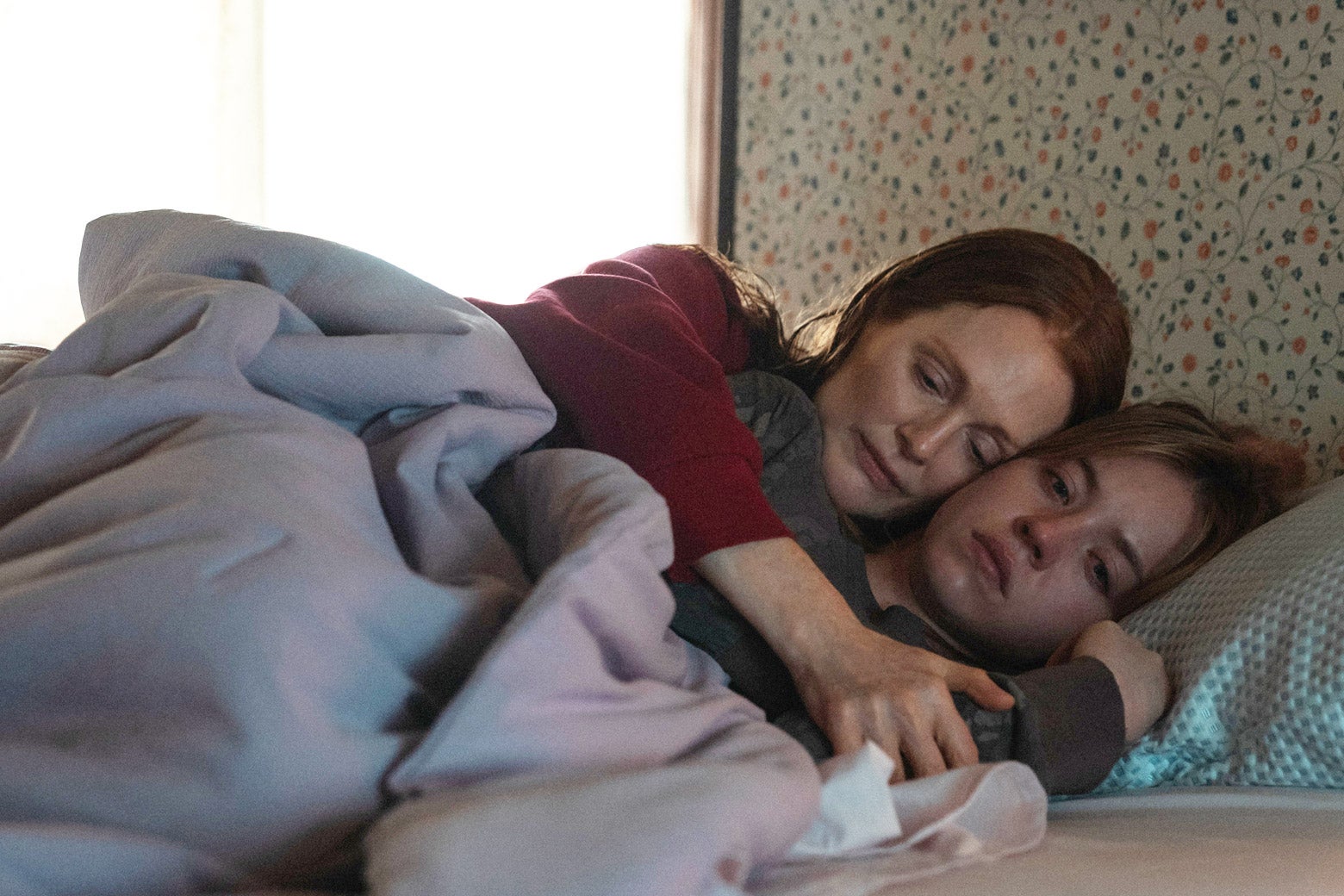
It’s all too easy to hate Claire, the character played by Sydney Sweeney in Echo Valley, Apple TV+’s new thriller, written by Brad Ingelsby (creator of Mare of Easttown) and directed by Michael Pearce. Claire’s mother, Kate (Julianne Moore), who dotes on her, trains horses on a farm in the fabulously lush Pennsylvania countryside. Kate left Claire’s father (Kyle MacLachlan, in a microscopic role) for a soulful, artistic farmhand (Kristina Valada-Viars), and counts among her friends another stalwart couple, played by Fiona Shaw and Melanie Nicholls-King. Claire could be living the cottagecore dream in a funky but ravishing farmhouse with her cool lesbian mom, riding horses all day, but no: She has to hook up with a skanky dude and start doing drugs, opening herself and her mother to a world of hurt.
Echo Valley is a serviceable thriller with an outlandish twist at the end, but the plot often seems at war with what feels like the movie’s true interest: Kate, a woman poleaxed by love. Kate’s wife, Patty, has died in a farm accident nine months before the movie begins, but she remains a presence in her widow’s dreams as well as in the old voicemail messages Kate listens to on repeat while doing her chores. The movie lingers over the routines that keep Kate’s fragile equilibrium in place: her bare feet landing on the bedroom rug every morning, the scoop she plunges into a vat of oats to feed the horses, the mucking of stables and splitting of firewood.
Claire drags Kate into the mess of her life when, after fighting with her boyfriend, Ryan (Edmund Donovan), she dumps a bunch of his stuff off a bridge. That’s the first sign the movie offers that Claire has a heedless, destructive side that her mother willfully disregards. Even Kate’s nudges toward reform are laughably indulgent. The local community college has a creative writing program, she meekly informs Claire. Forget a job; she’d be happy if her daughter just showed up for a short-story class a couple of times a week.
Unfortunately for both women, a stash of drugs belonging to the local sociopathic dealer, Jackie (Domhnall Gleeson), was hidden in the stuff Claire threw off the bridge, so she and Ryan have to go into hiding. Then Claire turns up claiming that she lost her temper and hit Ryan with a rock, killing him, presenting Kate with a body so thoroughly and professionally wrapped with plastic and duct tape that Claire’s flailing distress would arouse suspicion in anyone but a love-blinded mom.
Some intriguing currents flow through Echo Valley, such as the question of whether love makes Kate weak or strong. Grief has stunned her, and she’s canceled some of the riding lessons that have helped keep the farm solvent as a result. Claire brings Kate delight and comfort, but as soon as Kate doesn’t meet her daughter’s demands, the girl becomes breathtakingly cruel, at one point even threatening the family dog. It seems as if there isn’t anything Kate wouldn’t do for her daughter, a susceptibility Claire is more than willing to exploit. And underneath it all is Kate’s loss, which matches the size of the love her wife brought into her life.
On the other hand, Kate also seems embedded in a community that not only loves her but comes through for her when she really needs it. Her ex may grumble about it, but he’ll still cut her a check for a new barn roof, and above all she’s able to call upon the formidable force of aging-rural-lesbian solidarity, against which it is wise never to bet. It’s frustrating that the brisk pacing required of a feature film means the filmmakers can’t do more than just sketch Kate, the people in her life, and Echo Valley itself. Sensitivity to the intimate entanglement of place and character gave Mare of Easttown much of its appeal. Perhaps Echo Valley would have made a deeper impression as a miniseries?
Then again, there’s Claire. “It must be awful,” the movie’s villain tells Kate at one point, “having a kid like that.” Sweeney, too, might have done more with Claire’s blend of vulnerability and connivance, the addict’s ruthlessness and the adolescent’s yawning self-hatred. But she, too, doesn’t have the time, and so her Claire is essentially a monster, which makes Kate’s devotion to her more exasperating than tragic. Theirs is a relationship many viewers will find painfully familiar, but one that’s almost impossible to dramatize. Even an actor as gifted as Moore can’t make a viewer feel a parent’s irrational, even incredible love for the lost child buried deep within the addict’s manipulative selfishness. I could happily have watched eight episodes about Kate and her world. But more than one or two hours of Claire? That’s something only a mother could love.
News

THE FIRST QUESTION: Officers in Bennington, Vermont, said they initially approached Janette MacAusland to check on her health — but one of the first questions she asked them is now part of the investigative chain of events
On the evening of Friday, April 24, 2026, officers from the Bennington Police Department in Vermont responded to what appeared to be a routine welfare check at a family residence. The call came in around 9:15 p.m. after a woman…
THE LAST 24 HOURS: Investigators are reprocessing the final 24 hours before the children were found any conscious at their Wellesley home — including a brief interaction this evening that may now be more significant than initially thought
THE LAST 24 HOURS: Investigators Reconstruct the Final Day Before Tragedy Struck the MacAusland Home in Wellesley As the investigation into the deaths of 7-year-old Kai MacAusland and his 6-year-old sister Ella intensifies, authorities are meticulously reprocessing every detail from…
A CALL: Call logs related to Janette MacAusland show a 39-second outgoing call late Friday night — and the identity of the person who answered has yet to be released is complicating the case
A CALL: The 39-Second Outgoing Call Late Friday Night That Investigators Are Scrutinizing in the MacAusland Case As law enforcement pieces together the final hours of April 24, 2026, in the tragic deaths of 7-year-old Kai MacAusland and his 6-year-old…
TIMESTAMPS FROM NEIGHBORS: A neighbor near MacAusland’s home in Wellesley, Massachusetts, said they noticed unusual activity around 9:14 p.m. Friday — a timestamp now being compared by investigators with phone and vehicle data — but what they heard was even more horrifying
In the quiet, tree-lined streets of Wellesley, Massachusetts — an affluent Boston suburb known for its top-rated schools and family-friendly atmosphere — one neighbor’s casual observation on Friday, April 24, 2026, has become a critical piece in reconstructing the final…
RELATIVE’S CALL: A relative in Bennington, Vermont was the one who called police after seeing Janette MacAusland arrive late that night — but the first thing she reportedly said inside the house is now drawing attention
On the evening of Friday, April 24, 2026, a quiet residential street on Northside Drive in Bennington, Vermont, became the unlikely starting point for one of the most disturbing cases to cross state lines in recent memory. Janette MacAusland, a…
LAST MESSAGE DETAIL:Janette MacAusland’s ex-husband Samuel MacAusland has now spoken publicly about the custody fight — but investigators say a 7-word text she sent late Friday night is now being reviewed as one of the final messages before everything unfolded
In the affluent Boston suburb of Wellesley, Massachusetts, a bitter divorce and custody dispute ended in unimaginable tragedy on Friday night, April 24, 2026. Janette MacAusland, a 49-year-old acupuncturist, stands accused of strangling her two young children — 7-year-old Kai…
End of content
No more pages to load