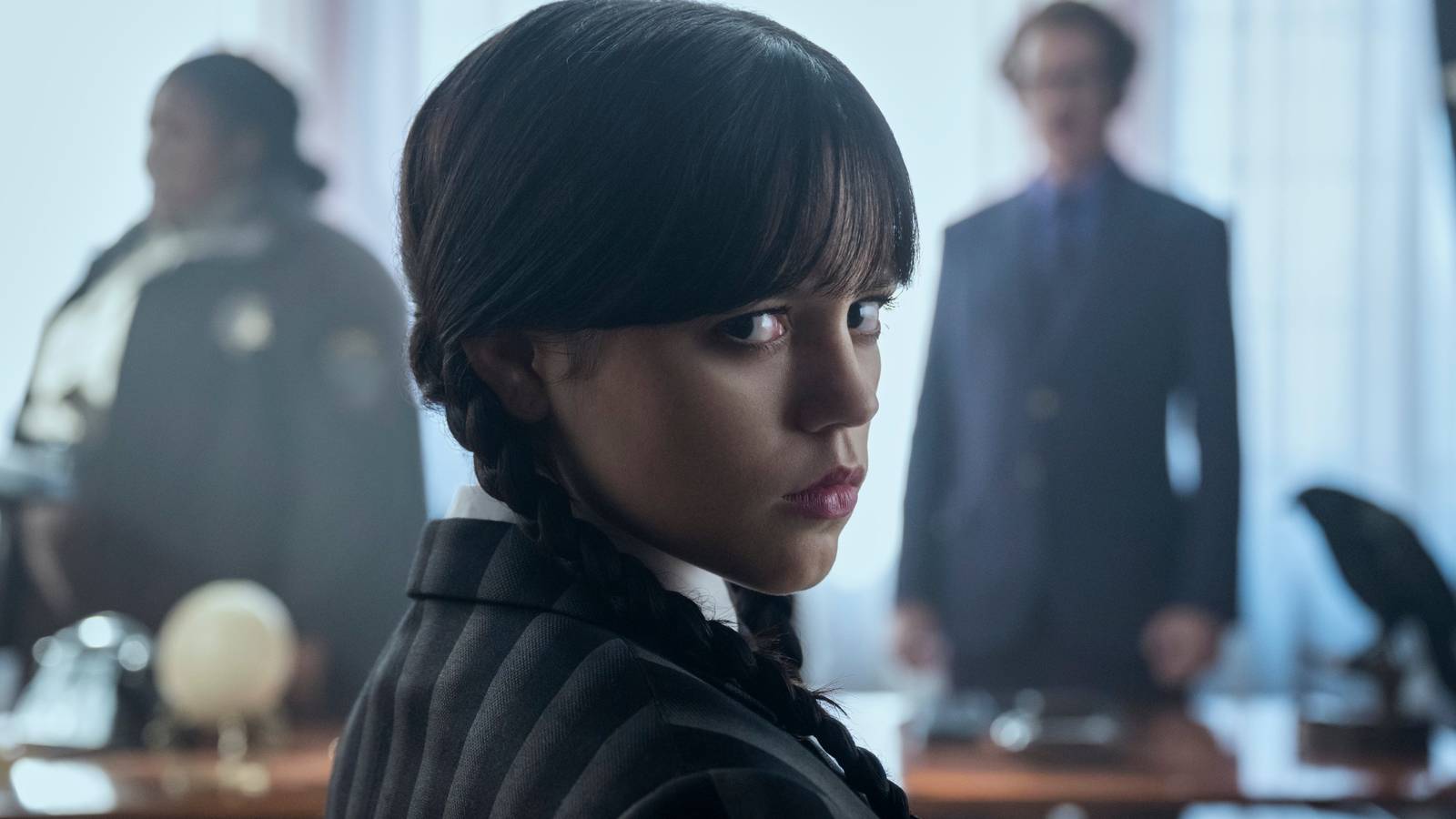
During an interview with Screen Rant during the LightBox convention in Pasadena, concept artist Dom Lavery spoke about hopping between the worlds of Rings of Power and Wednesday, the secret purpose of concept art in film development, and which concept sprang straight from his dreams into the world of Tim Burton’s Nevermore.
How Dom Lavery Stepped Into Nevermore

Stepping into the world of Wednesday for season 2 proved to be an interesting challenge for Dom Lavery, especially considering that he was “going back and forth” between the Netflix Tim Burton show and The Rings of Power with Prime Video. “It’s always a bit weird going from Middle-earth back into Nevermore.”
“I was re-watching [season 1], and I’ve known [production designer Mark Scruton] for ages; we go back a long way. I understand how he works, and we had lots of reference material.” According to Lavery, a big focus in the visuals for Wednesday are directly inspired by Charles Addams’ original New Yorker strips.
“Tim is such a visual person that it becomes tricky at times. He knows what he wants. When you know you’ve done something that is going to make it into the show, that has made Tim happy, it gives you a thrill.”
“The fact that so much of what we did and a lot of the drawings I did actually translated almost identically on screen, that was a big thrill.” One such translation was the Skull Tree, which Lavery reveals made the leap to the screen with a design that largely matches his original conception.
“I did a load of sketches and ideas for it, but I didn’t spend that much time working on it. The actual design itself, the one that was chosen, actually came to me in the middle of the night. I woke up in the middle of the night, and I’ve got a sketch pad next to my bed, and I went, ‘Oh, that might work.’ So I did a quick sketch and went back to sleep.”
“The following day, I worked that one up a bit and sent it off. That’s almost absolutely identical to what it looked like in the end. It’s funny how things suddenly come to you.”
Making What People Want (And Proving What They Don’t Want)


“The biggest thrill is… I did a lot of mood boards, quick black and white sketches for the big battle. It was before any of it had been worked out. It was more about trying to understand the sets that we were going to build, the locations, the sort of action that they were talking about doing.”
“I just did these really quick sketches to try and flesh out how it could evolve. I think it’s probably those that I’m most proud of.” Those sketches proved crucial to the season’s biggest battle on lots of fronts. Even though they’re just quick sketches, some of the elements translated really well.”
“What a lot of people don’t realize with concept work is that we’re not just doing pretty pictures just to sell a designer set. What we do influences other departments, like the stunts unit, the camera unit, and the directors. Everybody will look at these mood boards, and it starts discussions.”
As Lavery explained, so much of his work is about helping various corners of production. “We’re quite often trying to show people what they can’t do, what they don’t want, to try and make them realize what they can do and what they do want. We’re trying ot get it as wrong as much as trying to get it right.”
News
“THAT WAS HIS FIRST QUESTION…” After 13 days of suspense, Joey Rodriguez reportedly asked something that brought his father to tears — just five words, but no one in the room could forget them…
In the softly lit hospital room on the fourteenth floor of University Hospital in San Antonio, where machines hummed steadily and prayers had become a daily rhythm, 17-year-old Joey Rodriguez broke through thirteen days of heavy silence with a moment…
PLEASE DON’T LET THIS BE ANOTHER SUDIKSHA CASE… The search for James “Weston” Higginbotham has entered its fifth day, but as his parents released the latest medical examination results, fears escalated, and a four-word note in it is causing a storm
PLEASE DON’T LET THIS BE ANOTHER SUDIKSHA CASE… The search for James “Weston” Higginbotham has entered its fifth day, but as his parents released the latest medical examination results, fears escalated, and a four-word note in it is causing a…
We know he made it this far…: Search crews are retracing the final route of James “Weston” Higginbotham after investigators narrowed his last known movements to a stretch of less than 500 feet, but one witness account still doesn’t match the surveillance footage
We know he made it this far… Search crews are retracing the final route of James “Weston” Higginbotham after investigators narrowed his last known movements to a stretch of less than 500 feet, but one witness account still doesn’t match…
“Someone had to see him… right?”: As the search for missing Auburn student James “Weston” Higginbotham enters its 5th day, his family has revealed his fragile mental state before the trip, but detectives are now focusing on one unexplained detail — his phone signal traveled less than 200 feet before suddenly going silent near the station entrance
“Someone had to see him… right?” As the search for missing Auburn student James “Weston” Higginbotham enters its 5th day, his family has revealed his fragile mental state before the trip, but detectives are now focusing on one unexplained detail…
HOPE ISN’T GONE YET… The parents of missing college student James “Weston” Higginbotham say their son had recently become convinced his future was slipping away, but the detail haunting them most isn’t what he said — it’s the dark backpack with a small white patch that witnesses claim he was still carrying just 90 seconds before he disappeared into the crowd
HOPE ISN’T GONE YET… The parents of missing college student James “Weston” Higginbotham say their son had recently become convinced his future was slipping away, but the detail haunting them most isn’t what he said — it’s the dark backpack…
“PLEASE COME HOME…”: The family of Auburn student Weston Higginbotham says he battled unseen demons before disappearing on a trip to Japan, but his GPS location near his last known river is becoming the focus of the entire investigation
“Please come home…” The family of Auburn student Weston Higginbotham says he battled unseen demons before disappearing on a trip to Japan, but his GPS location near his last known river is becoming the focus of the entire investigation. In…
End of content
No more pages to load