BANGOR, Maine (WABI) — Bangor International Airport officials say the NTSB is now on the ground in Bangor to investigate Sunday’s fatal plane crash.
Officials report six people are presumed dead in the crash involving a private business jet from Houston, TX.
The FAA said Tuesday four were passengers and two were flight crew.
“According to the flight manifest there were six people on the flight. No one from the incident was transported to the hospital, and all on the flight are presumed to be deceased,” said marketing and business development manager for the airport Aimee Thibodeau. “No one from the incident was taken to the hospital, and all on the flight are presumed to be deceased. The identities of the people on the flight are not being released publicly at this time, pending positive identification.”
The statement followed a 10 a.m. press conference Monday in which Airport Director Jose Saavedra declined to comment on how many passengers were on the plane or the condition of those on board.
The new information, released at about 1:30 p.m. Monday, contradicted a preliminary report by the FAA which reported seven fatalities and one crew member seriously injured. The preliminary data was updated as of Tuesday morning to reflect the six deaths. The report says the fatalities consist of two crew members and four passengers.
Thibodeau went on to say, “When an accident like this happens, there are agencies and assets, both state and federal, that must coordinate their respective portions of the investigation. With the large number of stakeholders involved, it is important that we don’t release any information until all parties have completed their work and can confirm the information being released.”
Additional personnel from both the FAA and NTSB are expected to arrive over the next few days.
Airport director Jose Saavedra did confirm the aircraft was still on the runway as of Tuesday afternoon, where it was seen by WABI crew members covered in snow and ice. Saavedra says this is standard for investigations of this nature.
The Bangor Police Department says they are awaiting the approval of the NTSB before accessing the aircraft. When they receive approval, they’ll be able to care for and identify the victims with help from the State Office of the Chief Medical Examiner.
The NTSB has asked the scene be preserved in the meantime.
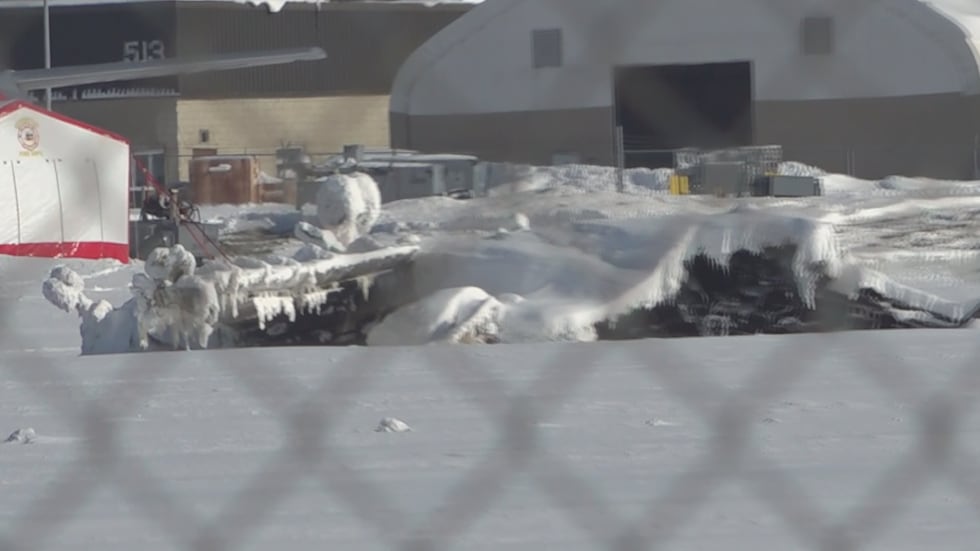
The Wreckage N10KJ on Bangor International Airport’s runway Tuesday afternoon(WABI)
What we know
The plane, N10KJ, a Bombardier Challenger 600 landed in Bangor enroute from Houston, TX’s Hobby Airport at 6:09 Sunday night, according to data from flighttracker24.com obtained by the Associated Press. The plane was on its way to Paris-Vatry Airport in France, per flight records. They stopped at BGR to de-ice and refuel.
The aircraft began departure around 7:45 p.m., meaning the plane was likely subject to the elements for over an hour during heavy snowfall and freezing temperatures before attempting takeoff. It was upon departure that the plane crashed.
According to the FAA preliminary report, the crash occurred under “unknown circumstances.” The plane came to rest inverted on the runway and caught fire. Images obtained by WABI show the aircraft’s landing gear pointed skywards.
FAA records show the plane was registered to a Houston, TX LLC. The address associated with the aircraft is home to personal injury law firm Arnold & Itkin Trial Lawyers.
At a press conference on winter storms that swept the nation, Harris County Commissioner Lesley Briones identified one of those deceased as her friend, Tara Arnold. According to the law firm’s website, Tara Arnold was an attorney at Arnold & Itkin and wife of the firm’s co-founder, Kurt Arnold. According to her biography on the website, Arnold was from Sabine Parish, Louisiana and an alumna of Tulane University Law School.
“My heart goes out to them and their children and their families. I worked at Arnold & Itkin for a time and so I know them well and this is just a tragedy,” Briones said. “In particular Tara is- she’s just a phenomenal person, a bold leader, and somebody who had a heart of service. So she was very involved in Precinct 4 and our sister non-profit Precinct 4 Forward. My heart and my prayers are with Kurt and their children and all of those affected members.”
Houston CBS affiliate KHOU has identified two others on board as Shawna Collins and Nick Mastrascusa. Lakewood Church, where Collins worked, called Collins a “light that brightened their days.” A fundraiser for Mastrascusa’s family says he was a chef and father of three from Hawaii. WABI media partners WMTW have also reported the pilot of the plane was Jacob Hosmer, according to a family member, who said “he is in Heaven now with Jesus.”
Minutes before the crash, controllers and pilots at the airport can be heard talking about low visibility and deicing, though it is not immediately clear who is talking to whom, according to audio obtained from LiveATC.net.
A controller clears the pilot of N10KJ for takeoff on Bangor’s Runway 33. Nearly two-and-a-half minutes later, a controller loudly radios: “All traffic is stopped on the field! All traffic is stopped on the field!”
Moments later, another controller is heard saying, “Aircraft upside down. We have a passenger aircraft upside down.”
The airport is then closed, and emergency vehicles are allowed to drive on the airfield.
The aircraft and the weather’s potential role in the crash
Flight records reviewed by WABI media partners WMTW show the aircraft involved in Sunday’s crash carries a federal warning related to cold-weather operations, according to government records.
The Federal Aviation Administration issued a directive in 2008 requiring a specific warning in the flight manual for the Bombardier Challenger 600, citing concerns about winter weather and takeoff safety. The directive followed three incidents in Canada.
According to the FAA, even small amounts of ice, frost or slush on the wings could cause a pilot to lose control of the aircraft during takeoff.
It is not yet known whether that history played any role in Tuesday’s crash.
Snow and ice can affect any aircraft, and pilots are not permitted to fly with ice on the wings. However, an aviation expert told WMTW the directive indicates the Challenger model is particularly sensitive to ice and requires extra precautions.
The Bombardier Challenger 600 is a wide-bodied business jet configured for nine to 11 passengers. It was launched in 1980 as the first private jet with a “walk-about cabin” and remains a popular charter option, according to aircharterservice.com.
According to the Associated Press, Crash investigators in England recommended improved procedures for ice detection after a 2002 crash, but significant changes weren’t made until after the NTSB finished its investigation in 2006 of the Colorado crash that killed the son of NBC television executive Richard Ebersol.
The FAA published new rules afterward to make clear to pilots and airports that even a small amount of frost on the wings can be a problem. The agency also clarified the standards for de-icing to make certain that all frozen particles are removed from the wings, and it required a combination of tactile and visual inspections.
Bombardier was also required to add a cold weather operations warning to the plane’s flight manual after three incidents in Canada where one of these planes rolled unexpectedly in ways the pilot didn’t command during take offs in cold weather and icing conditions.
The planemaker said it has delivered more than 1,000 of Challenger 600s, and the plane is designed to be safe. Bombardier said it is deeply saddened by the crash and will work with investigators to determine what happened.
WABI spoke with a traveler who was supposed to fly from Bangor to Tampa Sunday night.
“When we left we went to get de-iced and that failed the first time because the wings didn’t pass so the pilot said they were going to try one more time but the second time he came across and said that there was an accident in the airport and the airport is closing and we were going to go back to landing and get off the plane,” said Kathy Yergin. “I didn’t feel anything on that plane but my girlfriend who was going to the tamper to board next they could feel some kind of bump or the floor moved and everything but they didn’t know what happened.”
About half an hour before the crash, the pilot of a Florida-bound Allegiant plane radioed the tower to abort his takeoff.
“One, our deice fluid has failed and two, I don’t think the visibility is good enough for us to go, so we’re going to have to taxi back to the gate here,” the Allegiant pilot radioed. The controller responded by saying he was just getting ready to warn the pilot that visibility had dropped to about three-quarters of a mile.
At about the same time, the pilot of the Bombardier had taxied over to the deicing pad and was radioing in a request to get his plane’s wings and tail treated, according to audio posted by LiveATC.net . The plane remained at the deicing pad for about 20 minutes before taxiing to the runway.
Officials say the airport is now expected to be closed until noon Thursday, at the earliest.
The FAA and the National Transportation Safety Board will be investigating.
An Emergency Operation Center has been established at the Bangor International Airport.
According to the NTSB, their investigations involve three primary areas: the pilot, the aircraft and the operating environment. As part of this process, investigators will gather the following information and records:
Flight track data
Recordings of any air traffic control communications
Aircraft maintenance records
Weather forecasts and actual weather and lighting conditions around the time of the accident
Pilot’s license, ratings and recency of flight experience
72-hour background of the pilot to determine if there were any issues that could have affected the pilot’s ability to safely operate the flight
Witness statements
Electronic devices that could contain information relevant to the investigation
Any available surveillance video, including from doorbell cameras
Witnesses to the accident or those who have surveillance video or other information that could be relevant to the investigation are asked to contact the NTSB at [email protected].
A preliminary report will be available within 30 days; it can be accessed by searching the investigations database with the NTSB number CEN26FA098. It will also be posted on NTSB Newsroom Twitter .
A final NTSB report on the crash is expected in 12-24 months.
News
ONE DETAIL MADE EVERYONE STOP IN THE MIDDLE OF THE SURFING… Ashley Munoz’s community continues to show support after the tragic accident at 12:45 AM… and now, what their teammates have revealed about their last meal is truly touching
The digital landscape is often characterized by a relentless, fast-paced stream of information where users mindlessly scroll through endless updates, global crises, and brief glimpses of human lives. However, every so pool of data contains a moment so profoundly moving…
QUESTIONS REMAIN UNCHANGED… Ashley Munoz never returned home after the tragedy on Highway 101, an accident that changed the lives of many families forever… and tonight, it is said that what was at the scene was even more shocking,…
The unpredictable vulnerability of life is a sobering reality that communities across the nation hope they never have to confront, yet it is the exact nightmare that has shattered the peace of the Upstate region in South Carolina. On a…

SHE DID IT!!💔 Those were the words Ashlin Knuth’s mother posted under graduation photos showing the 18-year-old smiling in her blue gown… now people can’t stop talking about the boyfriend who survived the crash and what he may remember from those final moments…
The transition from the highest peak of youthful celebration to the absolute lowest depths of human tragedy is a vulnerability that communities hope they never have to witness, yet it is precisely the reality that has shattered the town of…
JUST HOURS BEFORE THE CRASH, ASHLIN KNUTH WAS SMILING IN HER GRADUATION GOWN 😢🎓 Her mom had just posted, “She did it!! So proud of you Ashlin!!” — but the detail people are now asking about is what happened inside that car with her 18-year-old boyfriend just hours later…
On Sunday, May 17, 2026, Ashlin Jade Knuth walked across the stage at Ottumwa High School in Iowa as part of the Class of 2026. Smiling brightly in her graduation gown, she celebrated a major milestone surrounded by family, friends,…

HE DISAPPEARED IN SECONDS: Search teams are racing to find missing rower Jeremiah Gamble on Lake Guntersville after he is believed to have fallen into the water and never resurfaced 👀 But there’s a worrying detail from the search area: a life vest was found…👇
On Sunday, May 17, 2026, a routine boating outing on one of Alabama’s most popular lakes turned into a desperate search and recovery operation. Jeremiah Gamble, a 25-year-old from Tallassee, Alabama, entered the waters of Lake Guntersville near Honeycomb Creek…
JEREMIAH GAMBLE NEVER CAME BACK UP: The search for 25-year-old Jeremiah Gamble took a troubling turn after teams began focusing on one specific area of Lake Guntersville 👀 Now, it’s one unsettling detail reportedly found beneath the water that has people desperate for answers… 👇
25-year-old man missing after going into water at Lake Guntersville The Disappearance of Jeremiah Gamble: A Tragic Boating Incident on Lake Guntersville On a sunny Sunday afternoon in mid-May 2026, Lake Guntersville, one of Alabama’s premier recreational waterways, became the…
End of content
No more pages to load