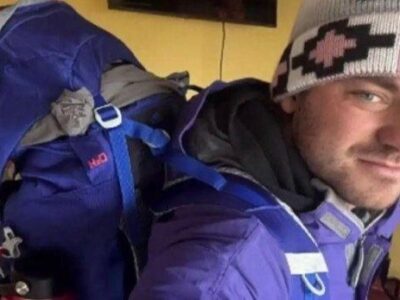
SEARCH IN THE FREEZE 🚨❄️ Hundreds of volunteers lined the lakeshore in sub-zero temperatures to search Trenton Massey, turning over thick layers of snow and examining frozen bushes. By the end of the day, they had found only a soaking wet glove stuck under a thin layer of ice
The disappearance of Trenton Massey, a 21-year-old student at Northern Michigan University (NMU), captured national attention in late February 2026 amid one of the harshest winter storms to hit Michigan’s Upper Peninsula in years. What began as a routine night out quickly escalated into a large-scale, multi-agency search operation characterized by sub-zero temperatures, heavy snowfall, treacherous ice, and an outpouring of community support. Volunteers by the hundreds braved the freeze to scour the lakeshore near Lake Superior, probing deep snowdrifts and frozen terrain in hopes of finding any trace of the missing young man. Despite exhaustive efforts, the only item recovered during intense ground searches was a single soaking wet glove lodged beneath a thin layer of ice—a haunting clue that underscored the dangers of the environment and the slim chances of survival.
Trenton Massey, originally from the Mid-Michigan area (including connections to Corunna and Laingsburg), was reported missing on Sunday, February 22, 2026. He had been out with friends earlier that evening, reportedly at a local bar in downtown Marquette. Surveillance footage from the Marquette Police Department (MPD) captured him around 3:25 a.m. (with some reports citing 3:08 a.m. or 3:35 a.m.) near East Baraga Avenue and the Founder’s Landing Boardwalk along the lower harbor of Lake Superior. In the video, Massey appeared disoriented, stumbling and having difficulty walking through the accumulating snow and ice. Notably, he was not wearing gloves despite the extreme cold, dressed only in a black and olive-green coat. He was observed walking out onto the ice from the north Founder’s Landing Pier before vanishing from camera view—marking his last known sighting.
The timing could not have been worse. Marquette was in the grip of a powerful winter storm that dumped heavy snow, reduced visibility, and plunged temperatures well below freezing, with wind chills making conditions feel even more brutal. NMU campus closed on Monday due to the weather, but the search for Massey intensified rather than paused. Authorities classified him as an endangered missing person, citing his apparent confusion and the life-threatening risks of hypothermia and ice instability.
The response was swift and comprehensive. The Marquette Police Department led the effort, coordinating with a coalition of agencies including the Marquette County Sheriff’s Office, Marquette County Search and Rescue, NMU Police Department, Michigan State Police (including K9 and Marine Services teams), Marquette City Fire Department, U.S. Coast Guard Station Marquette, U.S. Army resources, Michigan Department of Natural Resources (DNR) Conservation Officers, Alger County Sheriff’s Office, and private groups like No One Left Behind K9 Search and Rescue and Frontline Strong. Specialized equipment deployed included scuba divers, sonar, aerial drones, underwater remotely operated vehicles (ROVs), K9 units, hovercraft, airboats, and helicopters.
A key focus shifted early to the water of the lower harbor near Founder’s Landing. Searchers identified a hole in the ice not far from where Massey was last seen, prompting concentrated underwater operations. Officials feared he may have fallen through unstable ice, a tragically common hazard on Lake Superior during winter when shifting conditions create thin spots or open water.
On land, the human element proved equally remarkable. Hundreds of volunteers—students, locals, friends, family, and even strangers from surrounding communities—rallied to assist. They gathered at coordination points like the Hampton Inn lobby on South Lakeshore Boulevard, where organizers directed land-based searches. Equipped with poles to probe deep snow banks (a standard technique to check for buried individuals without missing hidden depressions or evidence), volunteers lined the lakeshore in sub-zero temperatures. They turned over thick layers of snow, examined frozen bushes, and combed the shoreline and adjacent areas meticulously.
Businesses stepped up in solidarity, providing warm-up spaces, food, drinks, transportation (including buses), gloves, hats, and other supplies. Downtown locations like Provisions MQT served as bases for coordination, with NMU leadership, including President Chris Olsen, present to support. The community’s response highlighted the tight-knit nature of Marquette and the Upper Peninsula, where strangers become allies in crisis.
Despite these heroic efforts spanning four days (from Sunday through Wednesday, February 25), no sign of Massey was found beyond initial clues. The only tangible discovery during one of the ground sweeps was a soaking wet glove stuck under a thin layer of ice near the search area. While not definitively confirmed as Massey’s (and reports vary on whether additional personal items surfaced), it symbolized the grim reality: exposure to Lake Superior’s frigid waters offers little chance of survival beyond minutes without immersion protection. Hypothermia sets in rapidly in such conditions, and even brief submersion can be fatal.
By Wednesday afternoon, February 25, around 4:00 p.m., the Marquette Police Department—led by Chief Ryan Grim—announced the suspension of formal search efforts. In press releases and public statements, authorities expressed confidence that all possible areas had been checked exhaustively, both on land and in the water. The investigation remains ongoing, with calls for any new information to be reported. Volunteers were encouraged to continue private efforts if desired but urged to prioritize safety: stay off the ice (deemed unstable), respect private property, and avoid risks to themselves.
The news rippled outward. Massey’s family, including his mother who shared emotional appeals and footage suggesting signs of severe hypothermia in his movements, expressed profound gratitude to the hundreds who dropped everything to help. “We cannot give gratitude enough to all those hundreds of students, family, friends, locals, strangers, and volunteers who have dropped everything to come and search for ‘my everything,'” one family statement read. In his hometown areas, communities held vigils, including one on Thursday night following the suspension, to support the family and hold onto hope.
This case underscores broader issues in northern climates: the perils of winter nightlife combined with extreme weather, the vulnerability of young adults to disorientation from alcohol or fatigue in blizzards, and the thin line between a night out and tragedy on frozen lakes. Lake Superior, the largest freshwater lake by surface area, is notorious for its cold (often near-freezing year-round) and unpredictable ice. Similar incidents have occurred in past years, where bodies sometimes surface in spring thaw after winter entombment.
As of late February 2026, Trenton Massey remains missing. The soaking wet glove found under the ice stands as a poignant, solitary artifact from the search—a reminder of the volunteers’ determination in the face of overwhelming odds and the unforgiving power of nature in the freeze. The community’s solidarity endures, a testament to human compassion amid heartbreak, even as the official hunt pauses pending new leads.