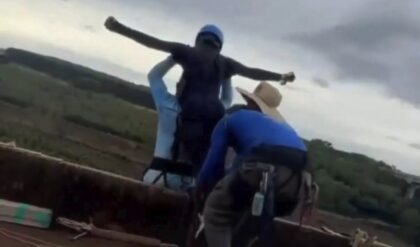
The investigation into the tragic plunge of twenty-one-year-old Maria Eduarda Rodrigues de Freitas has taken an even more chilling turn as local authorities and forensic teams piece together the frantic final moments on the platform. Eyewitness accounts now reveal that the initial four seconds of confusion were instantly followed by a wave of pure panic among the onlookers who watched her step off the edge of the Ponte do Esqueleto. Witnesses state that as soon as Maria Eduarda was launched into the open air, a terrifying realization swept through the crowd, causing people to scream out in desperation for someone to stop her.
However, in an extreme activity like rope jumping, where momentum takes over the exact moment a participant leaves the launching pad, there was absolutely no way to reverse the descent. The crowd could only watch in collective horror as she plummeted forty meters into the canyon below.
What responding officers allegedly discovered upon processing the scene just seconds after the incident has now solidified as a cornerstone of the criminal case against the operators. In addition to the heavy safety rope left completely unattached and coiled on the wooden planks of the platform, investigators uncovered a total failure in basic safety redundancies.
Law enforcement officials noted that the structural anchors and carabiners—the metal clips meant to secure a jumper’s harness to the primary life line—were completely disconnected and sitting idle on the staging area. This physical evidence suggests that the team of instructors failed to perform even a basic visual check before executing the jump.
The discovery completely dismantles any initial claims of an equipment snapping or unexpected mechanical failure, pointing instead to an absolute and fatal human oversight.
![Vídeo] Veja novo ângulo do acidente fatal de Maria Eduarda e como saltos eram realizados](https://www.bnewsrn.com.br/media/_versions/2026/06/novo-feed-bnews-natal_i4153436560_widelg.jpg)
The Civil Police of São Paulo are treating these physical findings as irrefutable proof of gross negligence. The fact that the entire primary rigging system remained on top of the bridge while the victim fell indicates that the instructors did not merely make a minor adjustment error, but completely omitted the most vital step of the entire operation. Police delegate Andrea Dantas Levy confirmed that this profound lack of care is what justified charging the three primary crew members with homicide involving implied malice. By setting up a high-risk attraction, charging money for it, and launching a human being off a twelve-story structure without verifying a single safety connection, the operators demonstrated a reckless disregard for human life that authorities say cannot be classified as a simple accident.
As the legal proceedings move forward, the physical evidence gathered at the site continues to fuel a national conversation regarding the complete lack of oversight in the unregulated adventure tourism industry. The tragic contrast between Maria Eduarda’s final, trusting smile and the stark reality of the disconnected safety equipment left on the bridge serves as a haunting reminder of the consequences of institutional complacency. For the family, friends, and millions of viewers following the case, the crucial evidence recovered by officers confirms the deeply painful truth that this entire tragedy was completely preventable.
Following the conclusion of the initial site analysis, investigators are now focusing heavily on reconstructing the exact psychological and operational timeline of that fateful morning. Extreme sports experts summoned by the police to evaluate the scene expressed absolute disbelief at the findings. They emphasized that a cross-checking protocol—where one instructor verifies the rigging, a second checks the harness, and a third independently signs off before departure—is an immutable, universal law in high-risk activities worldwide. The fact that all three instructors present on the platform completely bypassed this basic sequence points to a systemic complacency. This blind overconfidence is frequently observed in illegal, black-market operations where customer throughput and quick profits are prioritized over human survival.
Public outrage has intensified further as media outlets dig deeper into the operational history of the two groups, Entre Cordas and Ih Voei. Investigations have revealed that this was far from their first time organizing unauthorized jumps at abandoned, unmonitored locations. Prior to the incident, these groups had been aggressively marketing their services across social media platforms like TikTok and Instagram, attracting thousands of young thrill-seekers with stunning, adrenaline-fueled visuals coupled with promises of absolute safety. The distinct lack of strict regulatory enforcement against these online adventure clubs allowed them to operate openly for months, until Maria Eduarda’s fatal plunge exposed the hollow reality behind their flashy marketing.
For the victim’s family, the grief remains unbearable and completely irreparable. Maria Eduarda was not just a driven young woman who had recently earned her degree, but also an immense source of pride and emotional support for her parents and relatives. The legal counsel representing the family has declared that they will pursue the case to the absolute limit of the law. Their goal extends beyond securing long-term prison sentences for the three direct instructors; they intend to establish a powerful legal precedent. The family demands a complete overhaul of the laws governing adventure tourism across Brazil, pushing for mandatory federal licensing, unannounced state inspections, and severe criminal penalties for anyone operating high-risk activities without explicit municipal authorization.
This heartbreaking tragedy will undoubtedly be remembered for years to come as a costly lesson paid in blood. It serves as a profound wake-up call for all extreme sports enthusiasts to take personal responsibility for their safety, to constantly question operational protocols, and to never place blind trust in unregulated tour operators. The viral footage showing that fateful safety rope resting entirely unused on the wooden platform remains a chilling symbol of the incredibly fragile boundary between life and death when trust is misplaced in irresponsible hands.
News
4 SECONDS LATER, EVERYTHING CHANGED 🚨 Maria Eduarda smiled, stepped onto the stage, and trusted the staff around her, but what one staff member allegedly said just 4 seconds after the jump is now haunting millions of viewers. What fell to the ground is becoming crucial evidence 💔👇
Dưới đây là bài báo tiếng Anh phân tích chi tiết và sâu sắc về vụ việc chấn động vừa qua, tuân thủ nghiêm ngặt các yêu cầu về mặt định dạng, không sử dụng bất kỳ dấu chấm đầu…
WAIT… SHE DIDN’T HAVE A ROPE? 😨 Witnesses say panic erupted just seconds after Maria Eduarda disappeared from the edge of the cliff, when staff reportedly realized something was missing — a detail that is now at the heart of a criminal investigation involving six people 💔👇
The chilling realization hit like a thunderclap in the moments following Maria Eduarda Rodrigues de Freitas’s launch from the edge of Ponte do Esqueleto. Witnesses who had gathered for what was supposed to be an exhilarating rope jumping experience at…
MARIA EDUARDA POSTED THIS PHOTO JUST MINUTES AGO 📸💔 In her final series of images on social media, she appears excitedly by the bridge and equipment preparing for the jump. But a detail in the subsequent video is now at the center of a criminal investigation. 👇
Tragedy on the Skeleton Bridge: Maria Eduarda Rodrigues de Freitas’s Final Moments Spark Criminal Investigation into Fatal Rope Jump In the early hours of a Saturday morning in mid June 2026 Maria Eduarda Rodrigues de Freitas a vibrant 21 year…

🚨 I’ve been silent for months…: Austin Metcalf’s father says the gag order prevented him from speaking out — but what he said just 67 minutes after his mother, Karmelo Anthony, called him privately during a 3-hour podcast sparked a fierce online controversy… 👇 Read more in the comments
Breaking the Silence: Austin Metcalf’s Father Speaks Out After Gag Order Lifted – A Private Call, Podcast Rant, and Fresh Controversy in the Karmelo Anthony Case In the months following the high profile murder trial that gripped Texas and the…
‼️ “HE’S STILL MY SON” — Karmelo Anthony’s mother reportedly broke down after another emotional day in court 😢⚖️ As supporters and critics continue to clash online, one statement from the Anthony family is now fueling a new wave of debate across social media. Was this a mother’s unconditional love… or something much more controversial? 👇
In the tense atmosphere of a Collin County courtroom the words echoed with raw emotion cutting through the silence that followed a guilty verdict. “He’s still my son.” Spoken by Kala Hayes the mother of 19 year old Karmelo Anthony…
🚨 “NO MORE BEING SILENCED…” Austin Metcalf’s father finally broke his post-trial silence, launching a furious attack on Karmelo Anthony and his family, whom he claims spent months “playing the victim.” But it was the shocking new nickname he gave Austin’s killer in a 3-hour podcast that immediately sparked outrage, leading to accusations of racism and sparking heated debate on social media about one question… 👇 Did a distraught father finally say what everyone was thinking – or did he go too far?
Austin Metcalf’s dad calls Karmelo Anthony a ‘Watermelon Felon’ in explosive rant unloading on the killer’s ‘grifter’ parents The father of Austin Metcalf, who was fatally stabbed at a track meet by Karmelo Anthony, referred to his son’s killer as a ‘Watermelon…
End of content
No more pages to load