Tragically Grounded: The Shocking Air Collision in Rio de Janeiro That Claimed the Life of Oliver Tree
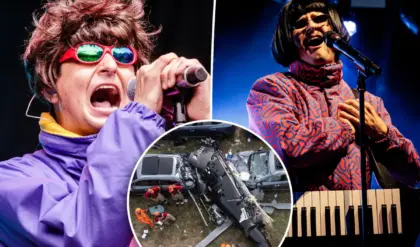
The chaotic reality of breaking news often presents a stark, terrifying juxtaposition between the high-octane celebration of pop culture and the sudden, immutable finality of human tragedy. On the morning of Sunday, June 14, 2026, the global music community and millions of internet followers were suddenly forced to confront this harsh reality. Initial frantic reports emerging from the coastal metropolis of Rio de Janeiro, Brazil, painted a picture of absolute disaster in the skies, signaling an event that would instantly halt one of the most eccentric and ambitious musical journeys of the modern digital era. Oliver Tree Nickell, the 32-year-old American singer-songwriter, rapper, and internet phenomenon universally known by his stage name Oliver Tree, was confirmed to be among six victims who perished in a catastrophic mid-air helicopter collision.
:max_bytes(150000):strip_icc():focal(749x0:751x2)/Oliver-Tree-BRIT-Awards-061426-257d63c556c54958b9fb14230d4312b2.jpg)
The incident occurred in the upscale, sprawling coastal neighborhood of Recreio dos Bandeirantes, located in the West Zone of Rio de Janeiro. For an artist whose entire public persona was built upon surviving theatrical, absurdist stunts, death-defying feats on oversized scooters, and leaning heavily into a cartoonish, invincible aesthetic, the cold reality of the aviation accident left fans worldwide in a state of profound, disbelieving shock. As the smoke cleared from a burning commercial parking lot below the crash site, international news agencies like the Associated Press and AFP confirmed a devastating outcome. There were no survivors. The alternative pop icon, who had amassed more than fifteen million followers on TikTok alone through hits like “Life Goes On” and “Miss You,” had been violently grounded just as he was preparing for the next massive international leg of his highly publicized global tour.
To fully comprehend the trajectory that ended so abruptly in the skies over Brazil, one must examine the sheer scale of the artistic operation Oliver Tree was conducting at the time of his passing. He was actively in the middle of what he boldly titled “The World’s First World Tour,” an immense, grueling promotional circuit launched in support of his fourth studio album, Love You Madly, Hate You Badly, which had been released to critical and commercial acclaim in April 2026. The ambitious tour was structured to encompass seventy planned concerts across thirty different nations, spanning multiple continents with the audacious, characteristically exaggerated goal of performing on all seven continents. He had just completed a highly successful, high-energy concert in São Paulo on June 6, and was using the brief three-week interim before his scheduled July 1 performance in Lisbon, Portugal, to immerse himself in Brazilian culture, film promotional material, and collaborate with local creative minds.
The days leading up to the disaster reflected the exact brand of chaotic, infectious joy that Oliver Tree brought to every country he visited. His final digital footprints, uploaded to his official Instagram and TikTok accounts, showed him developing a rapid, deep affinity for the local community. He was filmed visiting a vibrant favela, wearing a classic yellow Brazilian soccer jersey, kicking footballs with local youth, and embracing the warmth of his South American fanbase. He was a creator who thrived on physical presence, using the reality of his surroundings as a canvas for his absurdist comedy. Behind the scenes, however, he was also coordinating the complex logistics of an international career, moving between creative meetings, studio sessions, and scouting locations alongside a tight-knit circle of international content creators and producers.
The morning of June 14 was meant to be a routine transit flight across the notoriously gridlocked traffic of Rio de Janeiro. In a city where the wealthy, elite, and visiting international celebrities frequently utilize helicopters as standard taxis to bypass congested highways and move quickly between downtown centers and beachside enclaves, the flight seemed entirely ordinary. Oliver Tree boarded a Bell 206B JetRanger III helicopter, bearing the registration PP-MAC, which was operated by a private commercial fruit enterprise, Turfik Comércio de Frutas Ltda. The flight crew consisted of veteran Brazilian pilot Alexandre Souza. Joining Tree in the cabin was an elite, international group of young creative minds: Gaspar Prim, a prominent 23-year-old Argentine YouTuber and streamer known to millions online as “Gaspi”; Lucas A. Vignale, an acclaimed Argentine director and screenwriter who had collaborated on numerous high-profile digital video projects; and Lucas Frota, a talented 32-year-old Brazilian music producer and DJ.
Simultaneously, another aircraft was operating in the immediate airspace. A privately owned Aérospatiale AS 350B2 Écureuil helicopter, registered as PR-DJJ, was navigating the same sector under the sole command of Brazilian pilot Charles Marsillac. The weather conditions over the beachside community of Recreio dos Bandeirantes were clear, offering excellent visibility that should have made routine airspace separation a straightforward task for seasoned aviators. Yet, at approximately mid-morning, the paths of the two multi-ton aircraft converged with catastrophic precision several miles west of downtown Rio.

The physical mechanics of the mid-air collision were instantaneous and utterly destructive. The structural impact between the main rotor blades and fuselages of the Bell 206 and the Aérospatiale AS 350 caused an immediate loss of aerodynamic control. Eyewitnesses on the ground, including local tire repair worker Fernandes de Freitas, described looking up after hearing a sudden, deafening mechanical crunch to see one of the helicopters already enveloped in bright, aggressive flames while still tumbling through the air. In a detail that underscores the absolute terror of the final seconds, De Freitas reported noticing what appeared to be a passenger attempting a desperate, futile leap from one of the falling aircraft just moments before it struck the earth.
The primary mass of the Bell helicopter plummeted directly into the outdoor parking lot of a local car dealership specializing in modern electric vehicles manufactured by the Chinese automaker BYD. Upon hitting the pavement, the aircraft’s fuel cells ruptured and exploded, igniting an intense, fast-moving chemical fire that rapidly tore through approximately twenty parked electric vehicles, sending thick, toxic black smoke billowing into the sky. The secondary aircraft, the Eurocopter, did not catch fire but sustained equal destruction, crashing violently onto its upper frame with its landing gear facing straight up into the air. The sheer energy of the mid-air breakup scattered heavy mechanical wreckage, twisted metal, and structural fuselages across a wide debris field with a radius of at least 100 meters, leaving a tail section resting on the roof of a neighboring residential building.
The response from Rio de Janeiro’s Military Fire Department was immediate, but the scale of the impact left no room for life-saving interventions. Firefighters rushed to the burning BYD dealership, deploying heavy foam and water lines to suppress the roaring vehicle fires and stabilize the volatile environment. Fabio Contreiras, an official spokesperson for the local firefighting department, delivered the grim reality to national broadcasters via GloboNews, stating that while emergency teams were able to rapidly control and extinguish the flames, there were absolutely no survivors found within the wreckage of either aircraft. The bodies of the six individuals aboard were recovered from the localized impact zones, severely burned and compromised by the intense thermal energy of the post-crash fire, necessitating advanced forensic profiling and dental records for formal, legal identification.
As the shocked public began to process the magnitude of the loss, the machinery of the Brazilian federal and local authorities immediately shifted into an aggressive, multi-layered investigation. The Civil Police of Rio de Janeiro, spearheaded by lead investigator Alan Luxardo, secured the extensive debris fields and seized all available regional air traffic control logs, radar data, and maintenance records for both private helicopters. Early technical indicators analyzed by aeronautical experts pointed squarely toward human error as the foundational cause of the disaster. Investigator Luxardo publicly noted that the primary focus of the criminal and technical inquiry would center on determining whether the catastrophic lapse in situational awareness rested with the individual pilots or with the regional air traffic controllers responsible for managing the low-altitude flight corridors over the West Zone.
However, amidst the standard technical procedures of an aviation investigation, a highly unsettling and deeply mysterious element emerged to capture the attention of federal investigators. Authorities revealed they are currently attempting to meticulously trace the source, location, and exact digital routing of a cryptic 43-second phone call connected directly to the doomed flight. While police have remained highly guarded regarding the specific audio content or the identity of the individual who placed or received the call, the timing of the transmission has raised intense, speculative questions. Investigative sources indicate that the call occurred precisely during the critical window when the helicopters were navigating the congested airspace just moments before the impact. Speculation has rippled through local media regarding whether the 43-second call represents a frantic, final distress communication from one of the passengers inside the cabin, a distraction that compromised the pilot’s focus, or a chilling real-time audio recording of the collision itself captured on a remote server.
The news of Oliver Tree’s tragic passing triggered an immediate, unprecedented wave of mourning across the international entertainment landscape, bridging the gap between mainstream music and the global creator economy. High-profile tributes poured in from colleagues who had shared creative spaces with the unique artist. British internet personality, musician, and YouTuber KSI, who had famously collaborated with Oliver Tree on the hit single “Voices,” expressed his profound grief in an emotional, raw post shared on social media. KSI wrote of his complete inability to comprehend the reality of the situation, noting that at just 32 years old, Tree had so much life left to live, so much music left to craft, and so much boundary-pushing content left to share with a world that desperately needed his unique brand of humor.

Simultaneously, legendary Jackass star and comedian Steve-O shared a poignant photograph of himself alongside Oliver Tree, offering a rare glimpse into the genuine, deeply caring human being who existed beneath the ridiculous bowl-cut wigs and viral internet antics. Steve-O emphasized that despite Tree’s outward presentation as an unpredictable, chaotic internet troll, he was an incredibly loyal, grounded friend who consistently made an effort to check in on the well-being of those he cared about. The acting governor of Rio de Janeiro, Ricardo Couto, also issued an official state message, expressing his deepest institutional solidarity with the international families and friends of the six victims caught in the center of the sudden tragedy.
The ultimate tragedy of Oliver Tree’s death lies in the permanent silencing of a truly singular, post-modern artistic voice. He was an individual who successfully treated the entire internet as a stage for performance art, blending electronic music, alternative rock, hip-hop, professional stunt work, and absurdist, self-deprecating comedy into an unpredictable, highly lucrative package. He had taken an industry that often takes itself far too seriously and turned it on its head, proving that a musician could be a clown, a filmmaker, and a multi-platinum recording artist all at once. As fans gather on digital platforms to stream “Life Goes On” in a new, deeply somber context, the ongoing investigation into the mysterious 43-second phone call and the mechanical failure over Rio de Janeiro serves as a grim reminder of how quickly a life dedicated to defiance of gravity can be brought to an end.
News

Just now: Nurses say Brazilian woman Maria Eduarda survived a fall of 130 feet (approximately 40 meters), but upon closer inspection, heartbreaking events unfolded
The initial whispers that rippled across social media platforms carried a fleeting, almost miraculous ray of hope. Early online rumors and unverified digital chatter claimed that a twenty-one-year-old Brazilian woman named Maria Eduarda Rodrigues de Freitas had somehow cheated death,…

THE MISSING $634,000 THAT IS SUDDENLY OVERSHADOWING KARMELO ANTHONY’S APPEAL?! 🛑💰
THE MISSING $634,000 THAT IS SUDDENLY OVERSHADOWING KARMELO ANTHONY’S APPEAL?! 🛑💰 Just when many thought the next chapter of the Karmelo Anthony case would focus entirely on his appeal, a new controversy is shifting attention somewhere else entirely. The $634,000…

💔 THE HEALTH UPDATE XAVIER TAYLOR JUST SHARED AFTER THOUSANDS OF STRANGERS STEPPED IN TO HELP…
💔 THE HEALTH UPDATE XAVIER TAYLOR JUST SHARED AFTER THOUSANDS OF STRANGERS STEPPED IN TO HELP… Just when supporters were beginning to fear the worst, Xavier Taylor has finally broken his silence with a new update on his condition after…
💔 THE FUTURE AUSTIN METCALF NEVER GOT TO LIVE… While the internet argues about the verdict, Austin Metcalf’s mother says she can’t stop thinking about something else entirely. Not the courtroom. Not the sentence.
💔 THE FUTURE AUSTIN METCALF NEVER GOT TO LIVE… While the internet argues about the verdict, Austin Metcalf’s mother says she can’t stop thinking about something else entirely. Not the courtroom. Not the sentence. The future her son spent years…

“SOMEONE STOP HER!” 😳 Witnesses say people started screaming right after Maria Eduarda left, and what officers allegedly discovered just seconds later could become one of the most crucial pieces of evidence in the case 💔👇
The investigation into the tragic plunge of twenty-one-year-old Maria Eduarda Rodrigues de Freitas has taken an even more chilling turn as local authorities and forensic teams piece together the frantic final moments on the platform. Eyewitness accounts now reveal that…
4 SECONDS LATER, EVERYTHING CHANGED 🚨 Maria Eduarda smiled, stepped onto the stage, and trusted the staff around her, but what one staff member allegedly said just 4 seconds after the jump is now haunting millions of viewers. What fell to the ground is becoming crucial evidence 💔👇
Dưới đây là bài báo tiếng Anh phân tích chi tiết và sâu sắc về vụ việc chấn động vừa qua, tuân thủ nghiêm ngặt các yêu cầu về mặt định dạng, không sử dụng bất kỳ dấu chấm đầu…
End of content
No more pages to load