A viral monkey, his plushie, and a 70-year-old experiment: what Punch tells us about attachment theory
A baby macaque monkey named Punch has gone viral for his heart-wrenching pursuit of companionship.
After being abandoned by his mother and rejected by the rest of his troop, his zookeepers at Ichikawa City Zoo in Japan provided Punch with an orangutan plushie as a stand-in mother. Videos of the monkey clinging to the toy have gone viral worldwide.
But Punch’s attachment to his inanimate companion is not just the subject of a heartbreaking video. It also harks back to the story of a famous set of psychology experiments conducted in the 1950s by US researcher Harry Harlow.
The findings from his experiments underpin many of the central tenets of attachment theory, which positions the bond between parent and child as crucial in child development.
What were Harlow’s experiments?
Harlow took rhesus monkeys from birth, and removed them from their mothers. These monkeys were raised in an enclosure in which they had access to two surrogate “mothers”.
One was a wire cage shaped into the form of a “mother” monkey, which could provide food and drink via a small feeder.
Understand how AI is changing society, with our weekly newsletter
The other was a monkey-shaped doll wrapped in terry towelling. This doll was soft and comfortable, but it didn’t provide food or drink; it was little more than a furry figure the baby monkey could cling to.
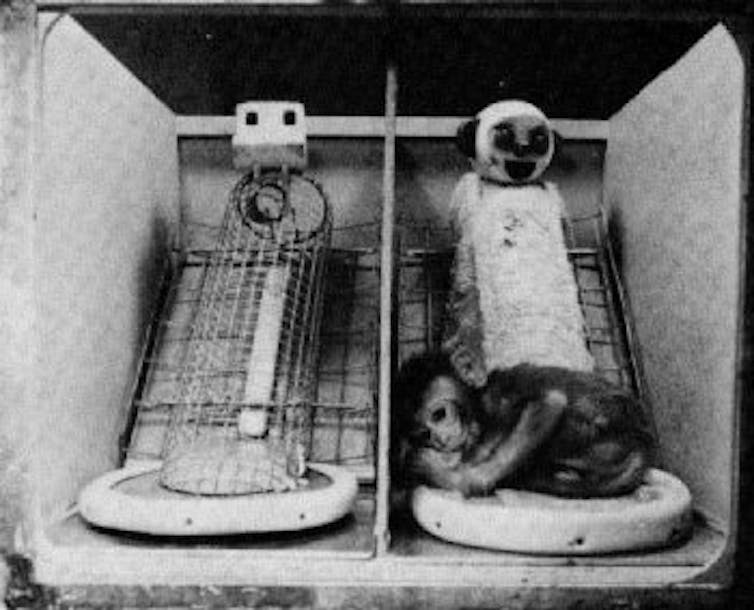
The wire ‘mother’ and the soft ‘mother’ in Harlow’s experiment. Harlow, H. F. (1958). The nature of love. American Psychologist, 13(12), 673–685.
So, we have one option that provides comfort, but no food or drink, and one that’s cold, hard and wiry but which provides dietary sustenance.
These experiments were a response to behaviourism, which was the prevailing theoretical view at the time.
Behaviourists suggested babies form attachments to those who provide them with their biological needs, such as food and shelter.
Harlow challenged this theory by suggesting babies need care, love and kindness to form attachments, rather than just physical nourishment.
A behaviourist would have expected the infant monkeys to spend all their time with the wire “mother” that fed them.
In fact, that’s not what happened. The monkeys spent significantly more time each day clinging to the terry towelling “mother”.
Harlow’s 1950s experiments established the importance of softness, care and kindness as the basis for attachment. Given the opportunity, Harlow showed, babies prefer emotional nourishment over physical nourishment.
How did this influence modern attachment theory?
Harlow’s discovery was significant because it completely reoriented the dominant behaviourist view of the time. This dominant view suggested primates, including humans, function in reward and punishment cycles, and form attachments to whoever fulfils physical needs such as hunger and thirst.
Emotional nourishment was not a part of the behaviourist paradigm. So when Harlow did his experiments, he flipped the prevailing theory on its head.
The monkeys’ preference towards emotional nourishment, in the form of cuddling the furry terry towel-covered surrogate “mother”, formed the foundation for the development of attachment theory.
Attachment theory posits that healthy child development occurs when a child is “securely attached” to its caregiver. This is achieved by the parent or caregiver providing emotional nourishment, care, kindness and attentiveness to the child. Insecure attachment occurs when the parent or caregiver is cold, distant, abusive or neglectful.
Much like the rhesus monkeys, you can feed a human baby all they need, give them all the dietary nourishment they require, but if you don’t provide them with warmth and love, they’re not going to form an attachment to you.
What can we learn from Punch?
The zoo was not conducting an experiment, but Punch’s situation inadvertently reflects the controlled experiment Harlow did. So, the experimental setup was mimicked in a more natural setting, but the outcomes look very similar.
Just as Harlow’s monkeys favoured their terry towelling mother, Punch has formed an attachment to his IKEA plushie companion.
Now, what we don’t have with the zoo situation is the comparison to a harsh, physically nourishing option provided.
But clearly, that’s not what the monkey was looking for. He wanted a comforting and soft safe place, and that’s what the doll provided.
Were Harlow’s experiments ethical?
Most of the world now recognises primates as having rights that are, in some cases, equivalent to human rights.
Today, we would see Harlow’s experiments as a cruel and unkind thing to do. You wouldn’t take a human baby away from its mother and do this experiment, so we shouldn’t do this to primates.
It’s interesting to see people so fascinated by this parallel to an experiment conducted more than 70 years ago.
Punch the monkey is not just the internet’s latest animal celebrity – he’s a reminder of the importance of emotional nourishment.
We all need soft spaces. We all need safe spaces. Love and warmth are far more important for our wellbeing and functioning than physical nourishment alone.
News

A STRANGE DETAIL IN THE FRONT SEAT: According to several reports cited by local media, some images from the scene show a small item lying near Declan Berry’s driver’s seat — this seemingly minor detail is drawing attention to the final moments before the accident
Two teenagers in car that crashed into river identified by police The body of Eden Bunn, 16, has been recovered from the River Nene near Wisbech but searches are continuing for 18-year-old Declan Berry. The car crashed into the River…

Breaking News: Police are offering a reward for information leading to Julian Ingram’s arrest, but a RUMORUS SPREADING about just ONE ADDRESS reveals what he fears
Shooting victims to be laid to rest as police offer reward for information leading to arrest of Julian Ingram Authorities believe the fugitive is still alive. Three victims of Julian Ingram’s alleged shooting spree in NSW will be laid to rest this…

THE CHAIR BY THE RIVER: Nicola Bulley’s phone was found neatly placed on a chair while a work call continued in silence — a chilling detail that has left many wondering why the device was left there
Retracing Nicola Bulley’s last known movements: Video tracks missing mother’s journey along river to bench where her phone was found after she vanished without a trace This video retraces the last known journey of missing mother-of-two Nicola Bulley who mysteriously vanished…
A WALKER SAID THE AREA WAS “EERILY QUIET” One local told reporters they passed the path shortly after 9:25 a.m.
A WALKER SAID THE AREA WAS “EERILY QUIET” One local told reporters they passed the path shortly after 9:25 a.m. They remembered seeing the dog… but no one else nearby. Investigators later described that stretch of riverbank as isolated and…

THE DOG WAS FOUND FIRST A woman walking near River Wyre around 9:33 a.m. noticed Nicola’s dog running loose
THE DOG WAS FOUND FIRST A woman walking near River Wyre around 9:33 a.m. noticed Nicola’s dog running loose. The harness was still attached… but strangely not clipped to the lead. Nearby, Nicola’s phone remained on the bench — still…

THE PHONE AT 9:20 AM: Nicola Bulley’s phone was found still connected to a work meeting on a bench beside River Wyre — but the mother of two had vanished minutes earlier, leaving investigators puzzled about what could happen in such a short moment
Nicola Bulley: Chilling reality of TikTok sleuthing laid bare as family reveal true extent of torment Ahead of a new BBC documentary about Nicola Bulley, the Mirror takes a look at the chilling reality of the amateur TikTok sleuths whose…
End of content
No more pages to load