An Air India flight crashed shortly after takeoff from Ahmedabad in northwest India on Thursday afternoon local time, killing more than 260 people.
The Boeing 787-8 Dreamliner, Flight AI171, was carrying 242 people bound for London. Only one passenger, a British man, survived.
The plane crashed less than a minute after takeoff, coming down on top of a college hostel around 1.5 kilometres from the runway. Little is known so far about the cause of the incident.
As an aviation safety expert, it is hard to avoid a sense of disbelief that an event such as this – involving one of the most advanced passenger jets in the world, built on the lessons of many earlier accidents – could happen in the 21st century.
Trouble after takeoff
Air crashes such as this one, in which a plane experiences trouble immediately after takeoff, are now extremely rare. They were more common in the past.
In one infamous 1999 incident, 32 people died when LAPA Flight 3142 crashed during takeoff from Buenos Aires. During the accident investigation, it emerged that the Boeing 737’s wing flaps had not been in the right position for takeoff and the crew had ignored alarms from the plane’s internal warning system.
The 2009 emergency landing of US Airways Flight 1549 on New York’s Hudson River also occurred shortly after takeoff. In that case, the problem was quite different: a collision with a flock of Canada geese shut down both engines, leading to a powerless aircraft.
However, the aviation industry puts a lot of resources into learning from accidents so they don’t happen again. LAPA Flight 3142 led to recommended improvements in pilot training and flight procedures. The rules for engine design were changed after the “miracle on the Hudson”.
So whatever caused the Air India crash, it may not be something we have seen before.
How did one passenger survive?
One passenger survived the crash. We don’t know exactly how.
He was sitting in seat 11A, next to an emergency exit. Reports say the plane “broke in half”, and the passenger found himself in the front half while the rear caught fire. He then walked from the wreckage and was found by rescuers.
Why did he survive when everybody else died? Research suggests that, in general, the seats at the back of the plane are the safest place to be in a crash – but this man was quite close to the front.
Based on what we know so far, my expert opinion is that we have no better explanation than to call it luck or a miracle.
Where to from here?
We won’t have a clear idea of what happened until a full investigation has been carried out. Air crash investigations follow a protocol laid out by an International Civil Aviation Organization document called Annex 14.
India’s Aircraft Accident Investigation Bureau will lead this investigation, putting together a team that will be assisted by representatives from the US National Transport Safety Bureau and the UK Air Accidents Investigation Branch, representing the countries of the plane’s manufacturer and passengers aboard.
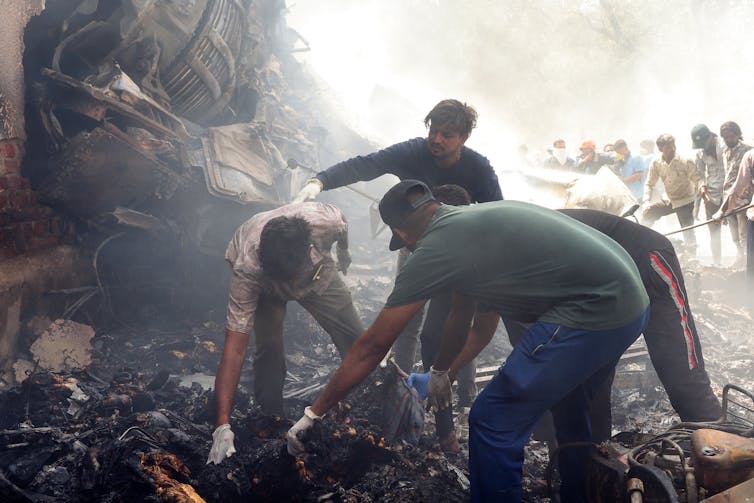
Rescuers sift through the wreckage of Flight AI171 in Ahmedabad. Sam Panthaky / AFP via Getty Images
The team will conduct a forensic investigation of the crash site to make sense of what happened. Alongside material evidence found at the site, they will look at the data stored in the plane’s “black box”, which includes data from the flight recorder and cockpit voice recorder, to learn about what happened in the leadup to the crash.
A slow, steady process
Air crash investigations can take a long time. Typically a preliminary report will be published 3 to 6 months after the crash, followed by a final report a year or two later.
The report will provide factual information on the cause of the accident and make recommendations. Depending on the cause, these might be changes to maintenance procedures, pilot and crew procedures, or even the design of parts of the aircraft.
Indian authorities will then disseminate these recommendations to whoever needs them around the world. The process is slow, but it moves in the direction of safer air travel. Everyone will be waiting to find out and learn.
In the meantime, it’s best to remember that we still don’t know what happened or why. Everyone wants answers, but speculation can do more harm than good.
News

A STRANGE DETAIL IN THE FRONT SEAT: According to several reports cited by local media, some images from the scene show a small item lying near Declan Berry’s driver’s seat — this seemingly minor detail is drawing attention to the final moments before the accident
Two teenagers in car that crashed into river identified by police The body of Eden Bunn, 16, has been recovered from the River Nene near Wisbech but searches are continuing for 18-year-old Declan Berry. The car crashed into the River…

Breaking News: Police are offering a reward for information leading to Julian Ingram’s arrest, but a RUMORUS SPREADING about just ONE ADDRESS reveals what he fears
Shooting victims to be laid to rest as police offer reward for information leading to arrest of Julian Ingram Authorities believe the fugitive is still alive. Three victims of Julian Ingram’s alleged shooting spree in NSW will be laid to rest this…

THE CHAIR BY THE RIVER: Nicola Bulley’s phone was found neatly placed on a chair while a work call continued in silence — a chilling detail that has left many wondering why the device was left there
Retracing Nicola Bulley’s last known movements: Video tracks missing mother’s journey along river to bench where her phone was found after she vanished without a trace This video retraces the last known journey of missing mother-of-two Nicola Bulley who mysteriously vanished…
A WALKER SAID THE AREA WAS “EERILY QUIET” One local told reporters they passed the path shortly after 9:25 a.m.
A WALKER SAID THE AREA WAS “EERILY QUIET” One local told reporters they passed the path shortly after 9:25 a.m. They remembered seeing the dog… but no one else nearby. Investigators later described that stretch of riverbank as isolated and…

THE DOG WAS FOUND FIRST A woman walking near River Wyre around 9:33 a.m. noticed Nicola’s dog running loose
THE DOG WAS FOUND FIRST A woman walking near River Wyre around 9:33 a.m. noticed Nicola’s dog running loose. The harness was still attached… but strangely not clipped to the lead. Nearby, Nicola’s phone remained on the bench — still…

THE PHONE AT 9:20 AM: Nicola Bulley’s phone was found still connected to a work meeting on a bench beside River Wyre — but the mother of two had vanished minutes earlier, leaving investigators puzzled about what could happen in such a short moment
Nicola Bulley: Chilling reality of TikTok sleuthing laid bare as family reveal true extent of torment Ahead of a new BBC documentary about Nicola Bulley, the Mirror takes a look at the chilling reality of the amateur TikTok sleuths whose…
End of content
No more pages to load