A More Faithful Rings Of Power Season 3 Must Zoom In On One Key Tolkien Theme
With The Rings of Power season 3 inevitable, it is time to pin down what a more faithful show actually means. The mass appeal of Tolkien ensures a challengingly diverse and subjective idea of a faithful Lord of the Rings adaptation. Avoiding out-and-out canon breaks – such as having Elendil alive during the Siege of Eregion – is a fairly universally agreed-upon point in this regard. But that critique is superficial and obsolete without suggesting a realistic alternative. Attempting to pinpoint that alternative reveals the complexity of the task and the insufficiency of the critique, but there is one clear way forward.
The Rings Of Power Can’t Have Faithful Details, So It Needs Faithful Themes
The Rings Of Power’s Source Material Presents Unique Challenges

The faithfulness that Rings of Power seeks is not in its detail – there’s virtually none to adapt. It is in theme, which needs to come through in character arcs. Rights aren’t an issue as concerns the show’s faithfulness. Although the show has rights to The Hobbit and The Lord of the Rings, it is securing one-off rights where it needs to. The huge gap between the format of the source material and the format of the show is the issue. This new show adapts an old text written in an even older style with little dialogue or graphic characterization.
With Tolkien’s legendarium originating in 1914, it will be 111 in 2025, just as worthy of an eleventy-first birthday party as Bilbo Baggins in The Fellowship of the Ring. Rings of Power is not just adapting content over a century old, it is adapting the work of a scholar in Old English and Old Norse. The show adapts stories outlined in The Lord of the Rings’ appendices but fleshed out in The Silmarillion, which is representative, in style, of quite a lot of the wider legendarium. LotR is a medieval romance but still feels fairly contemporary, unlike The Silmarillion.
In-universe, The Silmarillion is a collection of old Elvish myths and stories. It uses the formal, elevated diction of epic poetry like the Old English Beowulf, which Tolkien provided a brilliant translation of, or the Old Norse Poetic Edda, which Tolkien adored. It is not a novel and nor does it read like one. It reads more like the Bible or a historical textbook. There are few conversations recorded, few physical appearances detailed, and few messy, contradictory psychological states explored. Imagine adapting the Bible for television – that accurately projects the amount of invention needed for The Rings of Power screenplay.
…The Silmarillion is ageless because Tolkien was far ahead of his time.
Some may feel that such a text should never be adapted for the screen, and they shouldn’t watch The Rings of Power. But The Silmarillion is ageless because Tolkien was far ahead of his time. There is much to be gained from adapting this timelessly relevant story if viewers accept the inevitable differences between the adaptation and the books. There is not enough detail in The Rings of Power’s source material to create “word-for-word” scenes, plotlines, characters, or even timelines. Faithfulness must be pursued thematically. In Tolkien’s own words, adaptations must perceive “the core of the original.”
The Core Of J.R.R. Tolkien’s Story Was Respecting Natural Life
Lord Of The Rings Is About Mortality


Tolkien confirmed in a letter that the “real theme” of The Lord of the Rings was “Death and Immortality.” Tolkien’s legendarium encompassed many themes, but through it all, the core of the story was respecting natural life and not reaching for life beyond one’s means. Everyone who did this paid the price – Morgoth, Sauron, Gollum, Ar-Pharazôn, and Celebrimbor. This folly underlay Morgoth and Ar-Pharazôn’s tyrannical pursuit of power, and it was inextricably linked to Sauron’s pursuit of power, with unnaturally long life baked into the Rings of Power. This was in keeping with Tolkien’s Catholic views.
Mortality was a gift in The Lord of the Rings and the Men that forgot it were in error.
The Lord of the Rings was no allegory, but it contained allegorical elements. In many ways, the One Eru Ilúvatar reflected Tolkien’s God, while Morgoth reflected the devil. Eru’s Godhood was equivalent to his ability to bestow the Imperishable Flame, life itself. In seeking the Flame, Morgoth sought Godhood itself, and indeed, he proved violently tyrannical. Following in his footsteps, Sauron forged rings that extended mortality unnaturally so he could become “God-King,” in Tolkien’s words.
Lord of the Rings’ key theme played out across all its most important characters, and it has played out in Rings of Power’s characters where the show has been most successful.
Mortality was a gift and the Men that forgot it were in error. But even immortals looked for more life, proving that no life was ever long enough for one lacking faith. Meanwhile, some of Middle-earth’s greatest Elves – Elros, Lúthien, and Arwen – chose mortality over eternity. The character least affected by the One Ring had the most trust in Eru’s plan – Tom Bombadil saw no reason to participate in the War of the Ring. Neither Frodo nor Sam looked for power or life beyond their simple existences, which made them resistant to the One Ring.
More Focused Character Development Can Push This Theme Forward In The Rings Of Power Season 3
Lord Of The Rings’ Key Theme Needs To Come Through In Rings Of Power’s Characters

Lord of the Rings’ key theme played out across all its most important characters, and it has played out in Rings of Power’s characters where the show has been most successful. The parts of the show that have been the least faithful, or felt the least faithful, have been those that slipped a little too far from this theme. Galadriel’s revenge arc in The Rings of Power season 1 was fashionable, but a little removed from this theme. Revenge is in vogue, as are strong female leads.
Rings of Power faces the same compromise as any adaptation – that between faithfulness and good drama that reaches a modern audience. The freedom provided by the show’s original characters shows the writers’ potential for drama – they create amazing arcs. Adar’s character development was probably the best of the whole show, whereas Celebrimbor showed how compromise can challenge the show. His plotline may have been the most faithful, but his death didn’t carry half the dramatic impact as Adar’s.
The Letters of J.R.R. Tolkien, published in 1981, provides a range of Tolkien’s letters, offering huge insight into his work and beliefs.
For heroes to be heroic in modern drama, whether original characters or Tolkien characters, they have to convincingly overcome a struggle to reach their final position. Character development is key to character-driven television. Meanwhile, more simplicity and focus on Tolkien’s key theme of mortality and how it manifests in each character’s struggle, whether they are original or not, would make it more faithful. Clarifying this key theme of mortality in all original and Tolkien characters is the North Star that The Rings of Power needs to be faithful and dramatic.
The Rings Of Power Is On The Right Track Conveying This Essential Tolkien Theme
Some Rings Of Power Characters Successfully Demonstrate Tolkien’s Key Theme

Elendil demonstrates how invented but compelling internal conflict can drive Tolkien’s key theme in the show. Elendil had unwavering faith in the books, opposing Pharazôn, who envied and demanded the Valar’s immortality. In the show, Elendil’s children symbolize different parts of him. Anárion represents Elendil’s faith and true self, buried and denied, while Eärien represents his doubt. Meanwhile, the original character Adar demonstrated not just excellent character development but the tension between mortality and immortality, bearing the hallmark of Tolkien’s great heroes – giving up a Ring of Power.
Morgoth couldn’t capture the Imperishable Flame, so he corrupted Elves into Orcs instead – “the vilest deed of Melkor, and most hateful to Illúvatar,” according to Tolkien. Tolkien wrestled with Orc rights throughout his life. In his older years, he gravitated toward the conclusion that Orcs sprung from the Imperishable Flame, ultimately, like all other life on Middle-earth, and were therefore worthy of the same rights as other life – just as Adar said. The “new birth” that Morgoth offered Adar in Rings of Power was the most fundamental of lies – Morgoth had no genesis to offer and never did.
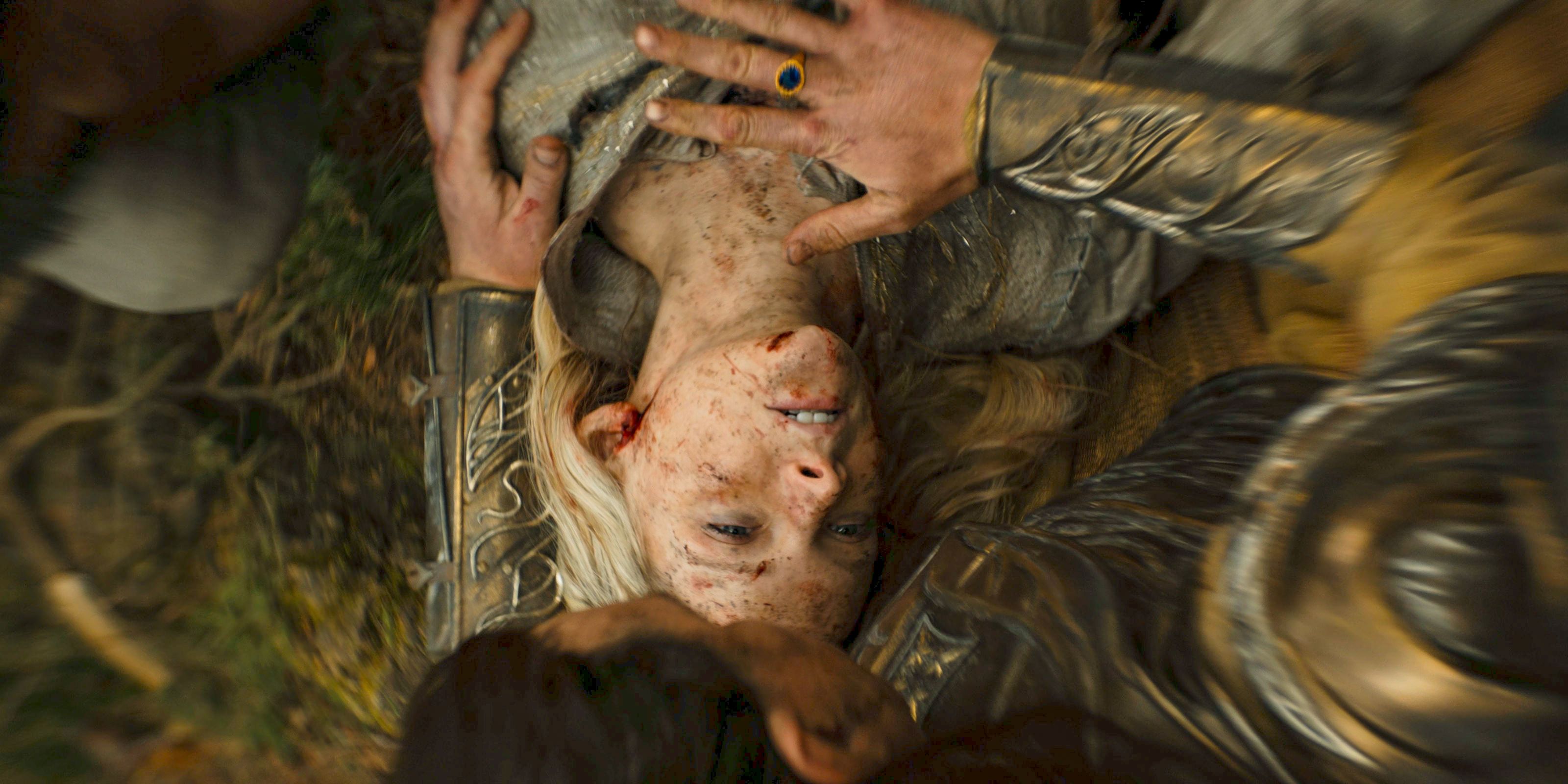
Wearing Nenya miraculously reversed the effects of “the vilest deed of Melkor,” healing Adar from a twisted Orc back into an Elf. Using magic taught by Sauron, the rings were built to prolong the natural way of things far beyond their given time. Adar proved the profundity of his redemption by recognizing the same folly in that ring as there had been in the wine he drank on that “dark and nameless peak.” No longer looking to Morgoth for dark, unnatural power, Adar finally accepted life the way it was in The Lord of the Rings: The Rings of Power.