The Lord of the Rings: What Was in the Far North of Middle-earth?
In stark contrast to the forests, swamps, and grasslands that made up Middle-earth’s most familiar regions, the Northern Waste was a vast tundra. Few plants could grow among the snow and ice, but it was not entirely devoid of life; the Northern Waste was home both to ferocious monsters and to the remnants of an ancient civilization. Though most adaptations of The Lord of the Rings have ignored the Northern Waste, it remains one of the most fascinating regions in Tolkien’s legendarium and is ripe for exploration.
The Dark Lord Turned the North of Middle-earth Into a Wasteland
His First Fortress Utumno Was Later Succeeded by Angband
Long before the First Age of Middle-earth, the Dark Lord Morgoth created Utumno, a massive fortress among the Iron Mountains in the far north of the continent. Much like Sauron’s stronghold of Dol Guldur, it emanated evil energy that transformed the surrounding landscape. While Dol Guldur turned Greenwood into the dark and oppressive Mirkwood, Utumno instead turned the area around the Iron Mountains into the desolate Northern Waste. Utumno was destroyed in the Battle of the Powers, and Morgoth was defeated in the War of Wrath, but even after these events, the Northern Waste remained as cold and barren as ever. This was a testament to the overwhelming power of Morgoth.
Locations of the Northern Waste
Description
Icebay of Forochel
Inlet of the Belegaer Sea in the southwestern Northern Waste
Cape of Forochel
Land around the Icebay of Forochel
Mountains of Angmar
Mountain range southwest of the Northern Waste
Mount Gundabad
Mountain south of the Northern Waste
Grey Mountains
Mountain range southeast of the Northern Waste
read more
Freezing temperatures were not the only threat in the Northern Waste. The region produced icy storms that sometimes traveled south through the rest of Middle-earth. A little over a thousand years before the events of The Lord of the Rings, one such storm stranded Amroth, the last King of Lórien, at sea. As such, Amroth’s unfortunate drowning was the reason that Celeborn and Galadriel became the Lord and Lady of Lothlórien. There were also dragons known as Cold-drakes in the Northern Waste, as most of those who served Morgoth fled there or to the Grey Mountains after the War of Wrath. Not every inhabitant of the Northern Waste was a fearsome monster, however.
The Witch-king Terrorized the Northern Waste & Its Forodwaith
Forodwaith Meant “People of the North” in the Sindarin Elvish


During the First Age, a group of Men called the Forodwaith lived in the Northern Waste as well, giving the location its alternate name. Tolkien wrote very little about the culture of the Forodwaith, and he did not explain when or why they settled in such an inhospitable region of Middle-earth. During the Third Age, the rise of the Witch-king’s kingdom of Angmar caused many of the Forodwaith to die or go into hiding. The few remaining Forodwaith came to be known as the Lossoth or Snowmen of Forochel. The Lossoth believed that the Witch-king had control over snow and ice, which was very possible, as he possessed powerful dark sorcery.
In the chapter “The Mirror of Galadriel” from The Fellowship of the Ring, Frodo mentions Gandalf traveling “from northern waste to southern hill.”
In early drafts, Tolkien used the name Forodwaith for Eriador, the region of Middle-earth that contained the Shire and Bree.
The Witch-king was around for more than 4,200 years, spanning both the Second and Third Ages, whereas his kingdom of Angmar lasted only 675 years.
The Lord of the Rings provided slightly more information about the Lossoth than their ancestors. The Snowmen bore similarities to real-world cultures who live near the Arctic Circle, such as the Inuit and Saami cultures, though Tolkien did not indicate how many of these similarities, if any, were deliberate. The Lossoth built snow huts, and they used sleds and skates to navigate the frozen environment. The latter were made of bone, indicating that there were animals smaller and less dangerous than dragons in the Northern Waste that the Lossoth could hunt. Unlike most of Middle-earth’s cultures, the Lossoth did not value jewels. This might have helped them avoid the attention of their draconic neighbors, who hoarded gold and precious gems.
The Inhabitants of the Northern Waste Aided Aragorn’s Ancestor
King Arvedui of Arnor Tried and Failed to Seize the Throne of Gondor

Most details about the Lossoth came from a passage in Appendix A of The Lord of the Rings. This section of the novel tells the tale of Arvedui, who was the last King of Arnor and an ancestor of Aragorn. When the forces of Angmar destroyed his kingdom, he fled north with a palantír to keep it from the Witch-king’s clutches. He sailed to the Northern Waste, where he would have died from cold if the Lossoth had not taken him in. He thanked the chief of the Lossoth by giving him the Ring of Barahir, a family heirloom. Though the Lossoth did not care for shiny things, Arvedui told them that his people would be willing to offer much in trade for the ring. Years later, the Dúnedain did exactly this so that they could give the Ring of Barahir to Aragorn. Despite the Lossoth’s help, Arvedui did not survive long in the Northern Waste, as he did not heed their warning against sailing before summer.
Lossoth meant “Snow Horde” and Forochel meant “North Ice” in Sindarin Elvish.
The Ring of Barahir was named after the father of Beren, a human hero of the First Age, and the only Man to come back from death.
Middle-earth doesn’t have many regions of permanent coldness.
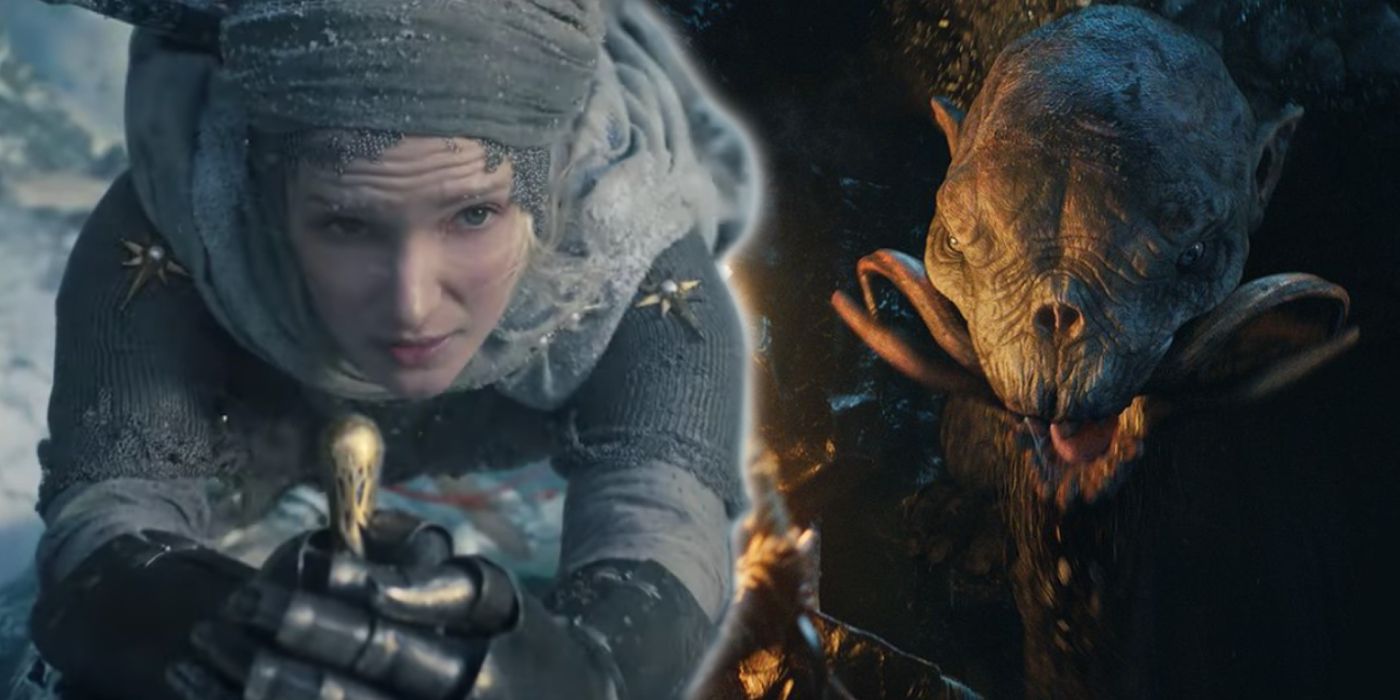
Jackson’s films did not include the Northern Waste, but they did appear in Prime Video’s The Lord of the Rings: The Rings of Power. In the first episode, “A Shadow of the Past,” Galadriel led an expedition of Elves to the Northern Waste in search of Sauron. There, they found an old fortress used by the forces of evil and encountered a snow-troll, which Galadriel killed. Tolkien mentioned snow trolls in The Lord of the Rings, though not about the Northern Waste. Aside from mountaintops like Caradhras, there was little snow and ice in The Lord of the Rings, so the Northern Waste stood out from the rest of Middle-earth’s landscape. This uniqueness, along with the region’s sparse lore, would make the Northern Waste the perfect location for an adaptation of The Lord of the Rings to explore in greater detail.
What Lies Beyond the Singular Continent of Middle-earth
There Are a Few Mysterious Locations That Tolkien Barely Mentions

The geography of Arda, the world in which the continent of Middle-earth was set, has undergone several geographical changes during Tolkien’s career. Although a finalized map never existed, his early writings included several maps depicting both flat and round versions of Arda. In the story, the ultimate deity Eru Ilúvatar created the universe known as Eä, which was to bear the planet of Arda. Very little is known about Eä itself, but the Valar referred to it as “the Little Kingdom” of Ilúvatar, suggesting that even the cosmos paled in comparison to its creator.
When Arda was first formed by Ilúvatar and nourished by the Valar, it was a flat disc of a planet that included the continents of Aman and Middle-earth (or Endor). Middle-earth was bigger before its northwestern region of Beleriand sank under the sea during the War of Wrath. After the fall of Morgoth and the Drowning of Númenor, however, Ilúvatar chose to separate Aman and Middle-earth by transforming Arda into a sphere. Other “continents” on Arda include the Dark Land, which was formed as a consequence of Morgoth’s first war with the Valar, and the still-mysterious Land of the Sun.
The complexity of worldbuilding in Tolkien’s mythos is one of the main reasons that his stories remain the bedrock of modern fantasy fiction to this day. Even Middle-earth alone is extremely elaborate, consisting of numerous regions and kingdoms throughout history. Both The Lord of the Rings and The Hobbit take place in and revolve around Middle-earth. Fans might also find a resemblance between Arda’s most important continent and Westeros in George R.R. Martin’s A Song of Ice and Fire. At the same time, Tolkien confirmed that Middle-earth was supposed to reflect the real Earth’s geography in some ways. Fans entering the franchise have a wide world waiting for them.