The Untold Narrative of the Yamashina Woods
The peaceful mountains bordering Kyoto are globally famous for their quiet bamboo groves, historic wooden temples, and tranquil shrines. Every year, millions of travelers journey to Japan’s ancient capital to experience this calm atmosphere and capture lasting family memories. For the Higginbotham family from Hoover, Alabama, a trip to Japan in late May 2026 was intended to be a joyous celebration marking the high school graduation of their youngest son. Instead, this dream vacation collapsed into an unimaginable heartbreaking tragedy when twenty-year-old James Weston Higginbotham disappeared into the dense forests bordering the city.
:max_bytes(150000):strip_icc():focal(749x0:751x2)/james-weston-Higginbotham-060826-f6928a514d254d558e294a7e2a780b46.jpg)
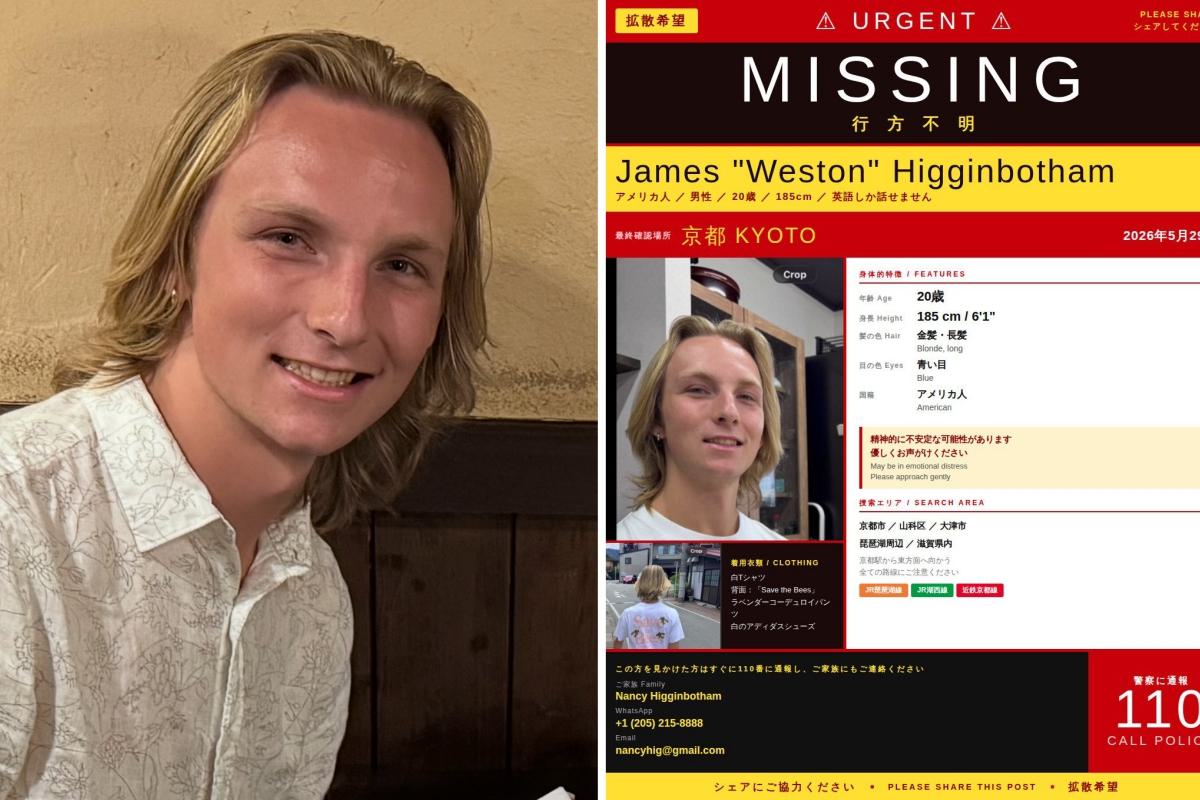
Weston, a junior studying biosystems engineering at Auburn University, went missing on May 29 and was found dead eight days later by a volunteer search and rescue team in the mountains of Yamashina Ward. As news of the discovery broke, media outlets across the globe quickly focused on the unusual circumstances preceding his disappearance, specifically an argument with his mother regarding the use of artificial intelligence tools. Early police commentary and initial media reports heavily framed the timeline around a young man who was emotionally distressed when he walked away, suggesting an impulsive, reckless flight into the wilderness.
For those who knew Weston best, that narrative created a deeply flawed and highly frustrating picture that failed to reflect his true character. Following the discovery of his body, a powerful and emotional statement from his family and close friends has reignited a fierce debate about what the public and the media may have profoundly misunderstood from the very beginning. The family is speaking out forcefully to correct the record, asserting that the sensationalized story being told about Weston’s final days is not the full story, and that early assumptions have deeply distorted the truth of who he was and what actually happened in those dark woods.
Beyond the Sensationalized Headline
When the initial news of Weston’s disappearance hit international headlines, the media focused heavily on what his mother, Nancy Higginbotham, candidly described as a dumb argument. While traveling, Nancy had been relying on ChatGPT to help navigate the trip, look up local transit schedules, and locate restaurants. Weston, an environmentalist deeply committed to ecological sustainability, held strong principled objections to the massive natural resources, water consumption, and electricity required to power large language models and artificial intelligence data centers. His objection was born out of deep academic conviction, but the media frequently reduced the incident to a trivial case of family bickering that caused an emotional outburst.
Close friends back in Alabama state that this presentation made Weston look volatile or immature, which completely contradicts the reality of his personality. Professors and peers at Auburn University described him as a brilliant, calm, and highly intellectual student who lived his values daily. He had embraced a strict vegan lifestyle, practiced deep pacifism, and was a passionate naturalist who would carefully carry insects outside rather than harm them. His decision to take a solo walk was not a dramatic, petulant tantrum; it was his standard, healthy way of seeking quiet reflection to process his thoughts. By focusing entirely on the AI argument, early reports masked the real focus of the story, turning a complex environmental student into a caricature of an angry teenager.
The Absolute Rejection of Self-Harm
The most painful consequence of the early media narrative was the wave of online speculation regarding the possibility of intentional self-harm. Because early police statements mentioned that Weston might have been emotionally distressed, and because his phone’s location-sharing services through the Life360 application were turned off shortly after he boarded a train to Yamashina Station, digital commentators quickly jumped to dark conclusions. The recent emotional statement from the Higginbotham family addresses this head-on, offering an absolute rejection of any theory involving self-harm.
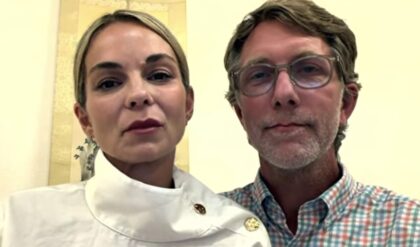
:max_bytes(150000):strip_icc():focal(749x0:751x2)/James-Weston-Higginbotham-parents-060426-8629e006894c42349da632239123a0f3.jpg)
Those closest to Weston have declared unequivocally that he would never have intentionally harmed himself. Family friends and loved ones emphasize that his retreat to nature was a form of therapy, a place where he always went to find peace and recharge his spirit. His decision to turn off his GPS tracking or let his phone battery drain was not a prelude to self-destruction, but a deliberate act of disconnecting from the digital world he found so ecologically taxing. He wanted to immerse himself in the natural world without the constant pinging of tracking apps, an action that aligned perfectly with his anti-technology philosophy at that moment. The family stresses that assuming mental instability obscures the true, tragic nature of what was a genuine outdoor accident.
An Outdoorsman Built to Endure
Another major point of misunderstanding was the assumption that Weston was an ill-prepared, naive American tourist who made a foolish error by wandering past trail markers into a dangerous forest. Before his body was located, his father, Keith Higginbotham, had pointed out that his son was an exceptionally resilient, highly capable outdoorsman. Weston was not a novice hiker; he was an experienced survivalist who had previously tackled solo treks across the rugged Pyrenees mountains in Europe, calling his mother at three in the morning just to share the beauty of an alpine sunrise.
Weston was trained in land navigation, understood how to read wilderness terrain, knew how to find fresh water, and was explicitly described by his family as built to endure harsh physical conditions. He possessed a profound respect for the wild and possessed the practical skills to survive in isolated environments. His friends find it incredibly difficult to picture him simply getting lost or panicking in a forest that sits adjacent to a major urban area. His presence on that hiking path near the Bishamondo Monzeki temple was a calculated choice by an experienced hiker who felt entirely equipped to handle a nighttime walk through the hills. He did not stumble into the woods by mistake; he walked into them as a confident navigator.
The True Culprit was an Unforgiving Nature
By dismantling the rumors of family drama and personal negligence, the Higginbotham family is pointing the public toward the true, brutal culprit of this tragedy: a sudden, violent, and completely unpredictable twist of nature. Shortly after Weston left Yamashina Station and approached the mountain trails on the evening of May 29, a powerful tropical storm swept across central Japan, bringing torrential rainfall, dense fog, and dangerous gale-force winds to the Kyoto region.
The geographical makeup of Kyoto’s eastern hills creates a unique and deadly trap for anyone caught in a severe storm. While the mountains appear manageable because they sit on the edge of a bustling city, the transition into thick wilderness is incredibly abrupt. Within minutes of entering the trail, a hiker is surrounded by a dense canopy of cedar and bamboo that completely blocks out ambient city light and destroys cellular reception. The soil in this region consists of thick clay, which transforms instantly into slick, unstable mudslides during heavy downpours.
The severe weather conditions severely hampered the initial search efforts, forcing over one hundred police officers, tracking dogs, and rescue helicopters to battle waist-high mud and zero visibility. The weather was so extreme that it completely masked Weston’s trail and made air surveillance impossible. The family argues that even the most seasoned survival expert would face a life-threatening crisis if caught on a steep, crumbling cliffside during a tropical deluge in complete darkness. Weston did not succumb to a lack of preparation or emotional distress; he was overcome by an overwhelming environmental catastrophe that would have imperiled any experienced hiker.
A Legacy of Principle and Honor
The tragic conclusion of the search came on the afternoon of June 6 when a dedicated volunteer search and rescue group found Weston’s body in a remote, mountainous section of Yamashina. Kyoto Prefectural Police confirmed that no foul play was suspected, aligning with the family’s understanding that a terrible accident had occurred in the dark, storm-ravaged woods. While the family has requested strict privacy as they begin to process an unimaginable loss, their public statements have succeeded in shifting the global conversation away from internet rumors and back toward the true character of their son.
Back home in Hoover, Alabama, and on the Auburn University campus, the community is choosing to remember Weston for his brilliant mind and unyielding convictions. Auburn University President Christopher Roberts and Hoover Mayor Nick Derzis have both expressed deep grief over the passing of a young man who possessed remarkable character and a bright academic future in biosystems engineering.
The emotional pushback from those closest to Weston serves as a vital reminder that human lives cannot be neatly summarized by a single headline or a brief disagreement. Weston was a young man who loved the Earth deeply, who walked into the mountains to connect with the nature he spent his life studying to protect, and who met a tragic, accidental end inside an unforgiving wilderness. His family and friends refuse to let his memory be defined by a dumb argument, ensuring instead that his legacy remains one of environmental passion, independent strength, and a profound love for the natural world.
News

“I still can’t picture him being there…” Friends of James “Weston” Higginbotham say the hardest thing isn’t that he was found after eight days — but where he was found
The Hidden Dangers of the Ancient Capital The ancient capital of Kyoto is famous for its quiet bamboo groves, historic wooden temples, and peaceful shrines. Millions of travelers come every year to experience this calm atmosphere and capture lasting family…
🚨 HE WAS SUPPOSED TO BE TAKING FAMILY PHOTOS IN KYOTO… NOT BE FOUND 8 DAYS LATER IN THE MOUNTAINS. The death of James “Weston” Higginbotham is leaving friends struggling to understand how a family vacation turned into a search spanning miles of rugged terrain
The ancient capital of Kyoto is famous for its quiet bamboo groves, historic wooden temples, and peaceful shrines. Millions of travelers come every year to experience this calm atmosphere and capture lasting family memories. For the Higginbotham family from Hoover,…

“He had mental health issues…” A close friend of the Joseph Chavez family and Greysen Chavez has just revealed the husband’s health problems that everyone had overlooked, until the wife confessed, at which point things took a completely new turn
The narrative surrounding the heartbreaking double-murder-suicide of ten-year-old twins Joseph and Greysen Chavez in Canoga Park has shifted from a focus on legal disputes to an intimate look at a severe mental health crisis. In the immediate aftermath of the…
“I WISH I HAD NOTICED THAT SIGN SOONER…” A family acquaintance of Joseph Chavez and Greysen Chavez has just revealed what caused their heated argument the most, but the most intriguing detail lies in their last phone call before 7:15 PM…
The investigation into the heartbreaking double-murder-suicide of ten-year-old twins Joseph and Greysen Chavez in Canoga Park has entered a deeply analytical phase. For days, the primary obstacle facing the Los Angeles Police Department was the absolute absence of typical warning…
BREAKING: The Joseph Chavez and Greysen Chavez case is prompting many to ask the same question about the parents’ marriage, especially after a detail related to the divorce agreement was mentioned…
The investigative focus surrounding the tragic double-murder-suicide of ten-year-old twins Joseph and Greysen Chavez in Canoga Park has shifted dramatically. In the immediate aftermath of the shooting inside the Owensmouth Avenue apartment, community members and law enforcement officials were trapped…
WHAT MADE A FATHER LOOK AT JOSEPH CHAVEZ AND GREYSEN CHAVEZ AND MAKE THAT DECISION…?” 72 hours after the Canoga Park tragedy, many are still searching for answers about the final moments before the tragedy, but the detail that reignited the investigation was the phone screen still lit on the bedside table…
The Illusion of a Perfect Sunday Evening The light inside the apartment on Owensmouth Avenue was warm, filled with the specific, chaotic energy that defines a large family gathering. It was the first week of June, a time when the…
End of content
No more pages to load