The Old Butler Slapped The Billionaire’s Son During The Inheritance Dinner… Nobody Dared To Stop Him
When I was a boy, growing up within the cavernous, echoing limestone corridors of the Whitmore estate, I operated under a series of absolute childhood certainties. The sun rose in the east; the autumn leaves turned amber and fell upon the pristine lawns; and Samuel was simply a permanent, immovable fixture of the house—much like the heavy mahogany paneling, the grandfather clocks that chimed through the night, or the imported Persian rugs that muffled the sound of hurried footsteps.
To my young, unformed mind, Samuel was no more and no less than the chief administrator of my domestic comfort. He was the man who materialized at the double oak doors every single morning at precisely 6:00 AM, holding a steaming cup of Earl Grey tea for my father in a bone-china cup. He was the man who pressed my school blazers, organized our family’s labyrinthine travel schedules, and always—without exception—stood precisely two paces behind my father’s left shoulder during public charity galas, press conferences, and high-stakes corporate board meetings.
To the financial media, whose glossy magazine spreads frequently featured profiles of my father’s meteoric rise in the global markets, Samuel was officially chronicled as a loyal, long-serving executive secretary and estate manager. To the high-society socialites, venture capitalists, and political figures who floated through our home during weekend cocktail parties, he was viewed as an aging, impeccably tailored butler who possessed an uncanny ability to anticipate every whim before it was even spoken aloud.
To me, he was simply Samuel. The quiet, stern-faced man who lived in the cozy, ivy-covered carriage house near the western garden gate, drank black coffee without sugar at dawn, and seemed to have been guarding the perimeter of our lives since the beginning of time.
I did not know the harrowing, blood-soaked history that lay buried beneath his calm, polite exterior. I had no inkling that long before he ever wore a bespoke black butler’s suit or carried silver trays across marble floors, Samuel had been a hardened infantry sergeant who shared a freezing, mud-filled trench with my father during a brutal, forgotten border conflict overseas. Twice during that hellish campaign, they had saved each other’s lives under deafening artillery barrages, dragging one another through shattered wire, smoke, and burning debris.
When the war finally sputtered out and my father returned to civilian life with nothing more than a battered canvas duffel bag, a high school diploma, and a fierce, unyielding ambition to build a business empire from the ashes, Samuel had been right beside him. My father had offered him equal partnership shares, executive vice-presidencies, and vast tranches of founding stock as the company began its meteoric climb.
Samuel had refused every single offer.
“I don’t want a seat on your board, Thomas,” Samuel had told him quietly on the dusty, uncarpeted floor of their very first rented downtown office, a place lit by a single flickering fluorescent bulb. “I didn’t survive the war to manage spreadsheets. I just want to stand at your back so nobody shoots you in the dark while you’re building this thing.”
And so, on the exact day my father officially incorporated what would eventually become a multi-billion-dollar global holding enterprise, the two aging veterans made a quiet, solemn covenant over a single, shared glass of amber Kentucky bourbon in the corner of a dimly lit pub.
It was a pact forged in brotherhood and iron.
If my father’s future son—born into unimaginable luxury, shielded from every hardship, and coddled by privilege—should ever grow arrogant, cruel, and completely forgetful of what it meant to possess basic human decency…
Samuel was granted the absolute, unrestricted authority to do whatever was necessary to break that toxic arrogance.
Even if it meant striking me across the face with his bare hand.
No one else in the world knew of this promise. It was kept locked away like a state secret, preserved in the quiet chambers of two men who understood a fundamental universal truth: that unearned wealth and unchecked privilege could corrupt a child’s soul far faster and more permanently than any amount of hard poverty could ever harden it.
Act II: The Slow Erosion of Grace and the Rise of Arrogance
As I transitioned from childhood into adolescence, and eventually into manhood, my father plunged deeper and deeper into the maw of his expanding empire. He routinely worked eighty-hour weeks, flying from Tokyo to Frankfurt, negotiating mergers over transatlantic phone lines, and forging a monolithic global financial powerhouse. He provided me with every conceivable material advantage known to modern civilization: private academic tutors who drilled calculus into my head before breakfast, a fleet of high-performance sports cars parked in the subterranean garage, exclusive Ivy League boarding schools, and unlimited trust funds that insulated me from the jagged edges of real-world consequences.
Yet, paradoxically, it was Samuel who truly raised me on a day-to-day basis.
While my father was locked away in remote corporate boardrooms reviewing quarterly earnings reports, Samuel was the steady, grounding presence in the sprawling manor. He was the one who drove me to my early morning soccer practices through the dense autumn fog, who sat by my bedside when I came down with the flu, and who patiently taught me how to polish my leather oxford shoes until they mirrored the morning light.
Whenever I stepped out of line—mocking a classmate’s worn-out clothing, bullying a junior student, or throwing a tantrum because my birthday gift wasn’t the exact sports car model I demanded—Samuel was there to intercept. He would firmly guide me to the study, hand me a pen and heavy stationery, and force me to write lengthy, handwritten letters of sincere apology.
Whenever I complained about minor inconveniences or whined about not getting my way, Samuel would look down at me with his steady, weathered grey eyes, placing a heavy, calloused hand on my shoulder, and remind me of a fundamental maxim:
“Money is only something you hold in trust for a very short life, Master Julian. Never confuse what’s sitting in your bank account with who you actually are in your soul.”
At the time, I nodded dutifully. I memorized the cadence of the words. I repeated them back when required, believing that I understood their profound weight.
But as the years rolled relentlessly onward, as my father’s physical health began to visibly fail under the crushing weight of age, and as I was handed the reins of executive vice-presidency within the parent corporation, those foundational lessons began to quietly rot away.
Surrounded by a suffocating entourage of corporate yes-men, sycophants, and sycophantic financial analysts who praised my every algorithmic prediction and laughed at my mediocre jokes, I started genuinely believing my own manufactured myth. I convinced myself that the company’s staggering, multi-billion-dollar success was entirely the direct product of my superior intellectual capacity, my visionary genius, and my ruthless business acumen. Empathy was quietly reclassified in my mind as a corporate weakness; loyalty was dismissed as an inefficient operational metric that needed to be aggressively pruned from the ledger.
Within eighteen months of taking total operational control of the daily corporate machinery, I initiated a sweeping corporate restructuring. I gutted the historic employee welfare and medical support funds. I authorized the immediate termination and layoff of over four hundred long-standing administrative, custodial, and clerical workers—many of whom had spent twenty or thirty years building the company from the ground up—simply to shave two fractional percentage points off our quarterly overhead and boost stock buybacks.
To my corrupted worldview, human beings had ceased to be people; they were merely disposable line items on an Excel spreadsheet, and historical loyalty did not pay quarterly dividends to our institutional investors.
Samuel tried to warn me. He did not come to me as a subordinate; he came as an elder guardian who had watched me grow from a teething toddler into a callous tyrant. On three separate occasions, he waited quietly in my private executive office after hours, standing by the panoramic window as the city lights flickered on below, speaking to me with a quiet, earnest, heartbreaking dignity about the devastating human cost of my corporate policies.
I waved my hand dismissively, mocking him right to his face.
“You’re an old man from a completely different century, Samuel,” I snapped one rainy Tuesday afternoon, casually tossing a thick stack of employee termination reports onto my mahogany desk with a sharp thump. “The modern global economy runs on cold, hard mathematical efficiency, not sentimental charity work. If people can’t pull their own weight, they get cut. Now, if you’re quite finished with your socialist lecture, please go back downstairs and make sure the silver is polished for tonight’s dinner party.”
Samuel looked at me for a long, agonizingly silent moment. His eyes did not flash with sudden anger or wounded pride. Instead, they flickered with a profound, chilling, terrifying disappointment—the look of a man watching someone he loved dearly turn into a monster right before his eyes.
Then, without uttering a single word in reply, he turned on his heel and walked out of the office, closing the heavy mahogany door softly behind him.
I thought nothing of it. In my infinite arrogance, I genuinely believed I was untouchable.
Act III: The Heir Apparent and the Fracture of Pride
The night of the annual winter board dinner was supposed to be my coronation—the definitive public transition of absolute power from the old guard to the new generation.
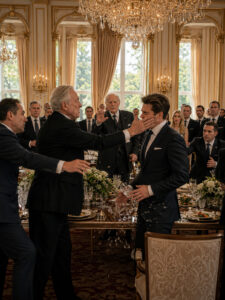
The main formal dining hall of our ancestral estate was packed to maximum capacity with fifty of the country’s most powerful institutional investors, senior banking partners, and high-ranking board members. Crystal chandeliers blazed overhead, casting a dazzling amber glow across the table settings of silver and crystal. My father sat at the very head of the long mahogany table, looking frail, gaunt, and leaning heavily upon his polished walnut walking cane, though his eyes—faded with age but still sharp as broken glass—scanned the room with acute awareness.
I stood at the central podium, clicking smoothly through a sleek, high-definition digital presentation outlining my aggressive master plan to completely liquidate our regional community support sectors, shutter our historical philanthropic foundations, and fully automate our entire customer service workforce using artificial intelligence. I was glowing with intoxicating self-satisfaction, basking in the polite, calculated, synchronized applause of the room.
As I paused for a brief moment to take a sip of iced water from my crystal glass, Samuel walked quietly, ghost-like, up behind my left shoulder. He leaned in close, his voice dropping into a low, respectful murmur meant exclusively for my ears.
“Sir, please excuse the interruption,” Samuel whispered gently. “You just misstated the historical name of the late founding partner on slide fourteen. It was Arthur Vance, not Arthur Sterling. You might want to casually correct the record before opening the floor to Q&A.”
It was a microscopic, trivial error. A minor, fleeting slip of the tongue during a complex thirty-minute corporate presentation that ninety-nine percent of the audience wouldn’t have noticed or cared about.
But in front of fifty titan-tier corporate executives, fueled entirely by my own toxic, fragile vanity and the two glasses of vintage champagne I had consumed during the entrée course, I felt as though a knife had been violently driven into my public prestige and infallible image.
I spun around on my heel with sudden, jerky violence. The sensitive clip-on lapel microphone picked up the harsh, abrasive rustle of my movement, amplifying it through the hall’s state-of-the-art acoustic speakers. My face flushed a violent, mottled crimson with boiling, uncontrollable rage.
“You are just a hired servant, Samuel!” I shouted, my voice cracking with vicious, venomous contempt that echoed off the high marble walls of the dining hall. “Stop interrupting my presentation! Know your proper place in this house, and get the hell out of this room right now!”
The silence that fell over the dining hall was absolute, suffocating, and terrifying. You could distinctly hear the faint, high-pitched electrical hum of the crystal chandelier overhead.
Samuel froze in place. He looked at me, standing tall and rigid in his immaculate black butler’s suit, his thick white hair gleaming under the warm overhead lights. His face remained entirely carved from ancient granite.
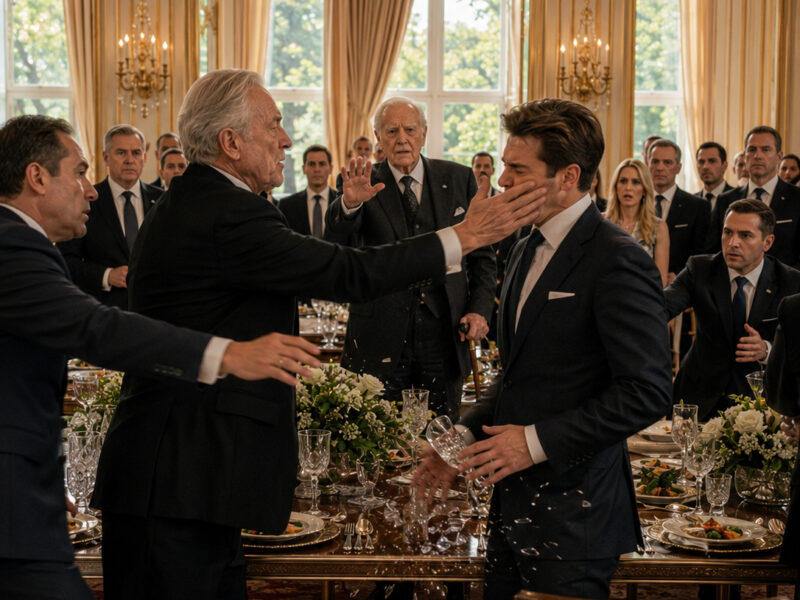
Then, with agonizing slowness and absolute deliberation, Samuel raised his right hand.
Crack.
The sharp, concussive sound of the open-handed slap echoed off the marble walls like a pistol shot in a cathedral.
My head whipped violently to the side from the sheer kinetic force of the blow. A searing, white-hot sting blossomed instantly across my burning cheek, and the inside of my lip split against my teeth, leaving a faint metallic taste of warm blood.
The expensive crystal wine glass slipped instantly from my trembling fingers, plunging toward the floor and shattering against the polished marble in an explosive burst of deep red liquid and glittering, razor-sharp shards.
Two burly, broad-shouldered corporate security guards stationed discreetly near the double mahogany doors instantly reacted to the perceived physical threat, lunging forward with identical low growls, their heavy hands reaching out to grab Samuel’s shoulders to drag him forcibly from the room.
“Get your hands off him!”
The roar did not come from me. It came from the head of the table.
My father stood up. He did not use his carved walnut cane for balance; with a sudden surge of adrenaline, he slammed the heavy wooden base down onto the polished floor with a thunderous thud that commanded absolute, terrified obedience across the entire room.
The security guards froze mid-stride, their boots arrested on the Persian rug. Not a single person in the entire room dared to breathe, let alone move a muscle.
My father walked slowly, deliberately, around the long mahogany table. His steps were heavy, his gait labored, but his dark eyes were locked entirely upon me as I stood clutching my throbbing, red-marked cheek in utter disbelief.
Then, my father walked past me and stopped directly in front of Samuel. He looked at his lifelong brother-in-arms with a deep, profound, and reverent emotion that I had never witnessed him show toward any member of his own biological family.
“You kept your promise after all these years, old friend,” my father said softly, his voice trembling slightly.
Samuel bowed his head respectfully, his voice thick with sudden, suppressed emotion. “I apologize for the scene, Thomas. Though, in truth… I waited far too long to finally do it.”
My father shook his head slowly, a grim, humorless smile touching the corners of his mouth. “No, Samuel. You shouldn’t have waited. You should have struck some sense into him years ago.”
Act IV: The Final Clause of the Master Trust
The entire board of directors sat paralyzed in their velvet chairs, their mouths slightly parted, staring in complete and utter incomprehension at the surreal drama unfolding before them.
My father turned his back slowly upon Samuel, walking toward the center of the dining hall. With a slight gesture of his wrinkled hand, he summoned our family’s senior corporate legal counsel, Richard Lawson, who sat near the corner holding a heavy, secure manila folder embossed with the family crest.
“Julian,” my father said, his voice dropping into a tone of quiet, devastating, and inescapable finality that cut straight to my marrow. “For twenty-five years, I watched you grow up within these walls. I gave you every educational advantage, every financial luxury, and every resource known to modern civilization.”
“Father, what is the meaning of this madness?!” I stammered, my hand still pressed desperately against my burning cheek, humiliation burning like acid through my veins. “He just struck me! Physically assaulted me in front of the entire board of directors! Fire him immediately! Call the police and have him arrested for battery!”
“Shut your damn mouth,” my father said, his voice dropping an octave into a tone so cold it could freeze running water.
He swept his gaze slowly around the room, locking eyes with every trembling, pale-faced executive and investor seated at the table.
“Thirty-five years ago, in a muddy trench far away from this comfort, Samuel and I made an unbreakable covenant,” my father announced to the silent assembly, his voice carrying clearly into every corner of the hall. “We swore upon our lives that if my future son ever grew so blinded by inherited privilege, so corrupted by wealth, and so devoid of basic empathy that he treated a loyal, lifelong servant with cruelty and contempt… he would instantly and permanently forfeit every single legal right to my business empire.”
He paused, letting the crushing weight of his words settle over the room like a shroud.
“Because a man who lacks the basic human capacity to respect the lowest, most vulnerable person standing in his own house is fundamentally unfit to lead human beings anywhere else in the world.”
My father turned sharply to the attorney standing by the wall. “Richard. Open the folder and read the final clause of the master trust agreement.”
Richard Lawson adjusted his wire-rimmed glasses with trembling fingers, carefully unfastened the brass clasp of the cream-colored envelope, and began to read aloud the legally binding addendum that had been filed with the federal courts decades prior.
“The legal inheritance, voting shares, and operational control of the Sterling-Whitmore Global Enterprise shall not automatically pass by bloodline to any biological heir carrying my surname.”
“True corporate and moral leadership requires foundational humility, unshakeable character, and an unwavering respect for human dignity across all social strata.”
“Should my son, Julian, publicly insult, degrade, humiliate, or commit an act of verbal or physical abuse against Samuel Vance prior to the formal, notarized transfer of executive power…”
“His inheritance is legally revoked, his executive authority is permanently and irrevocably suspended, and the board of directors is mandated under corporate charter to appoint an independent, external professional CEO to run the corporation in perpetuity.”
The room spun wildly on its axis.
I staggered backward under the sheer weight of the revelation, catching my hip painfully against the sharp edge of the mahogany table. I stared at my father, my breath coming in short, ragged gasps, my voice breaking into a desperate, hollow whisper.
“You… you planned this? You engineered this entire trap into the legal foundation of the company from the very beginning?”
“No, Julian,” my father replied quietly, stepping closer to me, his gaze full of profound sorrow. “I didn’t plan your failure. I simply understood the corrosive nature of unchecked human power. Money does not change a man; it merely strips away his polite social mask and reveals what he truly is underneath.”
He looked across the room at the stunned, silent faces of the board members.
“And tonight… you proved to every single witness in this room that you are nothing more than a spoiled, arrogant child wearing an expensive executive suit.”
Act V: The Weight of a Morning Bow
The restructuring that followed in the wake of that disastrous night was swift, absolute, and total.
Within forty-eight hours, the board of directors held an emergency vote and unanimously ratified the appointment of an experienced, external corporate turnaround specialist as Chief Executive Officer. My plush executive office on the top floor of our downtown skyscraper—with its breathtaking panoramic views of the city skyline, private wet bar, and imported leather seating—was immediately stripped of my nameplate, my files, and my authority.
I was not fired outright—my father’s legal rehabilitation program stipulated that I had to earn my way back from the absolute bottom if I ever wished to touch a single cent of family capital. I was demoted entirely, stripped of my title, my company car, and my credit cards, and assigned as an entry-level logistics coordinator in the regional supply chain warehouse down on the damp, industrial docks by the river.
There, I traded my Italian wool suits for a high-visibility orange safety vest, steel-toed boots, and a hard hat. I carried clipboards through freezing rain, manually loaded heavy shipping crates onto freight trucks alongside men and women half my age, and worked grueling twelve-hour shifts under warehouse supervisors who knew my infamous background and treated me with zero preferential courtesy.
Every single morning at precisely 6:00 AM, before I caught the early bus down to the docks, I walked through the grand marble foyer of the estate.
Samuel was always there.
He stood by the front door just as he had done for decades, quietly polishing the silver tray, greeting the pale morning light with an unshakeable, quiet dignity, and preparing my father’s morning coffee with the exact same meticulous care he had practiced for forty years.
Nothing in his world had fundamentally changed.
Except for one vital, transformative thing.
Whenever I walked past him in the hallway now, dressed in my dusty worker’s vest, carrying my lunch pail and smelling of diesel exhaust and warehouse cardboard, I no longer marched past him like an entitled heir waiting for his inheritance.
I stopped. I squared my shoulders. And I bowed my head low in deep, genuine, hard-earned respect.
And every single time, Samuel would pause his work, look me directly in the eye with his steady grey gaze, and offer a slow, dignified nod of acknowledgment in return.
It took me twenty-five years of arrogance, a public humiliation, a slap that rattled my teeth, and months of heavy labor in the dirt to finally understand a profound truth that my father and his dearest friend had known since the smoke of the battlefield cleared half a century ago:
The person with the true, lasting authority to shape your character is not always the man who signs your paycheck or hands you an executive title.
Sometimes, it is the quiet, steadfast man standing in the shadows by the door, holding fast to his integrity, ready to save you from your own destruction before it is entirely too late.