NOTHING TO HIDE: Nolan Wells’ close friend vehemently denies allegations related to phone evidence
NOTHING TO HIDE: Nolan Wells’ close friend vehemently denies allegations related to phone evidence
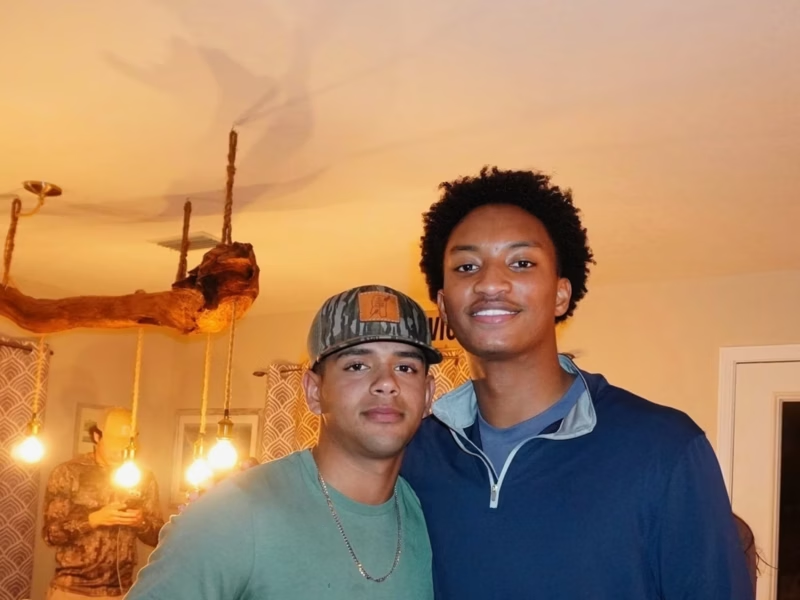
Amidst growing public speculation, Warren Hudson asserted that neither he nor anyone else in the group deleted messages, videos, or any other content from Nolan Wells’ phone. His statement comes as the family’s legal team continues to scrutinize the device for clues.
See more in the comments below 👇
**NOTHING TO HIDE: Nolan Wells’ Close Friend Vehemently Denies Allegations Related to Phone Evidence**
Amid mounting public speculation and intense scrutiny of digital evidence in the death of 18-year-old Nolan Xavier Wells, one of the young men present on the fatal Fourth of July boat trip to Horn Island has issued a direct and forceful denial. Warren Hudson, who has described himself as Wells’ best friend, asserted that neither he nor anyone else in their group deleted messages, videos, photos, or any other content from Nolan Wells’ cellphone. His statement comes as the Wells family’s legal team, led by civil rights attorney Ben Crump, continues to examine the device for potential clues about the teenager’s final hours.
Hudson’s denial, delivered during his recent appearance on conservative commentator Brandon Tatum’s podcast “The Officer Tatum” and echoed in related coverage, addresses one of the most persistent questions surrounding the case. Wells’ parents, Christine Wonsley and Elmore Wonsley, and their attorneys have repeatedly raised concerns that when the phone was returned to the family after the July 4, 2026, outing, significant content appeared to be missing—particularly from Snapchat accounts. The family has described the absence of photos, videos, and messages as highly unusual for a teenager known to document his social activities.
The phone has become a central piece of contested evidence. Wells traveled to the undeveloped barrier island off Mississippi’s Gulf Coast with a group of friends on the morning of July 4. According to accounts from Hudson and others, the group left their phones on the boat while in the water to protect the devices from the murky, sometimes deep conditions around Horn Island. Hudson has explained that it was common practice: “People get on the water to get off their phones… if I’m sitting waist deep in water… everybody’s leaving their phone on a boat. No one’s getting out of the boat with their phone in their hand.” He added that multiple phones belonging to various people were left around the boat’s console that day.
Wells did not return with the boat that experienced bilge-pump failure and began taking on water later that afternoon. His friends returned to the mainland with the phone still aboard. That evening, after realizing Wells had not been heard from, Hudson contacted Christine Wonsley around 11 p.m. and then notified the U.S. Coast Guard. The phone’s location was later tracked via Life360 to a friend’s residence. A family acquaintance retrieved it after some delay, according to accounts from the Wonsleys. When Christine Wonsley and her sister examined the device shortly afterward, they found what they described as empty Snapchat histories on Wells’ accounts—content that typically remains visible for a limited period. They and Crump have characterized the apparent deletions as suspicious and inconsistent with Wells’ usual behavior.
Crump has publicly highlighted the issue, stating that the friends took Wells’ phone when they left the island and that the family is trying to understand why messages appeared deleted upon its return. In interviews, he has linked the phone concerns to other elements of the case, including a bystander video that the family believes captures Wells arguing and demanding, “Give me my freaking phone,” shortly before the group’s departure. Authorities have not publicly authenticated the video or confirmed its relevance, and the Jackson County Sheriff’s Office has continued its investigation without declaring the phone evidence conclusive of any wrongdoing.
Hudson has rejected any suggestion of tampering. In his public comments, he has insisted that no one in the group deleted content from Wells’ phone. Coverage of his interview with Tatum includes his explicit denial of responsibility for any deletions, alongside his broader rejection of rumors linking him or the group to Wells’ death. He has framed the online speculation as harmful and fact-free, reiterating that Nolan was his best friend and that the group acted in an emergency situation focused on saving the boat rather than abandoning anyone.
The phone is now the subject of a joint forensic examination involving both law enforcement and the family’s independent experts. Digital forensics specialists note that modern smartphones often retain recoverable data even after deletions, including timestamps, metadata, and residual traces that can be difficult or impossible to fully erase without specialized tools. Attorneys familiar with such evidence have pointed out that electronic footprints—such as when messages were sent, received, or deleted—can provide a relatively objective timeline that is harder to alter than physical evidence. The ongoing review aims to determine what, if anything, was removed, when it occurred, and whether it holds relevance to the events of July 4.
This digital dispute sits within a larger set of unresolved questions. Officials have stated they have no evidence of foul play and have described Wells’ death as consistent with drowning in challenging waters known for strong currents and rapid depth changes. An independent autopsy commissioned by the family, however, ruled the cause and manner of death undetermined pending further investigation, noting limitations including decomposition and certain anatomical structures retained by the state medical examiner. The official state autopsy and toxicology results remain pending public release.
Hudson’s mother, Jackson County Chancery Court Judge Ashlee Cole, previously released a statement emphasizing her son’s full cooperation with investigators and the account that Wells chose to stay on the island to return later with others after the boat encountered mechanical trouble. Hudson has expanded on that narrative in his interviews, describing a crowded, festive scene with thousands of people and boats, repeated pleas for Wells to board the departing vessel, and Wells’ decision to remain with a girl he had met that day.
The Wells family has consistently challenged the idea that their athletic, phone-attached son would voluntarily separate from his group without communication or his device. They have described Nolan as a young man who stayed connected with family and friends through social media and location apps. The apparent absence of expected Snapchat activity on a holiday outing has reinforced their skepticism. Crump has framed the phone issues, the alleged argument video, conflicting witness statements about whether Wells intended to stay or return, and the delayed recovery of the body as elements that “don’t add up.”
Public interest in the case has remained high, fueled by social media discussion, the involvement of a prominent civil rights attorney, and the racial dynamics of a Black teenager traveling with predominantly white friends to a remote location and not returning with them. Mississippi public safety officials have stated there is currently no indication that race played a role. The Jackson County Sheriff’s Office, working with other agencies and the FBI in some capacity according to reports, has conducted numerous interviews and continues to seek photos, videos, and information from anyone present on or near the northwest tip of Horn Island on July 4.
Hudson’s recent denial forms part of a broader effort by those present that day to address what they describe as damaging and unfounded rumors. He has portrayed the group’s actions as those of friends dealing with a mechanical emergency on a busy holiday, repeatedly offering Wells the chance to leave, and later initiating the missing-person report when he failed to return. The family’s legal team, meanwhile, continues its independent inquiry, including forensic analysis of the phone, while urging a thorough official investigation that leaves no stone unturned.
As the joint examination of Wells’ cellphone proceeds, both sides await results that could clarify whether content was deleted, by whom, and whether it sheds light on the teenager’s movements or communications in his final hours. Forensic recovery, if successful, may reveal timestamps, deleted items, or location data that either corroborate or challenge existing accounts. Until those findings emerge, the phone remains a flashpoint: for Hudson and the group, a device left behind for practical reasons with nothing improper done to it; for the Wells family, a potential source of unanswered questions that demand rigorous scrutiny.
Nolan Wells’ death on and around Horn Island has left his family searching for a complete and credible explanation of how an 18-year-old athlete set out for a holiday celebration and never came home. Warren Hudson’s assertion that he and the others have “nothing to hide” regarding the phone evidence adds a clear public denial to the record. Whether forensic analysis of the device ultimately supports that claim, reveals deletions, or yields other relevant data will form one more critical chapter in an investigation that continues to unfold more than three weeks after the body was recovered. The family’s legal team has made clear it will keep pressing for transparency and answers, while Hudson maintains that the speculation surrounding him and his friends has been both painful and disconnected from the facts as he experienced them on July 4.
The contrast between the two perspectives—Hudson’s denial of any tampering and the family’s insistence that the phone’s condition raised legitimate red flags—underscores the difficulty of reconstructing events on a crowded, remote island with limited formal oversight. As investigators and independent experts dig deeper into the digital record, the hope on all sides remains that verifiable evidence, rather than rumor, will help determine what happened to Nolan Wells in his final hours.