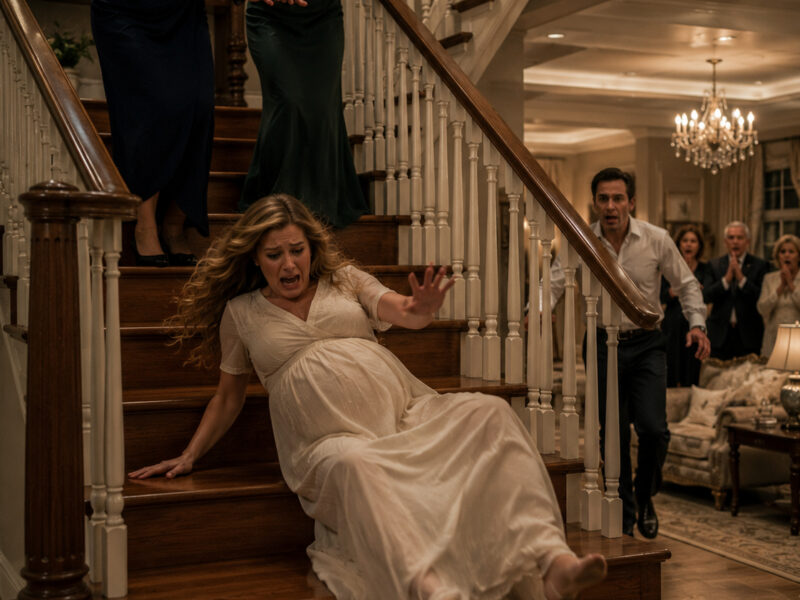
My Mother-in-Law And Sister-in-Law Pushed Me Down The Stairs… Then They Told Everyone I Had Faked The Fall
Chapter 1: The Child’s Canvas and the Pediatric Ward
The pediatric observation room at St. Jude’s Memorial Hospital smelled faintly of antiseptic, warm milk, and cherry-scented disinfectant wipes. Outside, the afternoon rain tapped a restless, erratic rhythm against the tall windowpane, mirroring the nervous thrum and the heavy, unresolved anxiety in my chest.
I sat propped up against a stack of crisp hospital pillows, my left leg immobilized in a rigid brace, my fingers resting lightly over the soft cotton blanket covering my abdomen. Beside the bed, Dr. Harrison—a pediatrician with kind, silver-streaked hair and deeply empathetic eyes—held a sheet of heavy construction paper covered in messy wax crayon strokes.
It was a drawing made by Ethan, my five-year-old nephew, the youngest son of my sister-in-law Victoria.
At first glance, it looked like standard childhood art: clumsy green triangles meant for trees, a blocky yellow rectangle representing the grand façade of the ancestral house, and crude stick figures with oversized heads and smiling mouths. But as Dr. Harrison traced the lines with a blunt finger, the seeming innocence of the drawing gave way to a chilling, photographic accuracy.
“Ethan brought this to the playroom nurse this morning,” Dr. Harrison said softly, his voice carefully measured so as not to alarm the child, who was currently playing quietly with colorful building blocks in the far corner of the room. “When I asked him about it during his routine checkup, he explained it with complete, innocent candor. He said he was just drawing ‘what happened at grandma’s house’ the night you fell down the stairs.”
I stared down at the paper. In the center of the drawing stood a crude figure of a woman wearing a bright blue dress—the exact shade of the designer silk dress Victoria had worn during that fateful Sunday family dinner. The blue figure stood directly behind another stick figure labeled with a scribble resembling a baby bump, both of her hands planted squarely against the figure’s back. To the side, near a series of jagged brown lines representing a staircase, stood an older woman with a severe gray bun—Margaret.
And near the bottom corner of the page, floating in a blank space, was a small stick figure of a man with a crooked tie. Ethan had pointed directly to it earlier and told the nurse with childish matter-of-factness: “Daddy wasn’t there yet.”
My breath hitched in my throat. The drawing captured the exact spatial arrangement of the grand hallway at Margaret Sterling’s estate seconds before I tumbled down the hardwood stairs, losing consciousness while six months pregnant with our first child.
Chapter 2: The Weight of Realization
The hospital door clicked open, and Daniel walked in, carrying a paper cup of lukewarm black coffee. He looked exhausted, the dark circles under his eyes a testament to the sleepless nights he had spent alternating between my hospital bedside and the police precinct downtown where the domestic inquiry was ongoing.
When he saw the paper in Dr. Harrison’s hand, he paused mid-step, his brow furrowing in confusion.
“What’s that?” Daniel asked, his voice rough from fatigue.
Dr. Harrison handed the drawing to him without a word. Daniel looked down at it. As the implications of the crayon strokes washed over him, the color drained completely from his face, leaving him looking hollow and ghost-like. He recognized the blue dress immediately. He recognized his mother’s silhouette by the stairs. And most damningly of all, he recognized the figure at the bottom of the steps—himself, arriving late from the study just in time to see me lying broken at the bottom of the flight.
“Ethan drew this in the playroom,” Dr. Harrison said quietly. “A child’s mind processes trauma through visual recreation. He didn’t understand the malice behind it; to him, it was just a scene he witnessed while playing with his building blocks near the parlor door.”
“He was supposed to be in the media room,” Daniel whispered, his fingers trembling as they gripped the edges of the paper. “Victoria told me… she swore Ethan was watching television upstairs when it happened.”
“Children see everything, Mr. Sterling,” Dr. Harrison replied gently, placing a comforting hand on Daniel’s shoulder before exiting the room to give us privacy.
For a long time, the room was dead silent save for the hum of the heart monitor and the rain outside.
Daniel pulled up a metal chair beside my bed. He didn’t look at me right away; his eyes remained glued to the childish drawing of betrayal. The weight of a horrifying realization was finally crashing down upon him, shattering the illusions he had harbored his entire life.
For eight years of our marriage, whenever a conflict arose between me and his mother or sister, Daniel’s default instinct had been defense. He had been conditioned by a lifetime of emotional manipulation to believe that Margaret could do no wrong, that Victoria was merely blunt, and that I—coming from a modest background—was simply overly sensitive. He had always believed them before he bothered to listen to his wife.
“They lied to me,” Daniel said, his voice breaking, the confession tearing out of his chest like a jagged splinter. “When I ran into the hallway that night, Victoria told me you tripped over your own heels. Mother swore you were rushing down the stairs in a hysterical fit. And I… God help me, I believed them because it was easier than facing the truth about my own family.”
I didn’t say anything. I couldn’t. The physical pain in my body was nothing compared to the hollow ache in my heart, but seeing the absolute devastation in Daniel’s eyes told me that the blindfold had finally, irrevocably been ripped away.
Chapter 3: The Changing Story of the Elite
No one in their right mind could take the drawing of a five-year-old child as the sole piece of legal evidence in a criminal court. Children mix imagination with reality; details can be warped by suggestion, fear, or a desire to please.
However, forensic science and physical reality do not lie.
By the following afternoon, the internal affairs and local police detectives handling the domestic endangerment inquiry had cross-referenced Ethan’s drawing with the physical trauma report, the hospital x-rays, and the precise angle of my fall. The medical examiners confirmed what the crayon lines suggested: the blunt force trauma to my lumbar region and the specific trajectory of my descent were entirely inconsistent with a slip, a trip, or an accidental stumble.
I had been pushed from behind with targeted, deliberate force.
As the legal net tightened around the Sterling estate, the carefully constructed narrative fabricated by Margaret and Victoria began to unravel with breathtaking speed. Realizing that the forensic evidence, the police interviews, and the household staff’s whispered testimonies were pointing directly toward criminal negligence and assault, their confident public denials evaporated into thin air.
They no longer claimed I had “simply fallen.”
Instead, through their high-priced defense attorneys, they shifted their strategy entirely. They began telling detectives a new, watered-down version of events: it was merely a heated family argument, they claimed; a sudden, regrettable scuffle in the heat of a verbal dispute; a tragic accident where a hand placed out of frustration happened to push too hard.
It was just an accident during a family quarrel, their lawyers argued in formal filings submitted to the district attorney. No criminal intent.
But it was far too late for excuses, legal spin, or aristocratic deflection. The mask of perfection had slipped, exposing the rotten core beneath.
Chapter 4: Kneeling at the Bedside
Three days after the medical board filed its conclusive report, the heavy oak door of my private recovery room swung open.
Daniel walked in, holding little Ethan by the hand. Our nephew looked up shyly, clutching a small, slightly crumpled get-well card adorned with a poorly drawn smiley face and clumsy lettering.
Daniel gently nudged Ethan forward. “Go ahead, buddy. Give it to your aunt.”
Ethan stepped up to the edge of the bed, handing me the card with wide, innocent eyes. “I’m sorry your leg is broken, Aunt Sarah,” he whispered softly. “Mommy said you fell down the big stairs because nobody caught you.”
I smiled softly, running my fingers through his soft dark hair. “Thank you, Ethan. That’s very sweet of you.”
Daniel thanked the nurse who had accompanied them, then gently guided Ethan out into the hallway into the care of a family services liaison. When Daniel returned, the casual air of confidence he had worn for the first few years of our marriage was entirely gone. He looked humbled, broken, and profoundly resolute.
He walked slowly to the side of my hospital bed. Without a word of preamble, he lowered himself down.
On the cold linoleum floor of the hospital room, Daniel knelt.
He rested his forearms on the mattress, his eyes welling with hot, unashamed tears as he looked up at me. The man who had once tried to balance the demands of a toxic dynasty with the love of a husband was completely gone, replaced by someone willing to burn that dynasty to the ground for our survival.
“I failed to protect you when you needed me most,” Daniel whispered, his voice thick with emotion, the words trembling as they left his lips. “I let my mother’s voice drown out your truth. I gave them the power to hurt you right under my roof.”
He reached out, his warm palm gently covering my bandaged hand.
“I won’t fail our child again. I swear to God, Sarah, I will never let them anywhere near our family ever again.”
I looked down at him, watching the heavy burden of his realization settle into his shoulders. Slowly, I squeezed his hand back. The forgiveness wouldn’t come easily—the scars, both physical and emotional, ran far too deep for simple words to erase. But as I looked into his eyes, I knew the first step toward healing had finally begun.
Chapter 5: Leaving the Estate Behind
Vengeance and legal battles consumed the next several months. The state prosecutor, armed with the medical reports, the staff testimonies, and the damning consistency of the household evidence, pressed forward with charges. Margaret and Victoria’s names dominated the front pages of the Charleston gazettes, transforming high-society scandals into front-page criminal news. The great Sterling family name was dragged through the mud not by outsiders, but by the weight of their own cruelty.
We didn’t attend the preliminary hearings. We didn’t listen to their desperate pleas for family solidarity or social preservation.
By the time the spring blossoms began to paint the city in shades of pink and white, my leg had healed, and our daughter was born—a healthy, beautiful baby girl with Daniel’s dark hair and a fierce, unyielding cry that filled our new home with vibrant life.
The day we packed our remaining belongings from the temporary apartment we had been renting, Daniel stood in the center of the living room holding a small cardboard box containing our family mementos.
Among the papers was Ethan’s drawing.
For a moment, Daniel stared down at the colored wax lines depicting the blue dress and the staircase. I watched him quietly, wondering if he would throw it away to erase the painful memory, or keep it as a trophy of our survival.
Instead, Daniel carefully slid the drawing into a thick manila folder and placed it at the very bottom of a keepsake chest.
He didn’t keep it as a weapon to use against his mother or sister in future legal battles. He kept it as a quiet, sobering talisman—a permanent reminder that human beings can lie, manipulate, and dress up cruelty in the language of etiquette, but the naked truth is often seen most clearly through the innocent eyes of a child who has never yet learned how to lie.
Chapter 6: A New Horizon and Sanctuary
Two weeks later, our moving truck pulled out of the low-country humidity of Charleston and headed northward toward a quiet, sunlit university town in Virginia where no one knew our last name, our social standing, or our family history.
We bought a modest, single-story house with a wide front porch and a sprawling backyard shaded by a magnificent weeping willow. There were no grand iron gates, no intimidating marble pillars, and no ancestral expectations hanging heavy over the doorways.
On our first Saturday morning in the new house, I sat on the wooden porch swing with a cup of warm tea in my hands. The morning air smelled of damp earth, blooming lilacs, and fresh-cut grass.
Through the open screen door, I could hear the soft, murmuring voice of my husband reading a picture book to our daughter in the living room, punctuated by her tiny, contented gurgles.
A gentle breeze swept across the porch, rustling the wind chimes hanging from the eaves. I looked out over the green lawn where a family of robins hopped across the grass, entirely safe, entirely free.
The past could not be rewritten. The scars on my skin and the memory of that cold marble floor would always remain as silent chapters in our history. But as Daniel stepped out onto the porch, handing me a fresh mug of tea and pressing a soft, lingering kiss to the top of my head, I knew with absolute certainty that we had finally escaped the shadow of the past.
We had built a sanctuary. And in this house, love was no longer measured by how much you were willing to endure for a family name, but by how fiercely you protected the ones who called you home.
Chapter 7: The Lingering Whispers of Charleston
Even hundreds of miles away in our quiet Virginia sanctuary, the shockwaves of the Charleston scandal continued to ripple through society columns and legal circles. The high-profile prosecution of Margaret and Victoria Sterling became a textbook case of aristocratic hubris colliding with modern forensic science. Legal scholars debated the ethics of family loyalty versus criminal accountability on morning talk shows, while local newspapers featured weekly updates on the dismantling of the old-guard estate.
Yet, physical distance was the greatest healer.
Back in our new neighborhood, life assumed a peaceful, predictable cadence. The neighbors knew us simply as Dan and Sarah—a young couple starting fresh with a newborn baby. No one asked about trust funds, corporate dynasties, or family crests. Here, community was measured by a wave across the fence, a shared cup of coffee on a Sunday morning, and the comforting anonymity of ordinary life.
Daniel threw himself entirely into his new work as a senior architectural consultant for a regional firm, using his creativity to design warm, functional family homes rather than managing cold corporate portfolios. Every evening, he returned home before sunset, eager to take over baby-duty, his face free of the perpetual furrowed brow that had defined his final years at Blackwood Manor.
We rarely spoke of his mother or sister. Their names had become ghost words in our household—obsolete terms from a life we had successfully left behind. But the lessons they taught us remained carved into our daily routines like permanent wood grain.
Chapter 8: The Weight of Unspoken Words
One quiet evening, after our daughter had finally fallen asleep in her crib, Daniel and I sat together on the living room rug. The soft amber glow of a single floor lamp illuminated the room, casting gentle shadows across the hardwood floor.
Daniel was holding the thick keepsake chest we had brought with us from Charleston. Inside lay birth certificates, wedding mementos, and at the very bottom, the manila folder containing Ethan’s crayon drawing.
He pulled the folder out, opening it slowly. His fingers traced the edge of the paper where little Ethan had drawn the blue dress, the staircase, and the tiny stick figure representing himself standing near the parlor door.
“Do you ever wonder what would have happened if Ethan hadn’t drawn this?” Daniel asked quietly, his voice carrying a fragile, reflective weight. “If the hospital staff hadn’t found it… would I have ever truly woken up?”
I shifted closer to him, resting my head against his shoulder, looking down at the childish strokes.
“I think the blindfold was already slipping, Daniel,” I answered softly, wrapping my arm around his waist. “The moment you stepped into that ambulance with me, leaving your mother standing at the gates, you chose a path. The drawing didn’t create the truth; it just made it impossible for you to keep hiding from it.”
Daniel exhaled a long, shuddering breath, the kind of deep sigh that releases years of accumulated psychological tension. He gently closed the folder and set the chest aside, wrapping both arms around me and pulling me close.
“I spent my entire childhood believing that protecting the family name meant protecting the people who wore it,” he murmured into my hair. “It took losing you, and almost losing our child, to realize that true protection only flows toward the vulnerable. I was a coward for so long, Sarah. I am so sorry.”
“You aren’t that man anymore,” I whispered back, kissing his cheek. “We broke the cycle. That’s all that matters now.”
Chapter 9: Roots and Branches
Spring transitioned into a lush, vibrant summer. The weeping willow in our backyard grew full and green, its sweeping branches creating a natural canopy over the emerald grass where our daughter now lay on a quilted blanket, kicking her tiny legs and cooing at the floating dandelion seeds.
I sat on the wooden porch steps, watching Daniel push a newly built wooden swing from a sturdy oak branch. He had crafted it himself, spending hours sanding the wood until it was perfectly smooth and safe for a child.
Life had taught us that true security does not come from high brick walls, iron gates, or millions of dollars in a dynastic trust. Security comes from transparency, mutual respect, and the unwavering courage to stand beside the people you love when the world expects you to look away.
Sometimes, when I looked at Daniel playing with our daughter, laughing as she grabbed his finger with her tiny, fierce grip, I thought back to the grand marble foyer of Blackwood Manor. I remembered the cold stone, the shattering crystal, and the terrifying silence before the ambulance arrived.
That night had been an absolute nightmare, a crucible of pain and betrayal that could easily have broken us. Instead, it became the fire that burned away the illusions. It forced us to strip away the expectations of others and build something real from the ashes.
As the sun began to dip below the horizon, painting the Virginia sky in streaks of violet and gold, Daniel walked up the porch steps, wiping a light sheen of sweat from his forehead, a radiant smile on his face.
He sat down beside me, wrapping his arm around my shoulders and pulling me into his side.
“Dinner is smelling amazing,” he noted, inhaling the savory aroma drifting from the kitchen window.
“It’s just simple home cooking,” I smiled, leaning my head against his shoulder. “No imported truffles, no silver platters, no high-society guests.”
“Best kind of meal in the world,” Daniel replied, pressing a gentle kiss to the top of my head.
We sat together in silence as the evening crickets began their familiar twilight symphony, watching the stars flicker to life one by one across the vast, open sky above our home. We were safe. We were whole. And we were finally, truly free.