My Mother-in-Law “Accidentally” Poured Red Wine On My Wedding Dress… The Security Camera Told A Different Story
The Grand Ballroom of the Riverside Hotel had never looked more magnificent. Crystal chandeliers cast a soft golden glow over hundreds of guests in formal attire. Long tables draped in ivory linen stretched beneath cascading arrangements of white orchids and pale roses. At the far end of the room, a raised stage held a large projection screen and a podium bearing the silver emblem of the Harrington Group—the conglomerate founded forty-five years earlier by the man now seated at the honorary table.
Tonight was the celebration of that founding. The entire family had gathered, along with business partners, politicians, and long-time associates. At the center of the family’s attention sat the founder himself, Harold Harrington, eighty-two years old, still sharp-eyed and straight-backed in his tailored midnight suit. Beside him sat his only son, Richard, and Richard’s wife of three years, Elena.
Elena wore a simple but elegant white evening gown of heavy silk. It was not a wedding dress—their wedding had taken place quietly years earlier—but the color and the clean lines made it look bridal under the lights. She had chosen it carefully, wanting to honor the occasion without drawing undue attention. Her dark hair was swept up, a single strand of pearls at her throat. She smiled politely at the guests who came to greet her, though her hands remained folded tightly in her lap.
Across the table, Richard’s mother, Victoria Harrington, surveyed the room with the practiced calm of a woman who had spent decades as the public face of the family’s charitable foundation. Her silver-blonde hair was perfectly coiffed. Her deep crimson gown stood out against the sea of softer colors. She lifted a glass of white wine, took a measured sip, and set it down again.
No one noticed when, a few minutes before the formal program began, Victoria rose and walked toward the rear hallway that led to the restrooms and service corridors. A relative—her younger sister—followed, chatting lightly about the flower arrangements. What neither of them realized was that a discreet security camera, installed after a previous incident involving a leaked conversation, recorded every step and every word.
Inside the ballroom the program began. Speeches were delivered. A short film about the company’s history played. Guests applauded. Then the screen shifted to live footage from various points in the hotel, meant as a light interlude showing the evening’s elegance.
Suddenly the image changed.
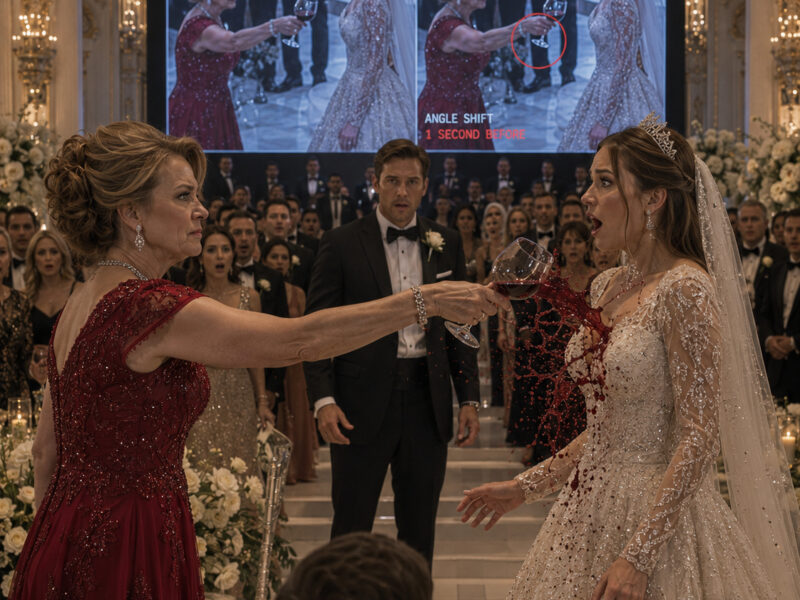
The large screen filled with a clear, high-resolution recording of the rear hallway. Victoria Harrington stood with her sister. In her right hand she held a glass of white wine. In her left, a glass of red. She looked both ways, then deliberately switched the glasses, placing the red wine into her own hand.
Her voice, captured clearly by the microphone, carried through the ballroom speakers.
“Only red is prominent enough on the white dress.”
The room froze.
On the stage, the master of ceremonies stopped mid-sentence. Conversations died. Hundreds of faces turned toward the honorary table.
Victoria’s face drained of color. She pushed back her chair so hard it scraped loudly against the floor and strode toward the stage, her crimson gown swirling around her legs.
“Turn it off!” she demanded, voice sharp and rising. “Turn that screen off immediately! That video has been edited. It is a fabrication. Someone has cut and spliced footage to destroy me!”
She reached the edge of the stage and pointed an accusing finger at the screen. “This is a malicious attack. I demand it be stopped!”
The hotel manager, a calm man in a dark suit, stepped forward from the side of the stage accompanied by the head of security and a technician carrying a laptop. The manager’s voice was measured and clear, carrying easily through the stunned silence.
“Mrs. Harrington, the footage you are seeing is being played directly from our internal secure storage system. It has not left the hotel’s servers. There has been no external editing, no splicing, no alteration of any kind. The timestamp and digital signature confirm it was recorded approximately twelve minutes before the formal program began.”
Victoria’s mouth opened, then closed. She turned as if to argue further, but the organizer of the evening—a long-time associate of Harold Harrington—stepped to the microphone with a quiet smile that held no warmth.
“There is, in fact, a second recording,” he said. “The camera in the service corridor captured additional context. We will play it now.”
The screen shifted again. This time the angle was slightly different, but the scene was unmistakable. Victoria, holding the two glasses, speaking the same words. Then she walked back toward the ballroom entrance, the red wine now in her dominant hand.
The entire audience sat in absolute silence.
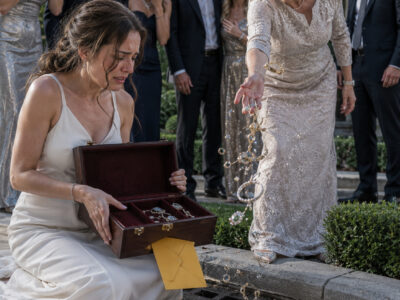
At the honorary table, Richard Harrington stared at his mother as if he had never seen her before. His face had gone pale. Elena sat motionless, the dark red stain already spreading across the bodice and skirt of her white gown where Victoria had “accidentally” bumped into her only minutes earlier during a toast. The wine had soaked quickly into the silk. Elena’s hands rested in her lap; she had not yet spoken a single word.
Harold Harrington rose slowly from his chair.
The founder of the Harrington Group did not hurry. He walked with the deliberate pace of a man who had built an empire through patience and iron will. Guests parted for him without being asked. He crossed the open floor and stopped directly in front of Elena.
With careful fingers he unfastened the heavy silk scarf that bore the embroidered Chairman’s insignia from around his own neck. The scarf was deep navy, edged in silver. He lifted it and gently draped it over Elena’s shoulders, arranging the fabric so that it covered the worst of the red stain on her dress.
Then he turned—not toward Elena, but toward his daughter-in-law by marriage, Victoria—and faced the hundreds of watching guests.
His voice, though aged, carried the authority that had once closed boardrooms and opened markets.
“This dress can be cleaned,” he said. “Character cannot.”
He paused, letting the words settle over the silent ballroom.
“Effective immediately, Victoria Harrington is suspended from every position she holds within the family charitable foundation and from any formal role connected to the Harrington Group. She will leave this gathering now.”
Two security officers moved quietly to Victoria’s side. She stared at her father-in-law, then at her son, then at the room full of people who would not meet her eyes. Not one guest rose to defend her. Not one voice spoke in her favor.
Victoria looked down at the white dress still marked with red, then at the young woman who wore it. A strange, thin smile touched her lips. Without another word she turned and walked toward the exit, the security officers following at a respectful distance. The heavy doors closed behind her.
Only then did the room begin to breathe again.
Harold remained standing beside Elena. He placed a steady hand on her shoulder for a moment, then returned to his seat. Richard still had not moved. His eyes remained fixed on the doors through which his mother had disappeared.
Elena touched the edge of the navy scarf that now rested against her collarbone. The silk was warm from Harold’s body. She looked up at the old man and gave the smallest nod of gratitude. He returned it once, then turned his attention back to the room as if the evening could somehow continue.
But nothing continued in the same way.
The formal program limped to an early close. Guests spoke in low, stunned voices. Many approached Elena to express quiet support; others simply offered sympathetic glances. Richard finally stood, walked around the table, and stopped beside his wife. He did not touch her. He only said, voice rough, “I didn’t know.”
Elena met his eyes. “I know.”
In the days that followed, the story spread through the city’s business circles with the speed of something both scandalous and oddly satisfying. The Harrington Group issued a brief public statement confirming Victoria’s removal from all foundation roles. No further explanation was offered. None was needed. The video had already spoken.
Elena returned the navy scarf to Harold the next morning, carefully cleaned and folded. He refused to take it back.
“Keep it,” he said. “It belongs to the person who needed it.”
She kept it.
Richard asked for a formal separation of living arrangements within the family estate. Victoria moved to a smaller property on the coast. She made no public statements. Those who visited her reported that she spent long hours staring at the ocean, speaking little.
Harold continued to appear at board meetings. His health remained steady. On more than one occasion he was heard to say, when someone mentioned the night of the anniversary, “A company can survive a bad quarter. A family cannot survive a rotten character at its center.”
Elena never wore white to a family event again. She did not need to. The navy scarf with the Chairman’s insignia became a quiet emblem of something stronger than fabric. When people asked about the events of that night, she answered only once, in a private conversation with a journalist who had known the family for years.
“The dress was never the point,” she said. “Anyone can spill wine. What mattered was the intention behind it, and the willingness of someone with real power to name that intention out loud.”
The journalist asked if she felt victorious.
Elena looked down at her hands for a long moment.
“No,” she said. “I felt seen. And for the first time in three years, I felt safe.”
Months later, when the foundation held its annual gala without Victoria’s presence, Harold asked Elena to deliver the opening remarks. She stood at the same podium where the screen had once displayed the hallway footage. Her voice was steady.
“Character,” she said, “is not proven by the speeches we give when everyone is watching. It is proven by the choices we make when we believe no one will ever know. Some stains can be washed from silk. Others remain on the person who caused them. I am grateful to stand in a family that still knows the difference.”
The applause that followed was long and genuine.
In the years that came after, the blue-door wedding shop of another story and the quiet rule of an old seamstress would never intersect with the Harrington ballroom. Yet the principle was the same. Kindness and cruelty both leave marks. One can be stitched over with care. The other, once revealed under bright lights and clear recordings, becomes part of the permanent record.
Victoria Harrington lived another eleven years. She never returned to the foundation. She never publicly acknowledged the video. When she died, the obituaries listed her former titles and the years of service, then fell politely silent about the final chapter.
Elena and Richard rebuilt something quieter and more honest between them. Harold lived to see two grandchildren. On the wall of his private study he kept a single framed photograph from the anniversary night: Elena standing in the white dress, the navy Chairman’s scarf around her shoulders, Harold’s hand resting briefly on her arm. The red stain was still visible beneath the silk, but it no longer looked like damage.
It looked like evidence.
Evidence that truth, once brought into the light, can protect the innocent more effectively than any amount of careful silence.
And evidence that some acts of dignity—small, deliberate, performed in front of hundreds of watching eyes—can restore what malice tried to destroy.
The dress was cleaned, eventually. The scarf remained with Elena. The video remained in the hotel’s secure archive, untouched and unedited, a permanent record of the moment when a lifetime of carefully built reputation collapsed under the weight of a single deliberate choice.
In the end, the thing destroyed that night was never the white silk.
It was the honor Victoria Harrington had spent a lifetime constructing—an honor that proved, under bright lights and unblinking cameras, to have been far more fragile than the fabric she tried to ruin.
**The Stain That Could Not Be Washed Away**
*(continued)*
In the quiet months that followed the anniversary gala, the Harrington estate felt different. The long corridors that had once echoed with Victoria’s decisive footsteps now carried only the softer sounds of staff moving carefully, as if the entire household were still holding its breath. Richard spent more time at the company headquarters than at home. When he did return, he and Elena spoke in measured sentences about practical matters—schedules, the children’s future schooling, the foundation’s next grant cycle—but the deeper conversations remained unfinished.
Elena kept the navy scarf folded in a drawer of her dressing room. Sometimes, late at night, she took it out and ran her fingers along the silver embroidery of the Chairman’s insignia. The silk still held a faint trace of Harold’s cologne, a reminder that power, when used with clarity, could protect rather than destroy. She never wore it again in public, yet its presence steadied her.
Harold Harrington, for his part, made no further public statements about the night. He simply continued to live according to the principle he had spoken aloud in front of hundreds of witnesses. At the next board meeting he requested that Elena be given a formal advisory seat on the foundation’s oversight committee. No one objected. Those who had been present in the ballroom understood that the request was not a gesture of pity. It was recognition.
Victoria’s departure from the main estate was handled with the same quiet efficiency the family applied to difficult business decisions. A smaller coastal property was prepared for her. Staff were assigned. A private driver was retained. She left on a gray morning without ceremony. Richard stood at the top of the steps and watched the car disappear down the long driveway. He did not wave. Elena remained inside.
In the weeks after Victoria’s relocation, letters began to arrive at the estate. Some came from long-time foundation donors who expressed quiet support for the change in leadership. Others came from women who had once worked under Victoria and now felt free to describe patterns of behavior they had previously kept silent about—subtle exclusions, carefully worded criticisms, the slow erosion of confidence. Elena read every letter. She answered none of them publicly. She simply filed them, understanding that truth, once released, continues to surface in its own time.
Richard eventually asked for a private conversation with his father. The two men sat in Harold’s study, the same room where the framed photograph of Elena in the stained dress now hung on the wall.
“I should have seen it earlier,” Richard said.
Harold regarded his son for a long moment. “Most people see only what they are prepared to see. You were raised to believe your mother was the moral center of this family. That belief protected her longer than it should have.”
“And Elena?”
“Elena survived three years of careful, quiet hostility without becoming bitter. That tells me more about her character than any speech could.”
Richard nodded slowly. The conversation did not resolve every tension between father and son, but it marked the beginning of a more honest alliance.
Elena, meanwhile, threw herself into the foundation’s work with a steadiness that surprised even those who had supported her. She reviewed grant applications late into the night. She visited community centers without press escorts. She listened more than she spoke. When journalists requested interviews about the gala incident, she declined. “The work matters more than the story,” she told the foundation’s communications director. “Let the work speak.”
Yet the story refused to fade entirely. In business circles it became a quiet reference point—an example of what happened when private cruelty met public evidence. Younger executives at the Harrington Group began to speak more carefully about integrity in leadership. Some of them had been present that night. They remembered the silence that followed Harold’s words, and the way not a single guest had risen to defend Victoria.
One year after the anniversary, the foundation held its annual fundraising dinner in the same ballroom. The large screen remained dark throughout the evening. No archival footage was shown. Elena delivered the keynote address wearing a deep green gown, simple and elegant. She did not mention the previous year. She spoke instead about the long arc of responsibility—how institutions, like families, are tested not by their stated values but by the moments when those values become costly to uphold.
Harold watched from the honorary table, older now, but still present. When Elena finished, he was the first to stand. The applause that followed was sustained and sincere.
After the dinner, a young woman approached Elena near the edge of the stage. She was a junior grant officer who had joined the foundation only six months earlier.
“I watched the video,” the young woman said quietly. “The one from last year. I know it isn’t public anymore, but someone showed it to me during training. I wanted you to know that it changed how I think about power. About who gets protected and who gets exposed.”
Elena studied the younger woman’s face. “What did you take from it?”
“That silence is never neutral. And that the person who is willing to name the truth in public is sometimes the only one who can stop the damage from spreading.”
Elena nodded once. “Remember that when it becomes inconvenient.”
The young woman left with a slightly straighter spine.
Two years after the incident, Victoria requested a meeting with Richard. They met at a neutral location—a quiet restaurant overlooking the harbor. Victoria looked thinner. The careful armor of her public persona had loosened. She spoke of loneliness, of the difficulty of being cut off from the work that had defined her. Richard listened without interruption. When she finished, he said only, “I will not ask Elena to forgive what you did. That is not mine to request. I will make sure you are comfortable. Beyond that, the distance remains.”
Victoria did not argue. She simply looked out at the water and nodded.
Elena never saw her mother-in-law again. She did not attend the funeral when Victoria passed away eleven years later. Richard went alone. Harold, by then in fragile health, sent a formal wreath and a single sentence of condolence through the family solicitor. The obituaries listed Victoria’s years of service to the foundation and made no reference to the circumstances of her departure. Those who knew the full story understood the silence as a final, restrained form of justice.
In the decades that followed, Elena and Richard raised two children who grew up with a clear-eyed understanding of what integrity required. The navy scarf remained in Elena’s keeping. When their daughter turned eighteen, Elena showed her the scarf and told her the story in full—the wine, the hallway camera, the moment Harold had placed the insignia around her shoulders in front of hundreds of witnesses.
“The dress was cleaned,” Elena said. “The stain came out completely. But that isn’t what mattered. What mattered was that someone with the authority to protect me chose to use it openly, without hesitation, and without trying to soften the truth.”
Their daughter listened carefully. Years later, when she herself faced a quieter form of professional sabotage, she remembered the story and chose to document everything, to refuse the comfort of private compromise, and to trust that evidence, when preserved, could still speak.
Harold Harrington lived long enough to see the foundation’s work expand into new cities. On the wall of his study the photograph remained: Elena in the white dress, the red stain partially covered by the navy scarf, his own hand resting on her arm. Visitors sometimes asked about it. He answered the same way each time.
“That was the night the family remembered what it was supposed to stand for.”
When Harold died, Elena was among those who spoke at the memorial. She did not mention the gala. She spoke instead of a man who understood that institutions are only as strong as the characters of the people who lead them, and that sometimes the most important act of leadership is the willingness to name a wrong in the full light of day.
The ballroom of the Riverside Hotel continued to host gatherings for many years. The security system was upgraded. The cameras remained. Staff who had worked there on the night of the anniversary occasionally told the story to new employees—not as gossip, but as a caution. They described the silence that had fallen over hundreds of guests, the way a single clear recording had dismantled a carefully built reputation, and the quiet dignity with which an old man had covered a young woman’s stained dress before turning to face the person responsible.
In the end, the white silk had been restored. The red wine had been forgotten by most. But the principle Harold Harrington articulated that night remained.
A dress can be cleaned.
Character cannot.
And when the two come into conflict under bright lights and unblinking cameras, the only lasting victory belongs to those who refuse to pretend the stain was ever an accident.
Elena kept the navy scarf until the end of her life. When her own grandchildren asked about the faded silver embroidery, she told them the story one final time, omitting nothing. She wanted them to understand that protection is not always gentle, that truth is not always comfortable, and that the courage to stand in public and say “this is what happened” can alter the course of a family more decisively than any private negotiation.
The scarf, by then threadbare at the edges, was placed in a simple frame beside the photograph from that night. Together they formed a quiet archive of a moment when power was used not to conceal, but to reveal—and when a single deliberate act of dignity proved stronger than a lifetime of carefully managed appearances.
The Harrington Group continued. The foundation continued. The ballroom continued to fill with new guests who knew nothing of the wine or the hallway camera. Yet somewhere in the institutional memory of the family, the night remained: a reminder that some stains are meant to be seen, and that the people who try to hide them often lose far more than the fabric they hoped to ruin.
Character, once tested in public, leaves its own permanent record.
And that record, unlike silk, cannot be sent to the cleaners.