My Mother-in-Law Threw My Mother’s Ashes Into The Trash… She Didn’t Know What Was Hidden Inside The Urn

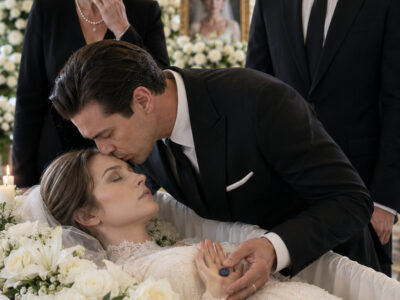
The memorial chapel was deliberately modest. White walls, simple wooden chairs, a single arrangement of white lilies at the front. No grand speeches had been planned. The woman whose life they had gathered to mark had requested only one thing in her final handwritten note: that her daughter be the one to carry her ashes to the sea, alone if necessary, and release them where the tide could take them.
Her name had been Linh. She had raised her daughter, Mai, alone after a brief and difficult marriage that ended before Mai’s fifth birthday. She had worked two jobs for most of her adult life—day shifts at a small accounting office, evening shifts cleaning offices in the financial district. She had never complained in public. She had simply saved, planned, and prepared for a future she might not live to see.
Mai stood at the front of the chapel now, thirty-one years old, seven months into a marriage that had already begun to show its fractures. Her husband, Dominic, stood slightly behind her. His mother, Patricia, occupied a chair in the first row with the rigid posture of someone accustomed to controlling the tone of every room she entered. Dominic’s grandfather, Raymond, had arrived only an hour earlier from the coast, still in the dark suit he had worn for the train journey. He sat at the end of the row and said very little.
The urn sat on a small table draped in white cloth. It was plain ceramic, the color of river stone, chosen by Linh herself months earlier when the diagnosis had become final. Mai had kept it in her apartment since the cremation. Today was meant to be the quiet transfer: a short gathering of relatives, a few words, and then Mai would take the urn home until the weekend, when she would drive to the sea and keep her promise.
Patricia had other ideas.
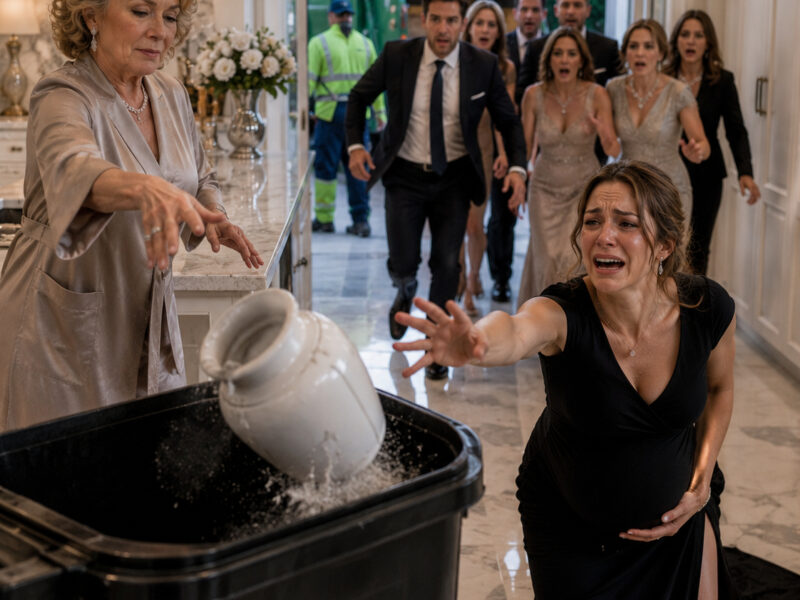
During a brief moment when Mai stepped away to speak with the chapel attendant, Patricia rose, picked up the urn, and carried it toward the side door that led to the service corridor. Her voice, low but sharp, carried just far enough for several people to hear.
“This is excessive. We can dispose of it properly later. There is no need to make a performance of scattering ashes. It only draws attention.”
Dominic moved to intercept her, but not quickly enough. Patricia had already reached the corridor and was speaking to a junior staff member about “removing unnecessary items before the formal part begins.”
Mai returned to the empty table and understood at once. She walked into the corridor, took the urn from Patricia’s hands without raising her voice, and carried it back to the center of the chapel. The room had gone still. Every person present now watched.
Dominic stepped forward. His face had lost color. “Mother. Put it down. This is not yours.”
Patricia’s expression tightened. “I am trying to spare everyone unnecessary drama. Your wife’s mother is gone. Lingering over remains helps no one.”
Raymond, who had remained silent until that moment, rose from his chair. The old man’s voice was quiet and carrying.
“Open it.”
Dominic looked at his grandfather, then at Mai. Mai nodded once. With steady hands she set the urn on the table again and stepped back. Dominic lifted the lid.
The top layer was exactly as expected: a sealed, heavy plastic bag containing the ashes, carefully closed with the funeral home’s official seal. Beneath that bag, however, the interior of the urn continued downward into a second, hidden compartment. The ceramic had been crafted with a false bottom, a detail only the funeral director and Linh herself had known.
Dominic reached in and removed three items.
A fireproof USB drive, black and unmarked.
A savings passbook from a local bank, its pages filled with decades of small, regular deposits.
And a sealed envelope addressed in Linh’s precise handwriting to her daughter.
Mai took the envelope first. She opened it in full view of the room and read the letter aloud because she wanted no one to claim later that the contents had been private or exaggerated.
Linh had written that she did not trust the period after her death to be free of dispute. She had seen enough families fight over far smaller things. She had therefore asked the funeral home to create a double-walled urn so that certain documents could remain with her remains until the day Mai herself carried them to the sea. Only then were they to be removed.
The USB, the letter explained, contained the complete records of a modest scholarship fund Linh had established in secret over the previous fifteen years. The fund was designated for any future grandchildren Mai might have, regardless of the circumstances of their birth or the state of Mai’s marriage. It also contained a final audio recording.
The savings passbook represented everything Linh had managed to set aside beyond the scholarship money—her life’s careful surplus, intended as capital for Mai if the marriage ever became unsafe or unstable.
Dominic’s hands were no longer steady. He plugged the USB into the small speaker the chapel kept for music. Linh’s voice filled the room—calm, slightly hoarse from illness, but unmistakably herself.
“If you are hearing this, it means you kept your promise to take me to the sea yourself. I am proud of you for that. Do not let anyone make you feel that your family is less valuable than theirs. You come from a woman who worked every day of her life so that you would never have to beg for dignity. Remember that when people try to measure you by their money or their name. You already have everything you need.”
The recording ended.
No one spoke.
Raymond turned to his daughter. The disappointment in his face was older and deeper than anger.
“You just attempted to throw into the trash not only a mother’s ashes,” he said, “but your own dignity. In front of witnesses.”
Patricia’s composure cracked. Tears came suddenly, followed by a rush of explanations—misunderstanding, concern for appearances, an attempt to protect the family from unnecessary emotion. No one stepped forward to accept the explanations. Dominic stared at the floor. Mai simply reached out and took the urn back into her arms, holding it against her chest the way she might have held her mother in the final weeks.
The gathering ended shortly afterward. Guests left in near silence. Raymond spoke briefly with Mai near the door.
“When you go to the sea,” he said, “you go with my respect. And if anyone in this family attempts to interfere again, you come to me directly.”
Mai thanked him once, quietly, and left with the urn.
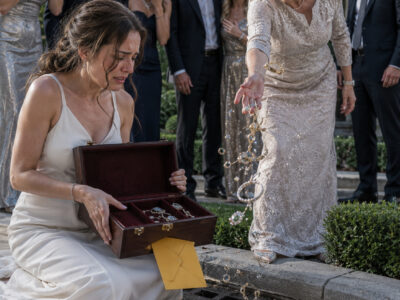
Three days later she drove alone to the stretch of coast her mother had loved. The sky was clear. The wind moved steadily offshore. She walked to the edge of the low cliff where the water met the rocks and opened the urn for the last time. She removed the sealed bag of ashes, then the USB, the passbook, and the letter, placing them carefully in her bag. Then she released the ashes into the wind.
They rose, scattered, and disappeared toward the open water.
Mai stood for a long time afterward with one hand resting on the empty ceramic. She understood then what her mother had truly left behind. The money would matter if it was ever needed. The scholarship fund would matter for children not yet born. But the most valuable inheritance was the sentence in the recording and the sentence in the letter: the clear, unbroken reminder that dignity is not granted by marriage or by in-laws or by anyone else’s ledger of status.
It is carried. It is protected. And when necessary, it is defended in public, even when the cost is the approval of people who never deserved to measure it in the first place.
Mai returned to the city that evening with the empty urn and the three items that had traveled inside it. She placed the passbook and the USB in a safe-deposit box the following morning. The letter she kept in her bedside drawer.
Dominic came to her apartment two days later. He did not ask to reconcile immediately. He asked only whether she would allow him to listen to the recording once more. She played it for him without commentary. When it finished, he sat with his head in his hands for a long time.
“I should have stopped her the moment she touched the urn,” he said.
“Yes,” Mai answered. “You should have.”
The conversation that followed was difficult and incomplete. It did not repair everything. It did, however, mark the first time Dominic fully acknowledged that his mother’s behavior had not been a misunderstanding. It had been a choice. And choices, once made in front of witnesses, could not be rewritten by tears or apologies offered too late.
Raymond arranged a private meeting with Patricia the following week. No one else was present. When Patricia returned to her own house afterward, she canceled the remaining social engagements on her calendar and made no further attempts to contact Mai directly.
The marriage between Mai and Dominic did not end in the following months, but it changed shape. Certain subjects became non-negotiable. Certain people were no longer granted automatic access. Mai continued to work, continued to save, and continued to carry the quiet certainty her mother had placed in her hands along with the ashes.
A year after the memorial, Mai drove to the same stretch of coast again. This time she carried only a single white flower. She stood at the same edge of rock and spoke aloud, though no one was there to hear.
“I kept the promise. I kept all of them.”
The wind moved through the grass behind her. The water below remained indifferent and constant. She stayed until the flower had been carried out of sight, then returned to the car.
In the years that came after, the scholarship fund quietly began to support its first recipients—students who would never know the name of the woman who had cleaned offices at night so that the money could exist. The savings passbook remained untouched, a reserve that gave Mai a freedom she never advertised. The recording she played only rarely, usually on the anniversary of the day she had taken the ashes to the sea.
Each time she heard her mother’s voice, the same sentence settled over her with renewed weight.
Do not let anyone make you feel that your family is less valuable than others.
Mai had learned the truth of it in a chapel, in front of people who had been prepared to discard both ashes and dignity for the sake of appearances. She had carried that truth to the water and released everything else. What remained was simpler and stronger than any inheritance measured in currency or status.
She had been given the knowledge of her own worth by a woman who had spent a lifetime proving it through work rather than words. And she had been given, in the most public and painful way possible, the confirmation that some people would never understand that worth—and that their misunderstanding no longer had the power to define her.
The urn stayed on a shelf in Mai’s apartment, empty now, its secret compartment open and unnecessary. Visitors sometimes asked about it. She answered only that it had belonged to her mother, and that it had done its final work.
The rest of the story she kept for herself, for the children she might one day have, and for the quiet moments when she needed to remember that the most important things a parent can leave behind are not always the ones that can be held in the hand.
Sometimes they are the ones that remain after everything else has been released into the wind.
**The Double Urn**
*(continued)*
In the months after Mai released the ashes, the city continued its ordinary rhythm, indifferent to the private recalibrations taking place inside one small family. Mai returned to work. She answered emails. She attended the required social obligations that came with Dominic’s position, though she no longer stayed longer than necessary. The empty urn remained on the shelf in her apartment, a quiet marker of a promise kept.
Dominic moved through the same days with less certainty than before. The recording of Linh’s voice had settled into him like a stone dropped into still water. He replayed it once, alone, late at night in his office, and then did not play it again. The words required no repetition. They had already done their work. He began, slowly, to examine the patterns he had previously accepted as normal: the way his mother’s opinions had shaped every family gathering, the way certain subjects were never allowed to surface, the way Mai’s background had been treated as something to be managed rather than respected.
Patricia made one further attempt at contact. She arrived unannounced at Mai’s apartment on a weekday afternoon carrying a small boxed cake and an expression of careful contrition. Mai did not invite her inside. They spoke on the landing for less than ten minutes. Patricia offered explanations that circled the same ideas—stress, misunderstanding, a desire to protect the family’s public face. Mai listened without interruption and then answered with the same calm she had shown in the chapel.
“You tried to discard my mother’s remains. You did it in front of people who will remember. I am not required to help you rewrite that.”
Patricia left the cake on the floor outside the door. Mai threw it away unopened.
Raymond visited twice in the following season. He did not come to mediate. He came to sit in Mai’s small living room, drink tea, and speak about the practical matters of the scholarship fund Linh had established. The old man had examined the documents on the USB with the thoroughness of someone who had spent a lifetime reading contracts. He confirmed that the fund was legally sound, modest but carefully structured, and entirely independent of the Langston family’s money. He offered to serve as an informal advisor if Mai ever wished it. She accepted the offer with quiet gratitude.
“Your mother understood something many people with far more resources never learn,” Raymond said on his second visit. “Dignity is not inherited. It is maintained. She maintained hers long enough to place a piece of it in your hands.”
Mai kept the savings passbook in the safe-deposit box alongside the USB. She did not spend the money. She did not speak of it. Its existence alone altered the internal balance of her marriage. She no longer felt the subtle pressure to remain silent for the sake of financial security. The knowledge that she could leave, if leaving became necessary, changed the way she entered every difficult conversation.
Dominic noticed the change. He did not resent it. In the clearer light that followed the memorial, he recognized that the imbalance had always been there; he had simply been protected from seeing it by the same system that had produced his mother’s behavior. The marriage did not collapse. It narrowed. Certain topics became closed. Certain relatives were no longer automatically included. The process was neither dramatic nor cruel. It was simply the necessary adjustment that follows the public revelation of private contempt.
A year after the ashes had gone into the wind, Mai drove to the coast again. This time she brought no flower and no ceremony. She stood at the same edge of rock and watched the water move. She thought of the double walls of the urn, of the funeral director who had agreed to the unusual request, of the decades of small deposits that had filled the passbook page by page. She thought of her mother’s voice saying that she already had everything she needed.
The sentence had seemed simple when she first heard it in the chapel. In the year that followed it had become a working principle. Mai applied it when Patricia’s name surfaced in conversation. She applied it when Dominic’s colleagues made casual assumptions about her background. She applied it when she caught herself measuring her own worth against the larger houses and older names that surrounded her husband’s family. Each time the principle held.
Grace was not yet born when the urn was opened, but the scholarship fund Linh had created would eventually reach children who carried both Mai’s blood and Dominic’s. Mai made certain the fund’s terms remained exactly as written. No amendments were requested. No family names were added for the sake of appearances. The money would go to education, nothing else. Linh had been clear about that.
When Mai eventually became pregnant, she informed Raymond before she informed Patricia. The old man received the news with a brief, genuine smile and a single practical question about the hospital. Patricia learned of the pregnancy through Dominic and sent a formal note of congratulations that Mai read once and filed away without reply. The boundary held.
The child was born in the early hours of a weekday morning. Dominic was present. Raymond arrived later the same day and sat in the hospital chair with the stillness of someone who understood the weight of new life. He looked at the infant for a long time and then at Mai.
“She would have been proud of the way you protected what she left you,” he said.
Mai nodded. She did not need to ask which “she” he meant.
In the years that followed, the empty urn remained on its shelf. Visitors to the apartment sometimes asked about it. Mai’s answers were brief and consistent. It had belonged to her mother. It had served its purpose. The rest of the story she kept for the moments when her own daughter was old enough to hear it in full—the chapel, the false bottom, the voice on the USB, the old man’s public rebuke, and the long drive to the sea.
She wanted the child to understand that inheritance is not only what is given. It is also what is refused. Linh had refused to leave her daughter unprotected. Mai had refused to allow that protection to be dismissed. The refusal had cost the approval of certain people. It had also preserved something that no amount of social acceptance could replace.
Dominic grew into a more careful man. He never became perfect. He still carried the habits of a childhood spent inside a hierarchy that valued appearance over substance. But he had heard Linh’s voice, and he had watched his own mother attempt to discard a woman’s remains for the sake of convenience. Those two facts remained with him. They altered the way he spoke to his wife and the way he would one day speak to his child about respect.
Patricia lived out her later years at a slight remove from the center of the family. She was not banished. She was simply no longer granted the authority she had once assumed. The difference proved permanent. At large gatherings she occupied a polite seat at the edge of the conversation. No one asked her to take charge of arrangements. No one consulted her on matters involving Mai or the children. The exclusion was quiet and collective, the natural result of a moment that had been witnessed by too many people to be rewritten.
Raymond died four years after the memorial. In his will he left a small personal bequest to Mai with a handwritten note that read only: “For the daughter who kept her word.” Mai used none of the money for herself. She added it to the scholarship fund.
On the tenth anniversary of the day she had carried the ashes to the sea, Mai returned once more to the same stretch of coast. This time her daughter walked beside her, old enough now to understand a simplified version of the story. They stood together at the edge of the rock while Mai spoke of a woman who had worked night shifts and saved in secret and arranged a double-walled urn so that certain truths could not be taken away.
“She made sure I would never have to ask anyone else for permission to keep my dignity,” Mai said. “That is what I want you to remember about her.”
The child listened. The wind moved across the water. The empty space where the ashes had once been held nothing now except the sound of the tide.
Mai had learned, in the long arc of years since the chapel, that the most important things her mother left behind were not the ones that could be deposited or invested. They were the ones that remained after every material object had been accounted for: the refusal to be diminished, the insistence on a promise kept, and the clear-eyed knowledge that some people will always measure others by the wrong scales.
She had been given that knowledge in the most public way possible, in a room full of witnesses, with her mother’s voice speaking from a device hidden beneath a sealed bag of ashes. She had carried it to the sea and released everything else. What stayed with her was lighter than ceramic and stronger than any family name.
It was enough.
It remained enough.
And on the days when the old pressures resurfaced—when a casual remark or a pointed silence tried to reopen the question of her worth—Mai returned, in memory, to the moment she had opened the false bottom of the urn and found, waiting for her, the exact proof that she had never needed anyone else’s permission to stand upright.
The urn stayed empty.
The promise stayed kept.
The voice on the USB stayed clear.
And the woman who had once cleaned offices at night continued, long after her ashes had disappeared into the wind, to protect the daughter she had raised to need no one’s validation but her own.