In just a few seconds, everything was turned completely upside down: Witnesses to the Lewes train derailment recount the 30 seconds they experienced

**HAPPY TO BE ALIVE**
**Bloodied passengers describe horror of being thrown from seats as train derailed and flipped at speed – with 20 hospitalised**
Bloodied and battered passengers yesterday spoke of their sheer relief at surviving a terrifying train derailment that sent carriages tumbling onto their sides at high speed near a busy Sussex station.
Survivors described being violently thrown from their seats, slammed into walls and windows, and dragged along the floor as the Southern service from London Victoria to Eastbourne left the tracks just north of Lewes shortly before 4pm on Thursday. Three of the eight carriages overturned, trapping some passengers inside as the train skidded and slid into the heathland beside the line. Around 150 people were on board. Twenty were later taken to hospital, two of them with serious injuries. There were no fatalities.
“I’m just happy to be alive,” one bloodied passenger said after being helped from an overturned carriage, his clothes stained and face marked by cuts. Others echoed the same stunned gratitude amid the chaos of screaming, dust, and the sudden inversion of their world.
The 14:24 service had been running delayed. Passengers later said they felt the train pick up speed, perhaps trying to make up time, before everything changed in seconds. The rear carriages began rocking violently. Then came a series of bangs, a sickening jump, and the sensation of flying before the carriages tipped and crashed onto their sides.
Rachel Heath, who was on board, recalled the moment the world turned upside down. “The train started rocking violently and then I remember clocking eyes with this guy and then there was a lot of screaming,” she said. “It felt like we flew in the air and the carriage landed on its side and it slid. I felt like it was going to completely flip over. There was a mum who was bleeding from her mouth and a dad and his son who had cuts. It was like a movie.”
Charlie Hobden, 31, from Lewes, was in one of the carriages that rolled. “It felt like a sliding snake,” he said. “We just went over and we were dragging along the floor. We tried to open the doors and then we saw people standing on top of the train and so we managed to get out on our own. Others waited and got on ladders to get out.” He escaped without injury and was assessed at the scene before being allowed home.
Nathan Cole, 30, was at the very back of the train and took the full force of the derailment. Facing backwards at the moment of impact, he watched the landscape outside his window transform into a wall of dirt and soil. “I’m looking out the window and I’m seeing dirt. I’m thinking I hope this window doesn’t bust because if the window breaks it’s going right in my face,” he said. He saw a woman fall past him “from the sky.” When the carriage finally stopped, dust filled the air and the smell of soil was everywhere. The left side of the carriage had become the sky. He tried to open a door above him but it would not budge.
Yana Ludwig, 56, an American graduate student travelling alone from London to Lewes, described the experience as “completely terrifying.” “There was a banging. Everything just went topsy turvy,” she said. “It seemed like a really long time but it probably was ten seconds of that before the carriage actually fell on the side.” She found herself propped up over another passenger and admitted she was “pretty banged up.” She estimated it took around 20 minutes for emergency services to reach them in what felt like a difficult location. Despite the fear, she noted how people immediately checked on one another. “These moments everybody kind of pulls together.”
Rob Bradley was travelling with his six-year-old daughter Mabel in one of the carriages that remained upright. He felt the train speed up and begin to rock before their carriage jumped vertically. The emergency brakes slammed on and everything was thrown forward. Looking back, he saw the carriage behind flipped onto its side and sliding down an embankment into a field. He and his daughter were unhurt, but he saw passengers from the overturned coaches with blood on their heads and clothes. Another traveller told him a window had shattered, cutting people.
Liton Miah from Eastbourne was on the train with his wife and daughters, heading to see relatives in London. The train overturned near Lewes. He suffered heavy bruising to his side but managed to protect his family and tried to help a bleeding couple. “The guy was bleeding heavily and there was not much I could do to help him,” he said. The family were taken to a local community centre where injured passengers were being triaged.
Tracy McGregor was in carriage seven, one of the three that left the tracks. She praised the passengers in the unaffected carriages who walked along the roofs of the overturned coaches and opened the doors so people could escape. “The train started swinging after we went over a stretch of track – we were delayed en route so we think the train might have been going quick to make up time,” she said. She described the train as full of “brilliant people” who showed “lots of camaraderie.”
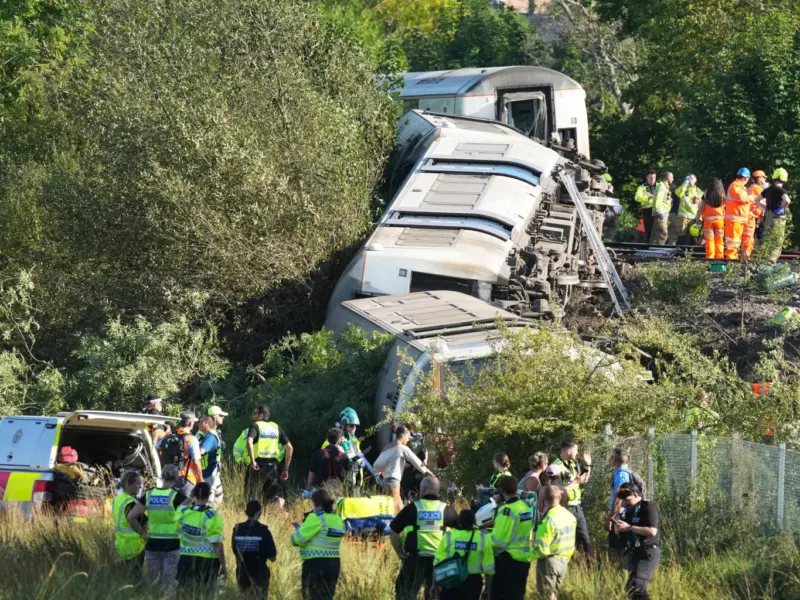
Other passengers reported similar scenes of pandemonium: luggage flying, bodies tumbling, the sudden inversion of seats becoming the floor and windows becoming the ceiling. Some climbed out through doors that were now above their heads and stood on the side of the carriages, waiting for help or making their own way down. Others remained trapped until firefighters and police could reach them with ladders and cutting equipment.
Emergency services responded in force. British Transport Police declared a major incident. South East Coast Ambulance Service sent more than 20 ambulances. Three air ambulances attended. East Sussex Fire and Rescue deployed ten fire engines, technical rescue units and a command support unit. Sussex Police also attended. Passengers not requiring hospital treatment were taken to Landport Community Centre for support. An air ambulance was seen taking off from the scene later in the afternoon.
Official figures confirmed two people sustained serious injuries and were taken to major trauma centres. A further 18 suffered less serious injuries. In total, around 20 people were hospitalised after some self-presented at hospital. All passengers were eventually evacuated safely. The Rail Accident Investigation Branch deployed a team of inspectors to the site. The cause remains under investigation. It is not yet known whether a track defect caused the derailment or whether the track buckled as a result of the incident.
Network Rail closed the lines between Haywards Heath and Lewes until further notice. Services through the area were cancelled for hours, with major disruption expected into the evening. Cooksbridge and Plumpton stations were not served. Southern Railway warned of significant delays. Transport Secretary Heidi Alexander said she was “deeply concerned” by the reports and thanked the emergency services working at the scene. The Transport Salaried Staffs’ Association also expressed concern for passengers, rail staff and responders, stressing that welfare must be the immediate priority.
Local residents rushed to help. Some directed shocked passengers toward the community centre. Others brought chairs so the injured and shaken could sit. One resident who spoke to people from the rolled carriages said many were “really bruised” but remarkably composed given what they had just endured.
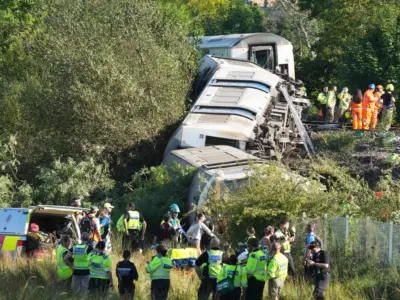
The derailment occurred on a warm afternoon during a period of high temperatures across the UK. Working in the heat added to the difficulty for emergency crews as they treated the injured in the open field beside the tracks. Photographs from the scene showed the rear three carriages lying on their sides, emergency vehicles lined up, passengers standing on the upturned metal, and paramedics treating people on the grass.
For many of those who walked away, the dominant emotion was simple survival. They had been thrown about like rag dolls inside metal tubes that suddenly refused to stay upright. They had seen blood, heard screams, and felt the train slide across the ground. Windows that should have shown countryside instead showed dirt and sky. Seats that should have held them instead became obstacles or projectiles.

Yet most climbed out. They helped one another. They waited for ladders or found their own way down. They sat in the community centre or in ambulances and later told their stories with a mixture of residual fear and profound relief.
“I’m happy to be alive,” became the quiet refrain among the bloodied and the bruised. In the chaos of a derailment that flipped carriages at speed and hospitalised 20 people, that simple statement carried the weight of everything that could have been far worse.
Investigators will now examine the track, the train, the speed, and the sequence of events that turned an ordinary afternoon journey into a scene of overturned carriages and emergency lights. For the passengers who lived through those terrifying seconds, the investigation is secondary. They are home. They are breathing. They are, against the odds of metal and momentum, still here.
The full scale of the disruption continued into the evening as rail operators worked to restore services and clear the line. For the 150 people who boarded the 14:24 at Victoria that afternoon, the journey ended not at Eastbourne but in a field near Lewes, amid dust, blood, and the overwhelming realisation that they had survived.
Many will carry the memory of the rocking, the jump, the slide, and the sudden silence after the screaming for a long time. Some will remember the stranger whose eyes they met in the moment of impact. Others will remember the hands that pulled them free or the ladders that appeared against the side of the carriage. All of them will remember the simple, powerful fact that they walked away.
Happy to be alive.