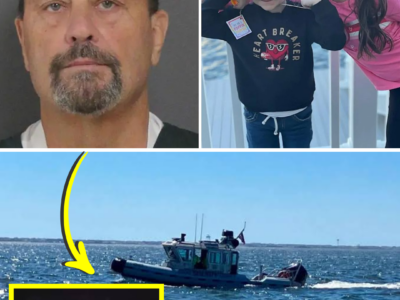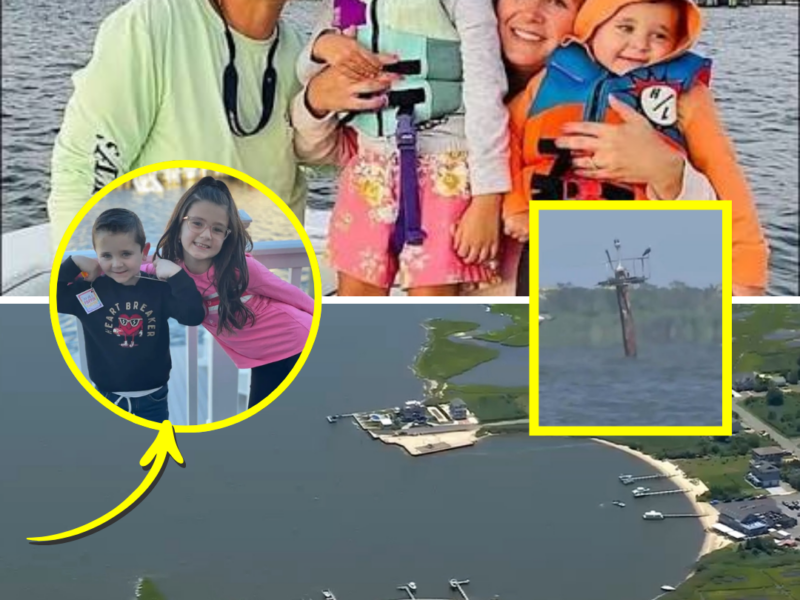
FINAL 911 CALL: Chaotic moments following the disappearance of two children in the dark waters of the bay are being pieced together. A family outing on Barnegat Bay turned into a desperate race against time when 9-year-old Mya and 7-year-old Sigmund were thrown from their boat. Bystanders immediately searched the darkness and pulled the two children back to safety. Details from the emergency call are helping investigators reconstruct the minutes following the collision—from the moment the children went overboard until rescuers arrived. This article reconstructs the details of the rescue operation.
On the night of July 19, 2026, a short boat ride across Barnegat Bay ended in a desperate scramble against darkness, time, and the unforgiving water. Shortly after 9 p.m., the 28- to 30-foot Tidewater center-console boat operated by Stephen Schneider struck Intracoastal Waterway channel marker No. 39. The impact threw 9-year-old Mya Bella Golabek and 7-year-old Sigmund Paul Golabek from the bow into the bay. What followed were chaotic, critical minutes that investigators have pieced together from the emergency call, statements, and the actions of those on scene.

An emergency call was placed at 9:09 p.m. reporting a serious vessel crash in the Berkeley Township area of the bay. New Jersey State Police troopers were dispatched and arrived in the area by approximately 9:19 p.m. In the intervening window—roughly ten minutes from the report—the grandparents and arriving first responders fought to locate and recover the children in the dark.
According to the affidavit of probable cause and Schneider’s statements to investigators, the collision ejected both children, who had been seated at the front of the boat wearing life jackets. Schneider said he immediately began searching the water. In the darkness he located his grandson, Sigmund, first. He then found Mya. Both children were face-down and unresponsive. CPR was started at once on the boat.
Berkeley Township Councilman James Byrnes later described the arrival of firefighters at the scene near MJ’s Restaurant Bar and Grill on Bay Boulevard, close to where the boat was brought in or met by responders. “The firemen jumped right in” to assist, Byrnes said. One child was observed with a life jacket next to him during the resuscitation efforts; the jacket would typically be removed to allow effective CPR. Rescue crews staged near the pier at the restaurant. The children were transported with CPR continuing to Community Medical Center in Toms River, where they were pronounced dead.
State troopers from the Marine Bureau at Point Pleasant Station and members of the U.S. Coast Guard also responded following the 9:09 p.m. call. Laurie Schneider, the children’s grandmother and the other adult aboard, was not seriously injured and declined medical treatment at the scene. Schneider himself displayed visible signs of impairment and was later taken to the same hospital, where a blood sample was obtained under warrant. That sample would later show a blood alcohol content of 0.16 percent.
The sequence reconstructed by investigators runs as follows: the impact occurred shortly after 9 p.m.; the emergency call came in at 9:09 p.m.; the grandparents recovered the children from the water and began CPR; first responders, including firefighters who entered the water, continued efforts at or near the shoreline by MJ’s; state police and Coast Guard assets arrived; the children were rushed to the hospital with ongoing resuscitation; and both were pronounced dead upon or after arrival.
No full public transcript of the 911 call has been released. Details available through court documents and contemporaneous reporting indicate a report of a serious vessel crash involving children in the water. The call triggered a multi-agency response that included marine units capable of operating on the bay at night. The proximity of the restaurant and the decision to return the boat toward that familiar shoreline appear to have shortened the distance to help, yet the combination of darkness, the force of the ejection, and the time required to locate the children in the water proved decisive.
The children’s life jackets, while properly worn, did not prevent them from being found unresponsive. Once recovered, continuous CPR was the primary intervention until hospital arrival. The rapid actions of the grandparents—searching immediately, recovering both children, and initiating CPR—represent the first and most critical phase of the rescue. The arrival of firefighters who entered the water and the subsequent transport with ongoing efforts formed the second phase. Despite these measures, the injuries sustained in the collision and immersion were fatal.
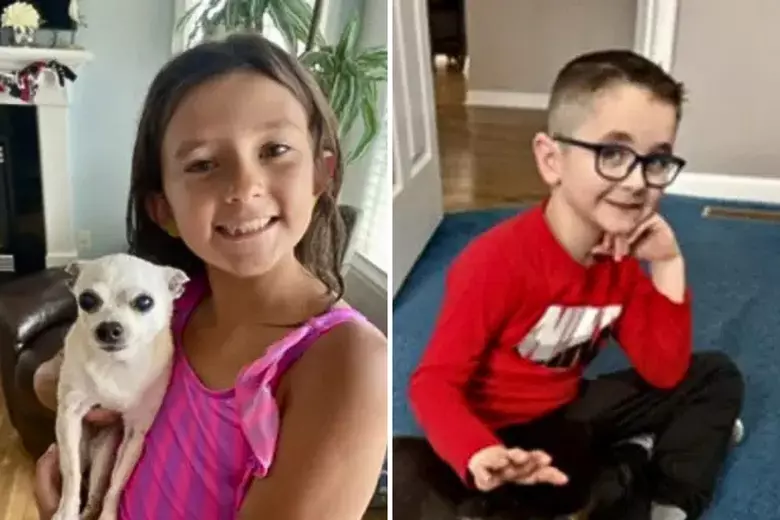
Investigators have used the timing of the emergency call, the statements of those aboard, and the observations of first responders to map these minutes. The call at 9:09 p.m. fixed a documented start to the formal response. The roughly ten-minute window until troopers reached the area, combined with the grandparents’ prior recovery of the children, frames the period of highest urgency. In that interval, two children who had been on a short evening boat ride after dinner were pulled from the bay and subjected to desperate efforts to restore breathing and circulation.
The reconstruction does not alter the outcome. Mya and Sigmund did not survive. Yet the details of the response—immediate search by family, recovery from the dark water, on-scene CPR, firefighters entering the bay, multi-agency arrival, and continued resuscitation during transport—illustrate how quickly the situation escalated from a navigational collision to a life-or-death emergency on Barnegat Bay. Those chaotic minutes, bookended by the impact and the hospital pronouncements, remain central to understanding the final chapter of the case.
The available record shows a swift family-initiated recovery followed by professional first-response efforts concentrated near the restaurant shoreline. The emergency call at 9:09 p.m. and the troopers’ arrival around 9:19 p.m. provide the primary public timestamps. Everything between those markers—the search in darkness, the finding of the children face-down, the start of CPR, the entry of firefighters into the water, and the race to the hospital—constitutes the reconstructed rescue operation that followed the children’s disappearance into the bay.