The Billionaire Grandma Made Her Daughter-in-Law Eat on the Floor
Chapter 1: The Gilded Cage and the Floor
For four years, I wore my marriage to Daniel like an ill-fitting, heavy winter coat in the middle of summer. I loved him—truly, deeply, and unconditionally. He was kind, steady, and protective in a way that made me feel safe against the howling storms of the world. But his love came with an anchor attached: his mother, Eleanor Vance.
Eleanor was a titan of industry, a self-made multi-billionaire whose corporate empire dominated the state’s commercial landscape. Following the passing of her husband, she ruled her family and her assets with an iron fist, treating human beings like ledger entries. And in her ledger, I was a massive liability. I came from a modest, working-class background; I didn’t hold an Ivy League degree, my family didn’t own a yacht, and my bank account didn’t have six figures trailing behind it.
To Eleanor, I was a gold-digger who had trapped her precious son, a parasite clinging to the branches of the Vance family tree. For years, I swallowed the quiet insults, the backhanded compliments, and the chilling exclusion, enduring it all simply because I wanted to preserve my marriage.
I should have known that monsters don’t stop when you feed them. They only demand more.
The breaking point arrived on a chilly Saturday evening during a mandatory family gathering at Eleanor’s sprawling, cliffside mansion. The dining room looked like a museum exhibit: a mahogany table stretching twelve feet long, laid out with imported French porcelain, crystal stemware that caught the amber glow of the crystal chandeliers, and courses prepared by a private executive chef.
Every single relative, cousin, and sycophantic family friend had an assigned seat.
Except for me.
When I walked into the dining hall a few minutes late due to heavy traffic, every seat was taken. I stood awkwardly near the edge of the room, holding my small evening purse, looking for an empty chair.
Eleanor, seated regally at the head of the table, lifted her wine glass slowly. Her silver hair was styled into an immaculate chignon, and her emerald necklace glinted coldly under the lights.
“Ah, Clara,” Eleanor announced, her voice carrying clear and sharp across the silent room, cutting through the classical music playing in the background. “You’re late. And as you can see, we have a full house tonight.”
“I’m sorry, Eleanor,” I said politely, offering a gentle smile. “I can easily grab a chair from the kitchen and squeeze in at the end.”
“Nonsense,” Eleanor replied, her lips curving into a cruel, artificial smile. “There is no space for you at this table. My guests are people of stature. People who belong.”
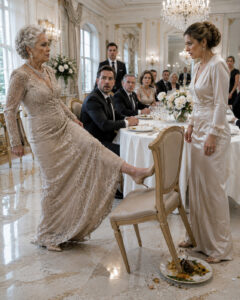
Before I could process her words, Eleanor stood up from her chair, walked deliberately around the length of the mahogany table, and stopped right beside my place setting. With a swift, dismissive motion, she picked up my heavy porcelain dinner plate—laden with seared duck breast and truffle reduction—and walked it over to the edge of the dining room floor.
She bent down and placed the plate flat on the hardwood floor, right beside a potted palm tree.
The entire dining room plunged into an absolute, suffocating silence. Silverware hovered mid-air. Dozens of eyes snapped toward me, some filled with cruel amusement, others with uncomfortable embarrassment.
“There,” Eleanor said, turning around and pointing a manicured finger downward at the floor. “You don’t belong at my table, Clara. If you wish to eat with the family, you may eat where you belong. At the bottom.”
Chapter 2: The Stand
A hot wave of humiliation rushed up my neck, flooding my face with burning heat. My breath hitched in my chest. For a second, every insecurity I had ever harbored about my background, my worth, and my place in Daniel’s life screamed in my ears.
I looked down at the plate resting on the polished wood floor. Then, I looked up at Eleanor.
Her chin was tilted high, her eyes daring me to cry, daring me to throw a tantrum so she could prove to everyone—and especially to Daniel—that I was unrefined and unstable.
I didn’t shout. I didn’t cry. I didn’t hurl insults, and I didn’t reach for a glass of water to throw in her face.
I simply stood tall, smoothed down the front of my silk dress, and took a deep, steadying breath.
“No, Eleanor,” I said, my voice completely calm, ringing out clearly across the silent hall. “I don’t think I will.”
Eleanor’s triumphant smirk flickered for a fraction of a second, replaced by sudden irritation.
“Excuse me?” she hissed, stepping closer. “You will do as you are told under this roof—”
Without finishing her sentence, Eleanor reached out with the tip of her designer stiletto heel and shoved my empty chair violently backward, crashing it into the wall.
“You have no right to sit at my table, and you have no right to defy me!” Eleanor snapped.
Before the echoes of her voice could fade, the sharp scrape of a chair pushing back shattered the tension.
Daniel slammed his fork down onto his crystal plate so hard the porcelain cracked down the center. He stood up from his seat, his broad frame rigid, his face pale with a furious, incandescent rage I had never seen in him before.
“What the hell are you doing, Mother?” Daniel’s voice boomed through the grand dining hall, vibrating with suppressed fury.
Eleanor blinked, genuinely startled. “Daniel, sit down. Your wife is forgetting her place—emulating the common manners she was raised with—”
Daniel didn’t sit down. He didn’t even hesitate. He marched around the table, his eyes locked entirely on his mother, ignoring the gasps and murmurs of the extended family. He walked straight over to where I was standing, stepped past the plate on the floor, and stopped right in front of me.
He reached out, taking my cold hand gently in his warm palm, squeezing it firmly.
“She is my wife,” Daniel said, his voice dropping into a low, terrifyingly dangerous register. “And if she doesn’t belong at your table, then neither do I.”
He turned his head to look at his mother one last time.
“We are leaving. Don’t ever expect us in this house again.”
Without waiting for Eleanor to reply, Daniel wrapped his arm around my waist, turning us both toward the grand double doors of the mansion. As we walked out across the marble foyer, the heavy silence of the dining room followed us out into the cool night air.
Chapter 3: The Weight in the Envelope
We climbed into Daniel’s car, the doors sealing out the oppressive atmosphere of the estate. The engine hummed to life, and Daniel gripped the steering wheel so tightly his knuckles turned chalk white. He pulled out of the massive iron gates, driving down the winding coastal road for several miles before pulling over safely at a quiet scenic overlook overlooking the dark, crashing ocean waves.
Daniel buried his face in his hands, letting out a long, shuddering sigh of pure exhaustion and overwhelming guilt.
“Clara… I am so, so sorry,” he choked out, his voice cracking. “I knew she was difficult, I knew she was cold… but I never, ever imagined she would humiliate you like that. In public. On the floor. I’m a terrible husband for letting it go on this long.”
I reached over, resting my hand softly on the back of his neck, running my fingers through his hair.
“It’s not your fault, Daniel,” I said softly, my voice surprisingly steady. “You stood up for me tonight. You chose me. That’s all I ever wanted.”
Daniel looked at me, his eyes shining with unshed tears in the dim dashboard light. “What do we do now? I’m cutting her off. I’m cutting off the trust, the properties, everything tied to her corporation. We’ll start completely fresh on our own.”
I offered him a small, mysterious smile—a smile that carried the weight of a secret I had been keeping hidden for nearly two weeks.
“We won’t have to cut her off, Daniel,” I murmured, reaching down to my leather handbag resting on the floorboards. “In fact, I think she’s going to be the one begging us for a conversation very soon.”
Daniel frowned, confused. “What do you mean?”
I unzipped the side pocket of my bag and pulled out a thick, manila legal envelope, sliding it across the center console into his lap.
“Open it,” I said quietly.
Daniel picked up the envelope, untied the string, and pulled out a stack of heavy, legal-certified documents bearing the embossed seals of the federal financial registry and the state property bureau. He turned on the overhead reading light, scanning the lines of text, his eyes growing wider and wider with every single page.
“Clara… what is this?” Daniel whispered, his voice trembling. “These are asset title transfers… commercial deeds… offshore trust accounts… and federal tax identification numbers.”
“Look at the signature line on the primary beneficiary authorization forms, Daniel,” I instructed gently.
Daniel flipped to the final page. His jaw dropped.
Printed clearly, boldly, and legally across the primary beneficiary line—the individual who held absolute administrative control over four major real estate holdings and two offshore venture funds worth upward of eighty million dollars—was a name that made his blood run cold.
My name. Clara Vance.
Chapter 4: The Stolen Identity
Daniel stared at the paper, thunderstruck, looking up from the document to my face in absolute disbelief.
“My mother… she put these assets under your name?” Daniel stammered, shaking his head. “How? When? Why would she ever do that? She hates you! She thinks you’re a penniless nobody!”
“She doesn’t know I have these documents,” I explained calmly, leaning back against the passenger seat. “Three weeks ago, my father—who, as you know, spent thirty years working as a senior compliance auditor for corporate tax agencies—was approached by an old colleague at the federal registry office. They noticed something highly irregular happening with several dormant shell companies tied to Vance Enterprises.”
I paused, letting the implications sink in.
“Your mother, for all her brilliance, made a fatal miscalculation years ago, long before we even met. When she was expanding her empire and trying to hide massive capital gains from federal oversight during the antitrust investigations in the nineties, she needed a clean, unassociated nominee—a completely unrelated third party with zero corporate footprint—to act as a legal placeholder for her primary offshore holding trusts.”
Daniel’s eyes narrowed as the puzzle pieces clicked violently into place in his mind.
“And through a bureaucratic coincidence or a manipulated filing error…” Daniel whispered, “her corporate lawyers accidentally used your name—your maiden name, Clara Miller, which matched an old clerical file—thinking it was a fictional or dead entity.”
“Exactly,” I nodded. “For years, she assumed those shell accounts were completely under her control, hidden behind layers of encrypted corporate governance. But when my father looked closer at the registry updates last month, he realized the legal loophole: because the original nominee signature and identity verification were legally bound to my social security profile, I am technically the legal owner of record for those multi-million-dollar trusts. Not her.”
Daniel sat in stunned silence, the magnitude of what I was holding washing over him. The woman who had just treated me like dirt, who had forced me to eat off the floor of her mansion because I wasn’t wealthy enough to sit at her table, was legally, financially, entirely at my mercy.
“She didn’t invite us to dinner tonight just to humiliate you, did she?” Daniel asked, a dark realization dawning on him. “She’s been trying to force us to sign a blanket ‘family asset waiver’ for months. She must have realized there was an audit discrepancy, and she wanted us to sign away our rights without reading the fine print.”
“She wanted me marginalized, humiliated, and compliant so I would sign whatever her lawyers slid across the table,” I said, my voice hardening slightly. “Instead, she pushed me too far. She reminded me of who I am, and what I’m capable of standing up against.”
“What do you want to do?” Daniel asked, looking at me not just with love, but with profound, genuine awe. “Do you want to strip her? Do you want to bankrupt her?”
“No, Daniel,” I replied, shaking my head. “I don’t want her money. And I don’t want revenge just for the sake of hurting her. I want justice. I want her to look me in the eye, knowing that the empire she worships above everything else… depends entirely on the woman she told to eat off the floor.”
Chapter 5: The Morning After
The sun rose bright and clear over the city the next morning. The air was crisp, carrying the promise of a new beginning.
At precisely 9:00 AM, my phone began to buzz continuously on the kitchen counter of our apartment.
It was Eleanor’s private secretary. Then it was her senior corporate counsel. Then, finally, it was Eleanor herself.
I let it ring three times before calmly tapping the screen and pressing accept.
“Clara,” Eleanor’s voice came through the speaker. It wasn’t the cold, arrogant tone from the night before. It was sharp, strained, and laced with an underlying panic she was desperately trying to conceal. “We need to talk. Immediately. Come to my office at Vance Tower within the hour.”
I smiled faintly, holding the phone near my ear while stirring my morning coffee.
“I’m sorry, Eleanor,” I replied, my voice light and unbothered. “I don’t do impromptu meetings. And certainly not at your office.”
There was a sharp intake of breath on the other end of the line.
“Listen to me, you ungrateful little—!” Eleanor started to snap, before catching herself, swallowing her pride with visible physical pain. “Name your terms, Clara. What do you want? Money? A house? Just come to the office. We have urgent corporate papers that require your immediate signature.”
“If you want to talk to me, Eleanor, you know where to find me,” I said smoothly. “And bring your legal team. You’re going to need them.”
I hung up the phone before she could reply.
Chapter 6: The Summit at the Kitchen Table
At 11:30 AM, a sleek black Maybach pulled up outside our modest, middle-class suburban townhouse.
The front doorbell rang with a sharp, insistent chime.
Daniel walked over to the door and pulled it open. Standing on the porch wasn’t just Eleanor. Flanking her on either side were her lead corporate attorney, Mr. Sterling, and two stone-faced security guards. Eleanor looked older this morning; the heavy designer makeup couldn’t entirely mask the dark circles under her eyes or the rigid tension in her jaw.
“May we come in?” Eleanor asked, her voice tight, the words tasting like ash in her mouth.
“It’s our home, Mother,” Daniel said coldly, stepping aside to let them pass. “Feel free. But leave the security guards on the porch. You’re safe here.”
Eleanor swept into our modest living room, her expensive cashmere coat rustling. She looked around the modest furniture, the framed family photos on the walls, and the open kitchen archway with undisguised disdain—until her eyes landed on me.
I was sitting at our small wooden kitchen table, sipping a cup of chamomile tea. Spread neatly across the wood grain were three crisp, certified copies of the asset trust deeds.
Eleanor stopped dead in her tracks. Her eyes locked onto the papers. The color completely drained from her face, leaving her looking ghostly pale.
“Where… where did you get those?” Eleanor whispered, her voice losing all its usual titanium strength.
“Good morning, Eleanor,” I said calmly, gesturing to the empty chair across from me. “Please, sit down. You don’t have to eat off the floor today. I promise.”
Mr. Sterling, the attorney, stepped forward, his eyes darting anxiously between his boss and the documents on the table. He quickly pulled out a pair of reading glasses, leaned over the table, and scanned the text. Within seconds, the attorney turned pale as well, his hands trembling slightly as he adjusted his collar.
“Mrs. Vance,” the attorney muttered under his breath, leaning toward Eleanor. “These… these are original master registry certificates. If these holdings are contested in federal court… the entire corporate restructuring of the holding trust collapses. We lose control of the primary capital assets.”
Eleanor sank slowly into the wooden chair opposite me. Her hands, usually so steady and commanding, rested limply in her lap. She looked across the table at me—not as a gold-digger, not as an unwelcome intruder, but as the person holding the executioner’s axe over her entire empire.
“What do you want, Clara?” Eleanor asked, her voice dropping to a hollow, broken murmur. “Name your price. Do you want the downtown commercial plaza? Do you want half my personal stock portfolio? Just sign the quitclaim deeds and hand over the registry codes.”
I set my teacup down gently onto its saucer. The ceramic clink echoed softly in the quiet kitchen.
“I don’t want your commercial plaza, Eleanor,” I said, meeting her terrified gaze with unwavering calm. “And I certainly don’t want your money.”
“Then why are you doing this?!” Eleanor burst out, a flash of her old arrogance momentarily breaking through her panic. “To destroy me? To ruin everything I built with my bare hands?”
“No,” I replied softly. “I’m doing this because for four years, you made it your mission to make me feel small, worthless, and invisible. You believed that wealth and status gave you the right to strip away human dignity—to treat people like dirt if they didn’t measure up to your standard of success.”
I leaned forward, resting my forearms on the table, looking directly into her eyes.
“I’m not here to take your empire, Eleanor. I’m here to teach you a lesson you should have learned a long time ago: respect costs nothing, but arrogance costs everything.”
Eleanor stared at me, the sharp edges of her formidable persona completely dismantled. She had fought boardrooms, hostile takeovers, and federal regulators for decades, but she had never encountered an opponent who couldn’t be bought, threatened, or intimidated.
“What happens now?” she asked, her voice barely a whisper.
“Now,” I said, picking up a pen and sliding a single legal document across the table toward her attorney, “we restructure the corporate charter under an independent oversight board. Your name remains on the executive board only under strict compliance guidelines. And every quarter, a significant percentage of the trust dividends will be permanently allocated to community housing and underprivileged scholarship programs—managed by an independent foundation that you have no direct control over.”
Mr. Sterling quickly reviewed the terms, looking up at Eleanor with wide eyes, silently nodding to indicate that it was the best deal they were ever going to get.
Eleanor looked down at the pen resting beside the document. Her hands trembled as she reached out, picked it up, and slowly, painfully, signed her name on the dotted line.
The titanium queen of Vance Enterprises had just been checkedmate by the woman she told to eat off the floor.
Chapter 7: A New Seat at the Table
Two months later, the corporate restructuring was complete, and the dust had finally settled.
The media ran wild with speculation about the sudden reorganization of Vance Enterprises, whispering about mysterious regulatory adjustments and hidden oversight boards, but the true story remained safely between the walls of our family.
Eleanor didn’t apologize—that wasn’t in her nature. But her visits to our home became rare, her tone when she spoke to me became rigidly polite, and the cruel insults vanished entirely. She had learned, the hard way, that some lines could never be crossed again.
On a warm Sunday afternoon, Daniel and I hosted a small, intimate dinner party at our new home. We didn’t have a twelve-foot mahogany table, crystal chandeliers, or a private executive chef. We had a rustic oak dining table, homemade lasagna, and a handful of genuine friends and family members who loved us for who we were, not what was in our bank accounts.
I sat comfortably at the head of the table, laughing as Daniel poured a round of wine for everyone.
As I looked around the room, taking in the warmth, the genuine laughter, and the profound peace settling over our lives, I realized something wonderful.
I never needed to belong at Eleanor’s table.
Because I had built my own.