IF the MARKER WASN’T lit…: Stephen Schneider’s defense team is banking on a technical detail that could change the course of the case!
**“IF THE MARKER WASN’T LIT…”: Stephen Schneider’s Defense Team Is Banking on a Technical Detail That Could Change the Course of the Case**
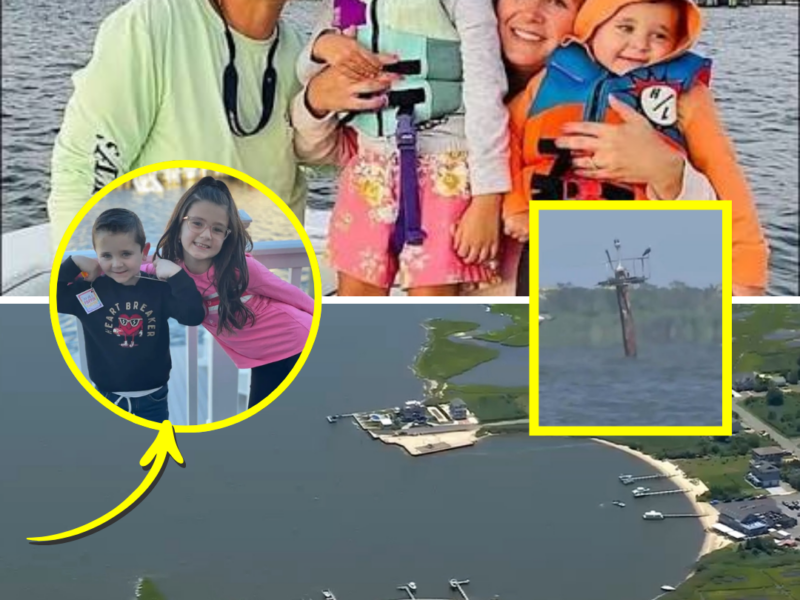
All eyes are now fixed on a single channel marker in Barnegat Bay. On the night of July 19, 2026, shortly after 9 p.m., a 28- to 30-foot Tidewater Custom 280 center-console boat struck Intracoastal Waterway day marker No. 39. The impact threw two young children into the dark water. Mya Bella Golabek, 9, and her brother Sigmund Paul “Siggy” Golabek, 7, both of Lacey Township, were wearing life jackets and seated at the front of the vessel. Their grandfather, Stephen Schneider, 64, of the Bayville section of Berkeley Township, and their grandmother, Laurie Schneider, recovered the children from the water. Both were unresponsive. Despite immediate CPR efforts and rapid transport to Community Medical Center in Toms River, the siblings were pronounced dead.
What began as a family dinner outing ended in profound tragedy. The Golabek children had arrived at MJ’s Restaurant Bar and Grill in Berkeley with their parents by separate boat. After the meal, the youngsters asked to ride home with their grandparents, whose residence was nearby. Schneider, an experienced lifelong boater familiar with the local waters, took the helm. He later told investigators he was traveling at approximately 20 mph when he saw the marker “at the last second” and struck it with the starboard bow. Both the boat’s radar and an infrared/low-light night navigation camera were reportedly active at the time.

Prosecutors have built a strong case centered on impairment. Schneider told authorities he consumed two Guinness beers and one Miller Lite over roughly two hours at the restaurant. A blood sample drawn later that night yielded a blood-alcohol concentration of 0.16 percent—twice New Jersey’s legal limit of 0.08 percent for operating a vessel. Toxicology experts concluded that his alertness, judgment, response time, perception, and coordination were “markedly impaired by alcohol.” He faces two second-degree counts of reckless vessel homicide (also called death by vessel), operating a vessel under the influence, and reckless operation of a vessel. If convicted on the homicide counts, he could face up to 20 years in state prison.
Yet Schneider’s defense team, led by attorney William Cunningham, is focusing attention on a different question: whether channel marker No. 39 was actually illuminated and sufficiently visible that night. During a detention hearing in mid-August 2026, Cunningham argued that it remained unclear whether the light on the marker was working. That technical detail, if substantiated by further investigation or expert analysis, could reshape how a jury evaluates the collision itself—and, by extension, the degree of recklessness attributable to the operator.
Navigational markers on the Intracoastal Waterway are critical safety aids, especially after dark. Marker 39 is described in court documents as a single-stanchion illuminated navigational aid. Local officials, including Berkeley Township Councilman James Byrnes, stated in the immediate aftermath that the marker was fully functional and its lights were working on the night of the crash. Police accounts have similarly characterized the marker as lit. Schneider himself said he saw it only at the final moment, despite having electronic aids engaged. The defense’s inquiry does not necessarily dispute the existence of the structure; it challenges whether the light was operating at the required intensity, whether it was obscured by conditions, or whether any maintenance or electrical issue reduced its visibility to a level that a reasonably careful operator—even one with some alcohol in his system—might fail to detect in time.
Nighttime boating on Barnegat Bay presents inherent challenges. The bay is a popular recreational waterway, but it is also shallow in places, laced with channels that demand precise navigation. Channel markers serve as the primary visual reference for safe passage. Under federal and state rules, illuminated aids are expected to provide reliable guidance after sunset. If evidence emerges that Marker 39’s light was out, dim, intermittent, or otherwise compromised, the defense could argue that the collision was not solely the product of operator impairment. Instead, it might contend that a critical safety system failed, contributing substantially to the accident. Such an argument would not erase the BAC evidence, but it could introduce reasonable doubt about the precise causal chain required for a reckless homicide conviction.
The broader context of the 2026 summer on Ocean County waters adds weight to the scrutiny of markers. Multiple fatal or serious incidents involving boats striking channel markers have been reported, prompting local discussion about the condition, placement, and maintenance of these aids. Boaters and officials have noted that freeze-thaw cycles, storms, and heavy use can affect marker integrity and lighting systems. While none of those other cases is identical to Schneider’s, the pattern has heightened public and legal interest in whether the aids themselves performed as designed. Defense investigators can be expected to seek Coast Guard or New Jersey Department of Environmental Protection maintenance records, any recent reports of outages, photographic or video evidence from the scene or nearby vessels, and expert testimony on light intensity, visibility ranges under the prevailing conditions that night, and the reliability of the specific type of fixture used on Marker 39.
Schneider has maintained that he is a lifelong boater who knew the route well. His electronic navigation tools were running. The children were properly wearing life jackets. These facts do not negate the high BAC, but they form part of a fuller picture the defense will present. At the detention hearing, Cunningham emphasized Schneider’s lack of prior criminal record, his deep community ties, and—most poignantly—letters of support from the children’s own parents, who asked that their grandfather be released pending trial. Superior Court Judge Wendel Daniels granted conditional release, citing those factors. Schneider is prohibited from operating a boat or motor vehicle until further court evaluation.
The prosecution’s position remains straightforward and powerful. Assistant Prosecutor Kate Burke has underscored that a BAC of 0.16 percent demonstrates a significant degree of impairment and that operating a vessel in that condition produced a catastrophic result. The state will likely argue that even if the marker light had any deficiency, an unimpaired operator using radar and a night camera should have detected the fixed structure in time to avoid it. The combination of speed, darkness, alcohol, and the presence of children in the bow created an unacceptable risk. Reckless vessel homicide statutes in New Jersey focus on the operator’s conduct and the resulting deaths; the presence of a navigational aid, even one that might later prove imperfect, does not automatically absolve an impaired driver.
Still, criminal trials often turn on the interplay of multiple contributing factors. Juries are instructed to consider the totality of the circumstances. If technical evidence raises genuine questions about the marker’s illumination, the defense can invite the jury to weigh how much of the “last second” discovery was attributable to alcohol versus an unexpected absence of the expected light signal. Expert witnesses on human factors, visual perception in low light, and the performance of marine navigation equipment could become central. Radar returns and camera recordings, if preserved, may show what electronic systems detected and when. Any discrepancy between those systems and the visual reality of a dark or poorly lit marker could prove significant.
The human dimension of the case is inescapable. Mya and Sigmund were remembered by family as close siblings who shared laughter, adventures, and an unbreakable bond. Their parents’ decision to support Schneider’s release pending trial speaks to the complexity of grief within a family torn by loss. Schneider himself has lived with the knowledge that his actions that night—however he understood them in the moment—led to the deaths of the grandchildren he loved. That reality will hang over every stage of the proceedings.
As the case moves toward trial, discovery will be critical. Both sides will examine the physical condition of the boat, any damage analysis, weather and lighting conditions on July 19, the precise location and orientation of the impact, and the operational status of Marker 39. Coast Guard light lists confirm that Marker 39 is designated as an illuminated aid (Fl G 4s on a pile with appropriate daymarks). Whether that light was functioning at the relevant hour is a factual question still under examination.
If technical evidence ultimately supports the defense claim that the marker was not adequately lit, the legal battle could enter a new chapter. The high BAC would remain a formidable obstacle, but the narrative of pure operator recklessness might be tempered by evidence of a systemic or equipment failure. Conversely, if records and witnesses confirm the light was operating normally, the defense’s technical focus may prove less persuasive, leaving the impairment evidence as the dominant factor.
Boating safety advocates will watch closely. Barnegat Bay and the surrounding Intracoastal Waterway see heavy recreational traffic each summer. High-profile cases involving channel markers underscore the need for reliable aids to navigation, rigorous maintenance, and strict adherence by operators to sobriety rules. Alcohol and darkness remain a dangerous combination on the water, just as they do on the road. At the same time, the public relies on government-maintained markers to perform their essential function. When those two realities collide in a courtroom, the outcome can influence both individual accountability and broader policy discussions about waterway safety.
Stephen Schneider’s case is still in its early stages. Charges have been filed, release conditions set, and the core factual disputes defined. The prosecution will press the impairment evidence and the resulting deaths. The defense will continue to probe the visibility of Marker 39 and the reasonableness of Schneider’s actions under the conditions he faced. Somewhere in the technical details of a single channel marker’s light—whether it burned brightly, flickered, or failed—may lie a pivot point that determines how the tragedy of July 19 is ultimately judged.
The loss of Mya and Sigmund remains the central, irreversible fact. No legal argument can restore them. What the justice system can do is examine the evidence with rigor, weigh competing explanations fairly, and reach a verdict grounded in the full record. For now, that record includes both a 0.16 percent BAC and an open question about whether the marker that ended their lives was illuminated as it should have been. The answer to that question could indeed change the course of the case.