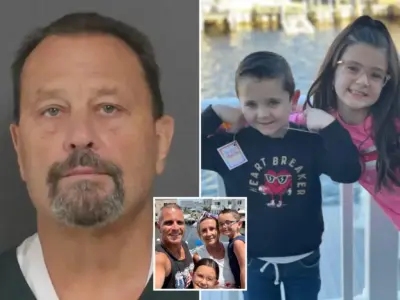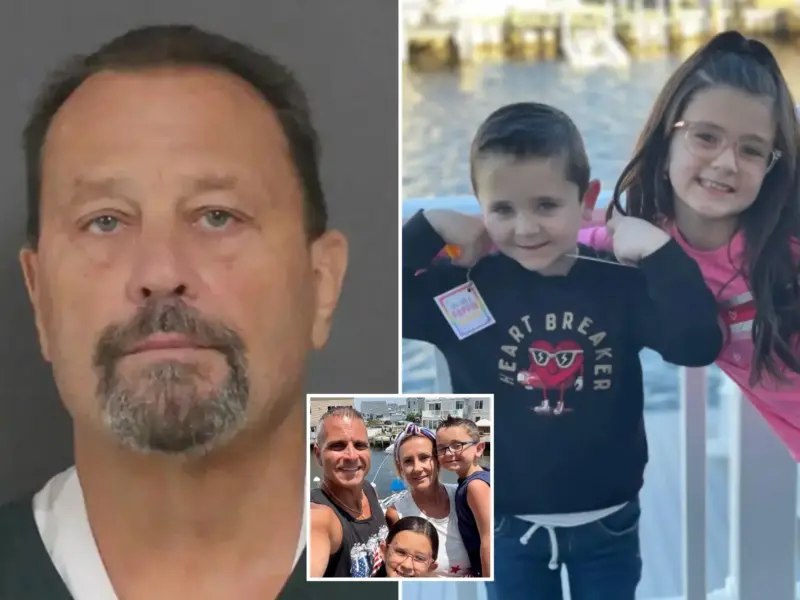
It wasn’t just about being “drunk”: Case records detail how Stephen Schneider allegedly lost the ability to react before his two grandchildren were thrown from the boat. Investigative documents suggest that the alcohol in Schneider’s system impaired critical functions required to operate the vessel. State Police contend that his judgment, reaction time, and coordination were all significantly compromised. Mya and Sigmund were on board the boat when the collision occurred. This detail is helping prosecutors build the argument that the tragedy was not merely an accidental crash.
**It wasn’t just about being “drunk”: Case records detail how Stephen Schneider allegedly lost the ability to react before his two grandchildren were thrown from the boat**
Investigative documents suggest that the alcohol in Stephen Schneider’s system impaired critical functions required to operate the vessel. State Police contend that his judgment, reaction time, and coordination were all significantly compromised. Mya Bella Golabek and Sigmund Paul Golabek were on board the boat when the collision occurred. This detail is helping prosecutors build the argument that the tragedy was not merely an accidental crash.

On the night of July 19, 2026, a routine family outing on Barnegat Bay ended in irreversible loss. Stephen C. Schneider, a 64-year-old Bayville resident, was at the helm of a 28- to 30-foot Tidewater center console vessel. With him were his wife, Laurie, and their two grandchildren: 9-year-old Mya Bella Golabek and 7-year-old Sigmund “Siggy” Paul Golabek. The children had joined their grandparents after a family dinner at MJ’s Restaurant in Bayville. They sat in the forward section of the boat, wearing life jackets, as Schneider guided the vessel toward home along a familiar stretch of the Intracoastal Waterway.
At approximately 9 p.m., traveling at about 20 mph, the boat struck Channel Marker No. 39. Schneider later told investigators he saw the single-stanchion illuminated navigational aid only “at the last second.” The impact threw both children into the dark water. Schneider and his wife recovered them face-down and unresponsive. Despite immediate CPR and rapid transport to Community Medical Center in Toms River, Mya and Sigmund were pronounced dead.
A blood sample drawn from Schneider hours later under a search warrant registered a blood alcohol concentration of 0.16 percent—twice New Jersey’s legal limit of 0.08 percent for operating a vessel. That number alone is significant. But the investigative records go further. Toxicologists from DrugScan Labs, identified in the probable cause affidavit as Doctors Cohn and Coyer, concluded that Schneider was unfit to operate a motor vehicle or vessel. They determined that alcohol had markedly impaired his alertness, sense of care and caution, perception, judgment, response time, and coordination.
These findings form the core of the state’s emerging argument. Prosecutors are not simply asserting that Schneider had been drinking. They are asserting that the alcohol in his system degraded the precise cognitive and motor functions necessary to detect a fixed hazard, process its location, and execute an avoidance maneuver in time. In the language of the case documents, the impairment was not abstract. It struck at the operational capacities required of anyone at the helm after dark on a busy waterway.
Reaction time is central to this theory. At 20 mph, a vessel covers roughly 29 feet per second. Even a modest delay in recognition or response can close the margin between a near miss and a collision. Schneider’s own statement that he saw the marker only at the last second is being examined against the backdrop of laboratory conclusions that his response time was markedly compromised. Prosecutors contend this is not the language of ordinary human error under difficult conditions; it is consistent with the documented effects of a 0.16 BAC on neural processing and motor control.
Judgment and perception receive equal emphasis in the records. Nighttime navigation on Barnegat Bay requires continuous visual scanning, interpretation of lights and reflective surfaces, and integration of information from radar and other electronics. Schneider told troopers that both the boat’s radar and an infrared/low-light night navigation camera were activated. He also stated he had traveled the route many times over a lifetime on the water. Yet the toxicologists’ assessment indicates that alcohol had impaired the very faculties needed to make effective use of those tools and that experience. Perception narrows. The ability to prioritize relevant stimuli diminishes. Decision-making slows. These are not peripheral effects. They are the mechanisms by which impairment converts a manageable navigational task into a catastrophic one.

Coordination, the final element highlighted by State Police and the laboratory conclusions, addresses the physical execution of any corrective action. Steering, throttle control, and the ability to maintain a steady course under stress all depend on intact fine and gross motor function. At a 0.16 BAC, the records indicate these were markedly degraded. Even if Schneider had registered the marker earlier, the state will argue, his compromised coordination would have reduced the likelihood of a successful evasive maneuver.
The presence of the children on board transforms these physiological findings into the foundation of the reckless vessel homicide charges. Mya and Sigmund were not distant bystanders. They were seated forward, in the path most directly affected by a sudden stop or deflection against a rigid steel marker. Prosecutors are expected to argue that operating a vessel in a state of documented impairment, with two young passengers in that position, elevated the conduct beyond ordinary negligence into recklessness under New Jersey law. The tragedy, in this framing, was not an unforeseeable accident. It was the foreseeable consequence of operating while critical functions were compromised.
Schneider was charged in mid-August with two counts of reckless vessel homicide, operating a vessel under the influence, and reckless operation of a vessel. At a subsequent detention hearing, prosecutors cited the 0.16 BAC and the laboratory conclusions about impairment to argue that he posed a danger. Defense counsel William Cunningham emphasized the accidental nature of the crash, Schneider’s limited criminal history, family support—including letters from the children’s parents seeking his release—and his expressed intention never to operate a boat or consume alcohol again. The court granted conditional release with restrictions on operating vessels or motor vehicles.
The defense has already signaled that it will not concede the impairment narrative without scrutiny. Counsel has indicated interest in independent review of the BAC results and examination of the channel marker’s lighting status that night. Schneider’s claim that navigational electronics were functioning opens another avenue: whether those systems provided timely warnings that a sober operator would have heeded, or whether environmental factors limited visibility regardless of blood alcohol level. Multiple collisions with channel markers occurred on Barnegat Bay during the 2026 season, several after dark, underscoring that fixed aids can be missed under certain conditions even without intoxication.
Yet the state’s case rests heavily on the specific language of the toxicology conclusions. “Markedly impaired” is not a casual phrase. It is a professional assessment of functional deficit across the domains most relevant to vessel operation: alertness, perception, judgment, response time, and coordination. Prosecutors can be expected to call the laboratory experts to explain how a 0.16 BAC produces these effects, how the timing of the blood draw relates to the estimated level at the moment of impact, and why the combination of those deficits made timely detection and avoidance of Marker 39 improbable.

The children themselves remain at the emotional and legal center of the case. Both wore life jackets. Both were recovered quickly by their grandparents. Neither survived. Their presence on the boat is not incidental to the charges. It supplies the element of risk that converts impaired operation into reckless vessel homicide. Prosecutors will argue that Schneider’s compromised faculties placed the children in mortal danger the moment the vessel left the dock with alcohol in his system at that concentration.
As the case moves forward, the interplay between the blood evidence and the operational realities of nighttime boating will dominate pretrial litigation and, ultimately, any trial. Discovery will focus on the complete toxicology file, the precise timing of drinks and the blood draw, maintenance and inspection records for the marker, data from the boat’s electronics if recoverable, and any contemporaneous observations of Schneider’s demeanor. Expert testimony on human factors, alcohol pharmacokinetics, and navigational visibility is likely from both sides.
The investigative records already make one point clear. The state’s theory is not limited to the bare fact of alcohol consumption. It is that the alcohol produced measurable, significant deficits in the exact capacities required to keep a vessel clear of a fixed, illuminated hazard. Judgment, reaction time, and coordination—according to the documents—were all compromised. Mya and Sigmund were aboard when those compromised functions met the channel marker. For prosecutors, that sequence is what distinguishes a tragic accident from a criminal act. Whether a jury will accept that framing remains to be determined. The case records, however, have already laid the foundation for the argument.