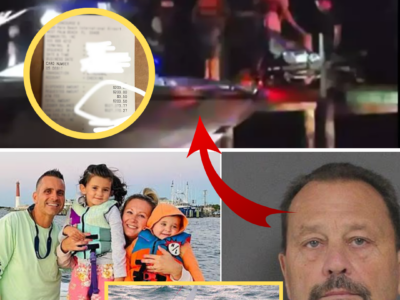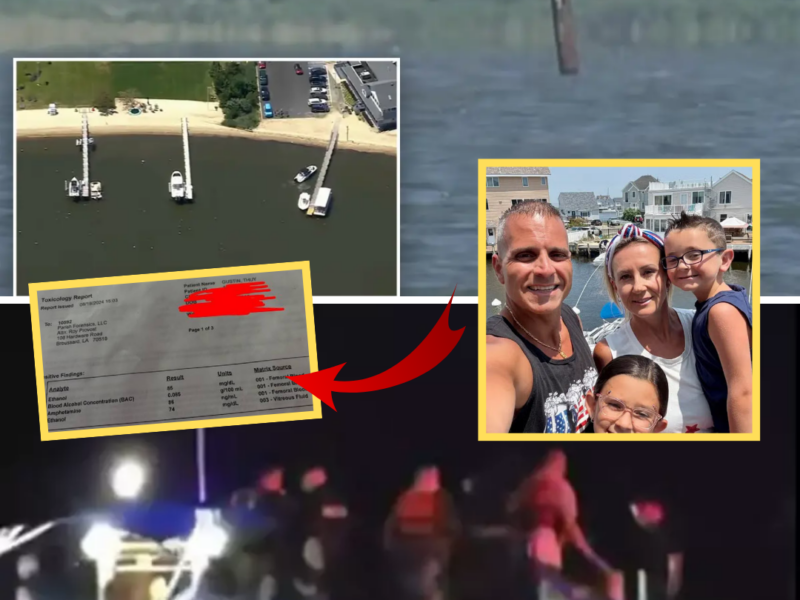
Cameras may hold the answer: When exactly did Stephen Schneider leave the bar before the boat trip that claimed the lives of two children?
Cameras may hold the answer: When exactly did Stephen Schneider leave the bar before the boat trip that claimed the lives of two children?
Investigators have established a timeline for the excursion on Barnegat Bay.
However, it is the hours leading up to that point where the story becomes complicated.
Stephen Schneider stated that he drank beer for about two hours at MJ’s Restaurant before operating the boat.
With CCTV footage available for cross-reference, every minute he spent at the restaurant could serve as evidence in the dispute surrounding the 0.16% blood-alcohol reading.
****************

Cameras May Hold the Answer: When Exactly Did Stephen Schneider Leave the Restaurant Before the Boat Trip That Claimed Two Children’s Lives?
Investigators have constructed a working timeline of the fatal excursion on Barnegat Bay on the evening of July 19, 2026. They know approximately when the family finished dinner at MJ’s Restaurant Bar & Grill in Bayville. They know that shortly after 9 p.m. a 28-foot Tidewater center-console boat struck an illuminated channel marker. They know that 9-year-old Mya Bella Golabek and 7-year-old Sigmund Paul Golabek, both wearing life jackets and seated near the front, were thrown into the water and later pronounced dead at Community Medical Center in Toms River.
What remains less precise — and potentially decisive — is the exact sequence of the final minutes Stephen C. Schneider spent inside the restaurant before he walked to the dock, boarded the boat, and took the helm. Schneider told New Jersey State Police that he had consumed two Guinness beers and one Miller Lite over the course of roughly two hours at the table. A blood sample drawn under warrant at 12:46 a.m. returned a blood alcohol concentration of approximately 0.16 percent, twice the legal limit. Between those two facts lies a stretch of time that surveillance cameras, if they recorded the relevant areas, may be able to measure with greater accuracy than memory alone.
The Established Framework of the Evening
Court documents describe a family gathering that brought Schneider, his wife Laurie, their daughter, their son-in-law, and the two grandchildren together at MJ’s. Schneider and his wife arrived by boat. The children’s parents arrived separately by boat with Mya and Sigmund. The group shared a meal lasting about two hours. After the meal the children transferred to their grandparents’ vessel for the return trip across the bay.
In the aftermath of the collision Schneider stated that his alcohol consumption during the dinner consisted of three beers. Laboratory analysis later concluded that his judgment, perception, response time, and coordination were markedly impaired. The numerical conflict between the three-beer claim and the 0.16 percent result has made the internal timeline of the restaurant evening a priority for investigators.
Why the Moment of Departure Matters
The precise time Schneider left the table and exited the restaurant is significant for several reasons. First, it marks the end of the period during which he acknowledges drinking. Second, it establishes how much time elapsed between the last possible drink and the moment he began operating the boat. Third, it provides a fixed point against which other evidence — order timestamps, payment records, staff recollections, and family observations — can be aligned.
If cameras captured Schneider rising from the table, handling the check, walking through the dining room or bar area, and exiting toward the dock, the footage can supply an objective timestamp for the transition from the restaurant to the vessel. That timestamp can then be compared with the approximate start of the two-hour dinner window and with the known time of the collision. The resulting sequence helps determine how long the alcohol had been in his system and how the measured BAC relates to the period of active consumption.
The Potential of CCTV Footage
Modern restaurants frequently maintain surveillance systems covering entrances, dining rooms, bar areas, and sometimes exterior approaches to docks or parking. If MJ’s cameras were operating and retained footage from the evening of July 19, investigators would have a continuous visual record of movement within those zones. The footage could show:
When Schneider and his party were seated.
The arrival of drinks at the table over the course of the meal.
The number of bottles or glasses that accumulated.
Schneider’s demeanor and coordination as the evening progressed.
The exact moment the group prepared to leave.
The path Schneider took from the table to the exit.
Any interaction with staff during the final minutes ashore.
Even partial coverage can narrow the range of possibilities. A camera that records only the bar or the main dining room may still capture the delivery of drinks or the departure sequence. A camera covering an exterior door or dock approach can establish when Schneider left the building and when the boat got underway relative to that departure.
The value of such footage lies in its independence from human recollection. Memory of time intervals is often imprecise, especially after a traumatic event. A timestamped video recording is not. If the system embeds reliable time data, the cameras can convert a disputed two-hour window into a sequence of measurable minutes.
Cross-Referencing Multiple Sources
Surveillance does not stand alone. It gains power when combined with other records. Point-of-sale systems often log the time an order is entered or a check is closed. Credit-card authorizations carry their own timestamps. Staff who served the table can be asked when they delivered the last round and when the party left. Family members can describe the sequence of leaving the table, settling the bill, and walking to the boats.
When these sources are placed alongside camera footage, inconsistencies become visible and consistencies gain weight. A receipt that closes at a certain minute, a camera that shows Schneider exiting three minutes later, and a family member’s recollection that the boat left shortly afterward can together produce a tighter timeline than any single source. That tighter timeline can then be examined against the three-beer claim and the 0.16 percent BAC.
The Scientific Context
The 0.16 percent reading already creates pressure on the stated consumption. For a typical adult male, three standard beers over two hours, followed by additional hours of metabolism before the blood draw, would not ordinarily yield a concentration of that magnitude. The more precisely investigators can establish when drinking ended and when the boat departed, the more accurately they can evaluate whether the reported volume of alcohol is consistent with the measured impairment.
If cameras show that Schneider remained at the table or bar for a longer period than he described, or that additional drinks arrived after the point at which he claimed to have finished, the three-beer narrative becomes harder to sustain. If the footage aligns closely with a two-hour window and limited service, attention may shift to other variables — prior consumption, individual metabolic differences, or the exact timing of the blood draw relative to the last drink.
Legal Significance
Schneider faces two counts of reckless vessel homicide, operating a vessel under the influence, and reckless operation of a vessel. Prosecutors have cited the 0.16 percent BAC as evidence of the degree of impairment under which he operated the boat with two children aboard. Schneider’s pre-test statement about three beers remains the primary competing account. Any objective record that clarifies the duration of the dinner, the pattern of service, and the exact moment of departure bears directly on the credibility of that account and on the interpretation of the toxicology result.
The children’s parents have supported Schneider’s pretrial release, describing him as a loving grandfather. That support forms part of the human context of the case. It does not eliminate the factual conflict between the stated consumption and the laboratory measurement. The potential availability of camera footage gives investigators a tool for addressing that conflict with greater temporal precision.
Reconstructing the Final Minutes Ashore
The critical sequence is the one that runs from the last possible drink to the moment the boat left the dock. Within that sequence lie the decisions and physical actions that placed Schneider at the helm. Cameras that recorded the interior of the restaurant can show how he moved through the space. Cameras that recorded the exterior can show when he reached the boat. Together they can compress an approximate two-hour claim into a series of observable minutes.
Staff who closed the check, family members who walked with him, and any other observers who saw the departure become secondary sources that can be checked against the video. The goal is not merely to confirm that Schneider left the restaurant; it is to establish, as precisely as possible, when he left relative to the consumption he described and relative to the collision that followed.
A Timeline Still Being Refined
Investigators already know the broad outlines of the evening: a family dinner lasting about two hours, a departure by boat, a collision shortly after 9 p.m., and a blood test hours later that registered 0.16 percent. What the cameras may supply is the finer grain — the exact minute Schneider rose from the table, the exact minute he exited the building, and the relationship of those minutes to the rest of the evidence.
In a case that turns in significant part on the distance between a claim of three beers and a reading of 0.16 percent, that finer grain matters. The hours leading up to the boat trip are the period during which the alcohol entered Schneider’s system. The final minutes of those hours are the last opportunity for observation before he took the helm. If the cameras recorded those minutes, they may hold one of the clearest available records of when the restaurant portion of the evening ended and the water portion began.
Stephen Schneider stated that he drank beer for about two hours at MJ’s before operating the boat. The blood test showed 0.16 percent. Between the claim and the number lies a sequence of ordinary actions — finishing a meal, settling a bill, walking to a dock — that multiple people witnessed and that cameras may have preserved. Establishing the exact time he left the restaurant is one practical way of testing the reliability of his account and of clarifying the timeline that led to the deaths of two children on Barnegat Bay.