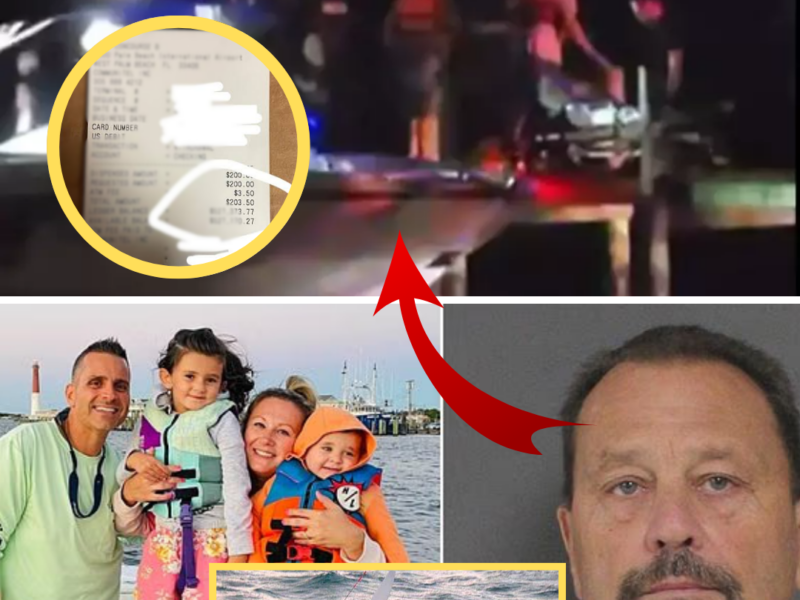
There were witnesses at the dinner table: Stephen Schneider admitted to drinking more than just beer, yet the blood sample told a completely different story!
There were witnesses at the dinner table: Stephen Schneider admitted to drinking more than just beer, yet the blood sample told a completely different story!
Before Mya and Sigmund boarded the boat with their grandfather, Stephen Schneider had dined with his family.
After the crash, he claimed to have consumed only three beers.
Those present could recount what they had seen.
And then, the blood sample revealed a blood alcohol content (BAC) of approximately 0.16%.
Three different sources of information—Stephen Schneider’s own account, the witnesses at the dinner table, and scientific evidence—now paint very different pictures of that night.
***********
On the evening of July 19, 2026, a family gathered for dinner at MJ’s Restaurant Bar and Grill on Bay Boulevard in Berkeley Township, New Jersey. Among them were Stephen C. Schneider, then 63 or 64, of Bayville; his wife Laurie; their daughter and son-in-law; and the couple’s two young children—9-year-old Mya Bella Golabek and 7-year-old Sigmund Paul Golabek of Lacey Township. The meal was ordinary. The aftermath was not.
After dinner, the children asked to ride with their grandparents back toward the Schneiders’ waterfront home. They boarded Schneider’s 28-foot Tidewater Custom 280 center-console boat, wearing life jackets and seated forward. Schneider took the helm. Shortly after 9 p.m., while traveling at roughly 20 mph through Barnegat Bay, the vessel struck an illuminated Intracoastal Waterway channel marker—identified in documents as marker No. 39, a single-stanchion navigational aid whose lights authorities later said were functioning. The impact ejected both children into the dark water.
Schneider later told investigators he immediately began searching. He recovered his grandson first, then his granddaughter. Both were face-down and unresponsive. CPR was started. First responders arrived after a 911 call in which Laurie Schneider can be heard describing the chaos: one child already on the boat, her husband still in the water looking for the other, the location near the channel marker. The children were taken to Community Medical Center in Toms River and pronounced dead.
Schneider told New Jersey State Police that in the roughly two hours at the restaurant he had consumed two Guinness beers and one Miller Lite—three beers total. That account formed one pillar of the narrative that would emerge in the weeks that followed. Family members had been present at the table. Scientific evidence would form another. The blood sample drawn under warrant hours later told a sharply different story.
A registered nurse drew Schneider’s blood at approximately 12:32 a.m. or 12:46 a.m. on July 20—roughly three and a half to four hours after the crash. Toxicology analysis by DrugScan Labs, reviewed by doctors including those named Cohn and Coyer in the affidavit, returned a blood alcohol content of approximately 0.16 percent. New Jersey’s legal limit for operating a vessel is 0.08 percent. The lab concluded Schneider was “unfit to operate a motor vehicle” and that his alertness, sense of care and caution, perception, judgment, response time, and coordination were “markedly impaired by alcohol.”
Prosecutors later described the result as catastrophic in its implications. At a detention hearing in Ocean County Superior Court on August 19, Assistant Prosecutor Kate Burke argued that the BAC demonstrated the degree of impairment with which Schneider chose to operate the vessel. “The defendant consumed enough alcohol to reach a BAC of approximately 0.16, and then operated a vessel, and the result was catastrophic,” she said. Schneider had been arrested on August 14 and charged with two counts of second-degree reckless vessel homicide (also referred to as death by vessel), operating a vessel under the influence, and reckless operation of a vessel. Conviction on the homicide counts carries a potential sentence of up to 20 years.
The gap between Schneider’s statement and the laboratory result is the central tension of the case. Three standard beers consumed over two hours by an adult male of average size and metabolism would not ordinarily produce a BAC of 0.16 percent several hours later. Alcohol is eliminated at a roughly predictable average rate—often cited in forensic contexts around 0.015 percent per hour—though individual factors such as body weight, food intake, sex, chronic tolerance, and the precise timing of drinks alter the curve. Retrograde extrapolation, the technique used to estimate BAC at an earlier time, is common in impaired-operation cases. Public discussion of the numbers quickly noted that reaching 0.16 percent hours after the last drink would typically require substantially more alcohol than three beers. Guinness, at about 4.2 percent alcohol by volume, and Miller Lite are not unusually potent; even allowing for pour size or residual alcohol, the arithmetic does not close easily.
No publicly detailed witness statements from the dinner table have been released that contradict Schneider’s three-beer claim with specificity. The family was present. The parents of Mya and Sigmund later wrote letters supporting Schneider’s release from pretrial detention, describing him as a loving grandfather. Those letters weighed heavily with Superior Court Judge Wendel Daniels, who on August 19 ordered Schneider released under Level III conditions that included a prohibition on operating a vessel or motor vehicle pending further evaluation. Defense attorney William Cunningham told the court that if released, Schneider would likely never set foot on a boat or consume alcohol again. The judge noted Schneider’s lack of significant criminal history and lifelong New Jersey residency.
The affidavit of probable cause, filed by New Jersey State Police Detective I. John Hannan and relying on the toxicology results received in mid-August, remains the primary public document. It records Schneider’s own words about the beers, the route he said he knew well, the radar and low-light camera he claimed were active, and his assertion that he saw the marker only at the last second. It also records the laboratory findings of marked impairment. The three sources—Schneider’s account, the presence of family at the table who could in principle recount what was ordered and consumed, and the blood evidence—do not align neatly.
Boating under the influence carries the same legal thresholds in New Jersey as operating a motor vehicle. Night navigation on Barnegat Bay, even on a familiar route near illuminated markers, demands attention, depth perception, and reaction time that alcohol systematically degrades. Life jackets were worn; they did not prevent the children from being ejected or from being found unresponsive. The channel marker’s lights were reported as operational. Schneider told investigators he had spent a lifetime on the water. Experience did not prevent the collision.
The children’s obituaries described an “unbreakable bond.” Mya and Sigmund were brother and sister and best friends who shared laughter and adventures. Their parents, Jennifer and Sigmund Golabek, lost their only two children in a single night. The grandparents who pulled the children from the water and began CPR now live with the knowledge that the vessel was under Schneider’s control and that laboratory analysis placed his blood alcohol at twice the legal limit hours afterward.
In the weeks after the crash, the case moved from investigation to charges to a detention hearing that balanced public safety arguments against family support and lack of prior record. Schneider remains presumed innocent. The prosecution’s theory rests on the impairment documented by the blood sample and the resulting deaths. The defense has signaled interest in independent review of the toxicology and in the condition of the navigational aid. Trial will test the weight of each piece of evidence: what was said at the restaurant, what was observed by those present, what the blood chemistry recorded, and how those elements map onto the final moments on the bay.
The dinner at MJ’s was meant to be a family gathering. The boat ride home was meant to be a short, familiar transit. Instead, three different pictures of the same evening—Schneider’s recollection of three beers, the potential observations of those seated with him, and a laboratory result of 0.16 percent—now define a case that ended two young lives and left a family fractured by both grief and the legal process that followed. The scientific evidence does not match the account of modest consumption. That mismatch, more than any single statement, continues to shape the public and legal understanding of what happened on Barnegat Bay on the night of July 19, 2026.
The broader context is a summer in which New Jersey waters had already seen multiple fatalities. Alcohol remains one of the most common factors in recreational boating deaths nationally. Laws set clear numerical limits; physiology and behavior frequently ignore them. In this instance the numbers are particularly stark: a claimed intake of three beers set against a measured concentration that toxicologists judged sufficient to produce marked impairment of the very faculties required to pilot a vessel at night. Whether additional alcohol was consumed, whether the claimed quantity was understated, or whether individual metabolic factors explain more of the discrepancy will be subjects for expert testimony. For now, the record presents the conflict plainly.
Schneider was released to await trial under conditions that restrict his ability to operate boats or vehicles. The children’s parents supported that release. The prosecutor described the outcome of the night as catastrophic. Between those poles sits the evidence: a family dinner, a short boat ride, an illuminated marker, two children in the water, and a blood sample that told a story the operator’s own words did not. The witnesses at the table may yet be called. The laboratory already has spoken. The courts will decide what the combination means for criminal liability. The irreversible facts—two children dead after a collision on a summer evening—remain unchanged.