SHOCKING: 1 unanswered question could now change everything in the HeeHaw case! Hannah Israel says HeeHaw was a bottle-raised baby donkey who had spent his life around people and was known for approaching strangers without fear. Officers reportedly saw the encounter differently after HeeHaw ran toward them while braying during a late-night search. Two completely different versions of those final moments have now emerged. It may only be when the bodycam footage is reviewed that the full timeline of what happened inside the pasture finally comes to light
**SHOCKING: One Unanswered Question Could Now Change Everything in the HeeHaw Case**
A single unanswered question now sits at the heart of the HeeHaw controversy and has the power to reshape how the entire incident is understood.
What exactly does the body-camera footage show of the final moments inside that dark Georgia pasture?
Everything else—two completely different versions of the encounter, the family’s grief, the officer’s placement on leave, the public outrage—orbits around this one missing piece of evidence. Until the video is reviewed in full and its contents made known, the story of how a bottle-raised baby donkey died during a search for a missing child remains locked in conflicting accounts that cannot both be true.
### Version One: A Friendly Greeting
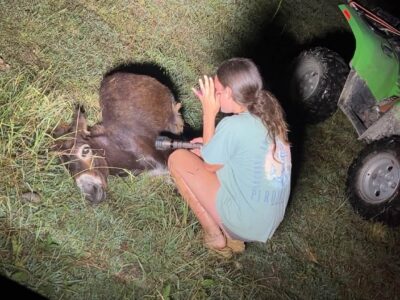
Hannah Israel has been consistent and specific. HeeHaw was a one-year-old miniature donkey she bottle-raised from birth at Elsberry Riding and Farm in Rockmart, Polk County. He lived inside the house as a foal. He grew up around people. He participated in petting zoos and visits to nursing homes. Strangers did not frighten him. Approaching unfamiliar humans while braying was simply how he interacted with the world.
“He never knew a stranger,” Israel wrote in the hours after the shooting. She has repeated the same core description to reporters: HeeHaw loved people. When he saw someone, he would run up, bray, and often press his nose close to investigate. That behavior, she insists, is exactly what occurred when officers entered his pasture around 12:45 a.m. on August 30, 2026.
In this version, the donkey was not charging in aggression. He was performing the social routine that had defined his short life. The officers, according to what Israel says she was told, responded by deploying a Taser and then a firearm. HeeHaw died in the same field where he had spent every day since he was old enough to live outdoors.
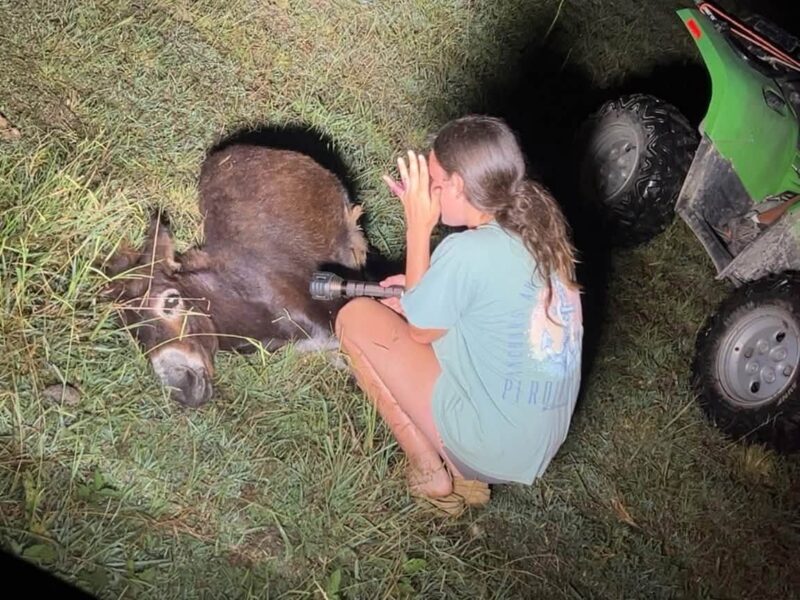
Israel has also stressed that the family received no prior warning that officers would enter the fenced pasture. The first notification came after the shooting, by phone. When the family arrived, the officers had already left. It took nearly an hour of searching with flashlights to find the donkey’s body.
### Version Two: A Perceived Threat
The officers’ reported account, as relayed to the family and reflected in early statements, is fundamentally different. During a late-night search for a missing 12-year-old girl, law enforcement personnel from the Cedartown Police Department (assisting Polk County Police) entered the pasture. HeeHaw ran toward them while braying. In the darkness and under the pressure of the search, the officers believed the animal posed a danger. They attempted to stop him with a Taser. When that did not succeed, an officer used a gun.
This version frames the encounter as a rapid threat assessment. A moving animal appearing suddenly, producing loud vocalizations, approaching in the dark—these factors, in the officers’ perception, created a situation that required force. The missing child was later found safe at a nearby church. The search itself succeeded. The secondary outcome was the death of the donkey.
Cedartown Police Chief Jamie Newsome has confirmed that one of his officers was involved, that the officer has been placed on paid administrative leave, and that the investigation has been transferred to the Georgia Department of Agriculture Law Enforcement Division. He has also confirmed that body-camera video exists and that he has viewed it.
### The Critical Gap
These two versions cannot be reconciled by statements alone. One describes a socialized pet offering a typical greeting. The other describes an animal whose approach was interpreted as a threat serious enough to justify a Taser and then lethal force. The difference is not a matter of tone or emphasis. It is a difference in the fundamental character of the same few seconds.
That is why the body-camera footage has become the single most important unanswered question in the case.
Chief Newsome’s public remarks have already introduced a notable tension. When asked by a reporter whether the officer on the video said he feared for his life, Newsome answered “No.” When asked whether the officer explained why he shot, the chief again said no, noting that he had not discussed the matter further because the case was being handled by the state agency.
This exchange does not resolve the conflict. It intensifies it. The family was told the officers believed they were in danger—a standard formulation that often accompanies justified use of force. Yet the chief who watched the video indicated that the officer did not verbalize fear for his life. The discrepancy places even greater weight on what the camera actually recorded: the donkey’s movement, the officers’ positioning, the timing between Taser and shot, any audible statements, and the overall context visible in the frame.
### What the Footage Could Reveal
Body-worn cameras are imperfect. They capture only what is in front of the lens. Lighting can be poor. Sound can be incomplete. Context outside the camera’s view can matter. Still, in contested use-of-force incidents, they frequently provide the clearest available record of sequence, proximity, and demeanor.
In the HeeHaw case, a careful review of the footage could answer several decisive questions:
– Did HeeHaw approach at a run, a trot, or a casual walk?
– Was his body language consistent with curiosity or with aggression?
– How close did he get before the Taser was deployed?
– How much time passed between the Taser and the gunshot?
– What, if anything, did the officer or other officers say in the moment?
– Was the pasture environment visible enough to assess whether the officers had clear alternatives?
If the video shows a small, non-aggressive animal approaching in a manner consistent with Israel’s description, the “danger” narrative becomes far more difficult to maintain. If it shows a more chaotic or startling sequence, the officers’ perception may appear more understandable even if the outcome is still tragic. Either way, the footage has the potential to move the case from competing stories to a shared factual timeline.
The Human Stakes
For Hannah Israel, the unanswered question is not abstract. HeeHaw was not livestock in the distant sense. He was the bottle baby she raised, the animal who lived in the house, the participant in petting zoos who made children smile. She has called him “my son.” The family found his body themselves after the officers left. The emotional weight of that night is inseparable from the demand for a clear account of how it ended.
Public reaction has reflected the same intensity. A GoFundMe launched for legal fees has raised well over $100,000. Online discussion has focused heavily on the power imbalance between armed officers and a small farm animal on its own property, and on the broader pattern of police shootings of family pets. The fact that the missing child was found safe has not diminished the sense that something went badly wrong in the pasture.
Chief Newsome has described the incident as tragic and expressed that his heart goes out to the family, while declining to offer opinions that could interfere with the external investigation. The Georgia Department of Agriculture Law Enforcement Division now holds primary responsibility for determining what occurred.
### Why This One Question Changes Everything
If the body-camera review ultimately supports the officers’ reported perception of danger, the case may settle into a narrative of a high-stress nighttime search that produced an unfortunate but, in the moment, understandable decision. Training, protocols for rural searches, and the challenges of identifying livestock behavior in the dark would become the focus of any policy discussion.
If the footage instead aligns more closely with Israel’s account—a socialized baby donkey approaching in a familiar, non-threatening way—the implications are more severe. Questions of training, judgment, property entry procedures, and the threshold for using force against animals would intensify. Civil litigation would rest on stronger ground. Public trust in the handling of the incident would face greater strain.
The difference between those two possible outcomes is not minor. It is the difference between a tragic misjudgment under pressure and a preventable killing of a friendly animal in its own home. That is why the single unanswered question about the bodycam footage now carries the potential to change everything.
Until that video is examined in detail and its contents enter the public record—whether through an official report, a legal proceeding, or a decision to release it—the HeeHaw case will remain suspended between two incompatible stories. The full timeline of what happened inside the pasture on that August night will stay incomplete. And the central mystery of how a bottle-raised donkey who had spent his life around people ended up dead after running toward officers while braying will continue to demand an answer that only the camera can fully provide.
The missing child is safe. HeeHaw is gone. The one piece of evidence that could finally reconcile the two versions of his final moments remains, for now, out of public view. When it surfaces, the story of that night in the pasture may look very different from either of the accounts currently in circulation.