BREAKING: The final seconds before HeeHaw’s tragic encounter may hold the biggest answer yet! His owner says the baby donkey was friendly, familiar with people, and had never shown fear around strangers. But officers reportedly believed the situation had become dangerous when HeeHaw approached them in the pasture. The controversy has now centered on what happened between the moment HeeHaw started moving toward them and the moment the encounter escalated. And one recording may be able to trace those seconds moment by moment: the bodycam footage.

BREAKING: The Final Seconds Before HeeHaw’s Tragic Encounter May Hold the Biggest Answer Yet
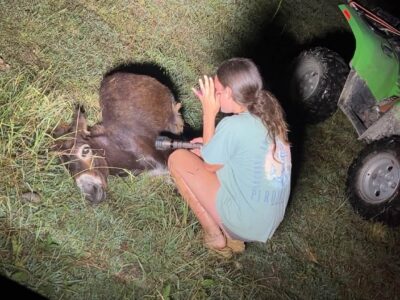
In the darkness of a Polk County pasture just after midnight, a one-year-old bottle-raised donkey named HeeHaw began moving toward a group of officers. Within a short span of time—measured in seconds rather than minutes—the encounter escalated from an approach to the use of a Taser and then a firearm. HeeHaw died where he stood.
Those final seconds have become the most contested and consequential part of the entire case.
Hannah Israel, the donkey’s owner, maintains that HeeHaw was friendly, thoroughly familiar with people, and had never shown fear around strangers. Officers, according to the account relayed to the family, believed the situation had become dangerous once the animal ran toward them while braying. The controversy has narrowed to a precise window: what happened between the moment HeeHaw started moving and the moment force was used. And one recording, more than any statement or recollection, may be able to reconstruct those seconds moment by moment—the body-camera footage from the officer involved.
A Friendly Animal Who Knew People
Israel’s description of HeeHaw has remained consistent since the early hours of August 30, 2026. The miniature donkey was bottle-raised from birth at Elsberry Riding and Farm. He spent his earliest weeks and months inside the family home. He grew up interacting with humans daily. He took part in petting zoos and community events. Strangers did not alarm him.
“He never knew a stranger,” Israel wrote. She has elaborated in interviews that HeeHaw’s typical response to seeing people was to approach them, bray, and often press his nose close in curiosity. That pattern of behavior, she says, is precisely what occurred when officers entered the pasture during the search for a missing 12-year-old child. In her view, the donkey was offering the same greeting he had offered countless times before.
The family has also emphasized the circumstances of the officers’ entry. According to Israel, there was no prior notification or request for permission to enter the fenced pasture. The first contact came by phone after the shooting had already taken place. When the family reached the property, the officers were gone. Locating HeeHaw’s body required nearly an hour of searching the dark field with flashlights.
The Officers’ Reported Perception
The contrasting account, based on what Israel says she was told that night, presents a different sequence. Officers assisting in the search for the missing child entered the pasture. HeeHaw ran toward them while braying. In the darkness and under the operational pressure of the search, the officers concluded the animal posed a danger. A Taser was deployed. When it did not stop the donkey, an officer fired a gun.
This version treats the approach itself as the critical trigger. A moving animal appearing suddenly, producing loud sounds, closing distance in low light—these elements, in the officers’ reported assessment, transformed a livestock encounter into a threat that required immediate response. The missing child was later located safely at a nearby church. The search succeeded. The secondary result was the death of the donkey in his own pasture.
Cedartown Police Chief Jamie Newsome has confirmed that one of his officers was involved after being called to assist Polk County Police. The officer has been placed on paid administrative leave. The investigation has been turned over to the Georgia Department of Agriculture Law Enforcement Division. Critically, Newsome has also confirmed that body-camera video of the incident exists and that he has reviewed it.
The Narrow Window That Matters Most
The dispute is no longer primarily about whether officers were present or whether HeeHaw approached them. Those facts are largely shared. The controversy has compressed into the brief interval between the start of the donkey’s movement and the escalation to force.
In that window lie the questions that statements alone cannot settle:
How fast was HeeHaw moving?
What was his posture and trajectory?
How close did he come before the Taser was used?
What audible or visible cues accompanied the approach?
How much time elapsed between the Taser deployment and the gunshot?
What, if anything, did the officer or other personnel say during those seconds?
Israel’s account fills that window with a familiar, non-aggressive social behavior. The officers’ reported account fills it with a perceived threat that justified progressive force. Only a continuous visual and audio record can show which description more accurately reflects the sequence.
Why the Bodycam Is Uniquely Positioned to Answer
Body-worn cameras record from the officer’s approximate point of view. They capture motion, proximity, sound, and the officer’s own verbalizations in real time. While they have limitations—restricted field of view, variable lighting, possible audio gaps—they remain the closest available tool for reconstructing a fast-moving encounter second by second.
Chief Newsome’s responses to direct questions have already heightened the importance of that recording. When asked whether the officer on the video said he feared for his life, Newsome answered “No.” When asked whether the officer stated a reason for shooting, the chief again said no, explaining that he had not pursued further discussion because the matter had been referred to the state agency.
These answers do not close the case. They underscore the gap. The family was informed that the officers believed they were in danger. The chief who watched the footage indicated that a verbalized fear for life was not present. The bodycam is the only source that can show what actually unfolded in the seconds when perception and action collided.
The Stakes of Those Seconds
For Hannah Israel, the final moments are not an abstract timeline. They represent the last actions of an animal she raised by hand, treated as family, and watched interact safely with the public for a year. She has called HeeHaw “my son.” The demand to understand exactly how a friendly approach became a fatal encounter is personal as well as public.
For the officers and the departments involved, the same seconds will determine whether the use of force is judged a reasonable response to a perceived threat under difficult conditions or an unnecessary escalation against a non-threatening animal. Training standards for rural searches, recognition of livestock behavior, and the threshold for deploying intermediate and lethal force against animals all turn on the details of that short interval.
Public attention has fixed on the same narrow frame. The GoFundMe established for legal expenses has raised substantial sums, reflecting widespread interest in forcing a clearer accounting. Online discussion repeatedly returns to the same point: the difference between a greeting and a threat is visible only in the precise sequence of movement, distance, and response.
What Comes Next
The Georgia Department of Agriculture Law Enforcement Division now leads the investigation. Whether its eventual findings will include a detailed public description of the body-camera contents, or a decision to release the footage itself, remains to be seen. In many similar cases, video evidence becomes available through official reports, civil discovery, or voluntary release under public pressure.
Until that happens, the final seconds before HeeHaw’s death remain the most important unanswered portion of the story. Two coherent but incompatible narratives currently occupy that space. One describes a socialized baby donkey doing what he had always done. The other describes an approach that officers experienced as dangerous. The bodycam is the only recording positioned to trace those seconds continuously and resolve which account aligns with the visual and audio record.
The missing child was found safe. HeeHaw was not. The brief span of time between the donkey’s first movement toward the officers and the moment the encounter turned fatal may ultimately determine how this case is remembered. When the body-camera footage is fully examined, those seconds—more than any later statement—are likely to supply the biggest answer yet.