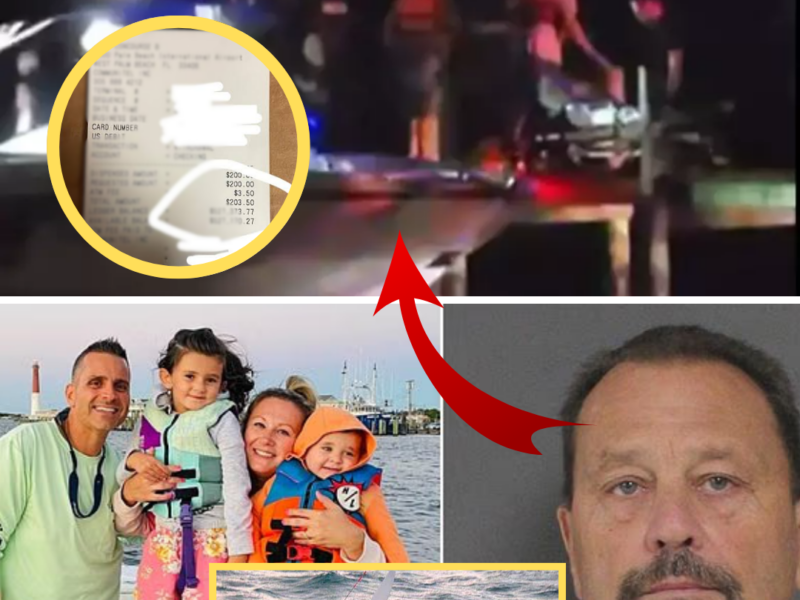
Stephen Schneider might recall the number of beer bottles, but the signs observed by the police were beyond his control!
Stephen Schneider might recall the number of beer bottles, but the signs observed by the police were beyond his control!
A statement can be based on memory.
But a person’s condition right in front of the police is a matter of direct observation.
Following the crash that claimed the lives of Mya and Sigmund, officers noted the signs used to assess Stephen Schneider’s condition.
Subsequently, a BAC result of approximately 0.16% was recorded.
Two different types of evidence are now being weighed against each other to determine the true state Stephen Schneider was in that night.
********

The tranquil, shimmering expanse of Barnegat Bay along the New Jersey coastline is a cherished haven for summer recreation, family boating trips, and peaceful evenings on the water. Yet, beneath the serene surface of these coastal inlets lies a serious maritime environment where split-second errors, diminished reaction times, and environmental hazards can converge into sudden, irreversible tragedy. A peaceful summer night on the water turned into an unthinkable nightmare when a thirty-foot vessel struck a waterway channel marker with devastating force, claiming the young lives of nine-year-old Mya Golabek and seven-year-old Sigmund Golabek. The fatal collision sent shockwaves through Berkeley Township and the wider Ocean County community, plunging a grieving family into an agonizing legal battle focused on accountability, forensic toxicology, and the precise observations made by law enforcement officers at the scene.
The central figure in the criminal prosecution is sixty-four-year-old Stephen Schneider of Bayville, New Jersey, the grandfather who was operating the center-console Tidewater vessel at the time of the crash. According to the probable cause affidavit filed by the New Jersey State Police, the tragic incident unfolded shortly after nine o’clock on a July evening. Schneider, along with his wife Laurie, had spent the evening dining at a waterfront restaurant with their grandchildren and the children’s parents. Following dinner, nine-year-old Mya and seven-year-old Sigmund expressed a desire to ride back with their grandparents on their boat rather than returning with their parents. The short journey across the dark bay, however, ended in catastrophe when the vessel slammed squarely into an Intracoastal Waterway channel marker. The violent impact instantly ejected the two young children into the dark water. Though Schneider and his wife immediately jumped in and pulled the unresponsive children from the bay, and despite frantic life-saving efforts by first responders and emergency medical personnel, both Mya and Sigmund were tragically pronounced dead at a local hospital.
In the wake of the disaster, investigators immediately sought to reconstruct the final moments leading up to the crash, setting off a complex legal debate centered on conflicting layers of evidence regarding the operator’s physical state. According to statements provided by Schneider to state troopers during the initial investigation, he recalled consuming a limited quantity of alcohol during dinner—specifically stating that he had drank two Guinness beers and one Miller Lite over the course of approximately two hours. While a statement regarding the exact number of consumed beverage bottles can be heavily influenced by subjective recollection, fading memory, or minimization under stress, the physiological reality observed directly by law enforcement officers at the scene stood entirely beyond the operator’s control. Responding troopers noted distinct, objective physical signs of impairment during their face-to-face interactions with Schneider in the immediate aftermath of the tragedy, prompting authorities to obtain a search warrant for a formal blood draw.
The subsequent chemical analysis added an undeniable layer of scientific data to the state’s investigation. According to laboratory reports from DrugScan Labs cited in court documents, a blood sample drawn from Schneider at approximately 12:46 a.m. yielded a blood alcohol concentration of 0.16 percent—exactly double the legal limit of 0.08 percent established for operating a vessel or motor vehicle in New Jersey. Medical experts reviewing the toxicology results concluded that Schneider was thoroughly unfit to operate a watercraft, noting that his alertness, sense of care and caution, depth perception, judgment, response time, and physical coordination were markedly impaired by alcohol at the time of the collision. This objective chemical reading contrasted sharply with the defense’s attempts to frame the incident around external navigational challenges, such as whether the channel marker was properly illuminated, and Schneider’s lifelong familiarity with the local waterways.
As the case proceeded through the Ocean County Superior Court system before Judge Wendel Daniels, legal arguments increasingly weighed these two distinct forms of evidence against one another to determine the true state in which Stephen Schneider operated his vessel that night. Prosecutors, led by Assistant Prosecutor Kate Burke, emphasized the damning convergence of the 0.16% BAC level and the physical indicators of intoxication observed by troopers, arguing that the high level of impairment directly contributed to the deadly failure to avoid a stationary navigational marker. Conversely, defense attorney William P. Cunningham sought to contextualize the timeline and highlighted the extraordinary circumstance that the parents of the deceased children submitted letters pleading for the grandfather’s release, describing him as a devoted family pillar who was suffering unimaginable grief alongside the rest of the family.
During a high-stakes detention hearing, Judge Daniels ultimately decided to release Schneider under Level 3 pretrial monitoring conditions, which mandate weekly court check-ins and strictly prohibit him from operating any motor vehicle or watercraft pending a substance abuse evaluation and trial proceedings. Yet, as the legal proceedings march toward upcoming court dates, the core of the state’s case rests squarely on the confrontation between human memory and objective forensic reality. Whether examining the recalled tally of beer bottles from dinner or evaluating the undeniable chemical proof of a 0.16% blood alcohol concentration alongside the unyielding physical signs witnessed by police officers, the judicial system must meticulously weigh every facet of evidence to establish accountability for a tragedy that forever altered a family and stunned a coastal community.
The wider legal and societal ramifications of the Barnegat Bay tragedy extended far beyond the immediate courtroom arguments, thrusting the complex issue of maritime safety and recreational boating intoxication into the regional spotlight. Marine law enforcement agencies across New Jersey utilized the high-profile case to emphasize that operating a vessel carries the exact same legal responsibilities, chemical thresholds, and sobriety standards as driving an automobile on public highways. Safety advocates noted that open-water navigation presents unique nighttime hazards, including shifting currents, unlit environmental markers, and limited visibility, all of which require optimal cognitive function, rapid reaction times, and zero chemical impairment. The devastating loss of young Mya and Sigmund Golabek served as a somber reminder to boating communities throughout the Jersey Shore that the recreational freedom of the water can turn fatal in an instant when judgment is compromised by alcohol consumption.
For the grieving family members caught in the center of the judicial storm, the path forward remained fraught with unimaginable emotional conflict. On one side stood the unyielding mandate of the criminal justice system to prosecute boating under the influence resulting in death—charges that carry severe prison sentences under New Jersey law. On the other side stood the agonizing human reality of a tight-knit family trying to navigate a double catastrophe: the tragic loss of two beloved grandchildren, paired with the pending criminal prosecution of the grandfather who cherished them. Letters submitted by the children’s parents pleading for leniency and highlighting the profound remorse and grief felt by Stephen Schneider illustrated a rare and heartbreaking dynamic rarely seen in standard criminal trials. As the court proceedings continued toward resolution, the case stood as a tragic testament to how a single evening of impaired decision-making on the water can ripple across generations, leaving a permanent scar on a community and forever transforming the lives of everyone involved.