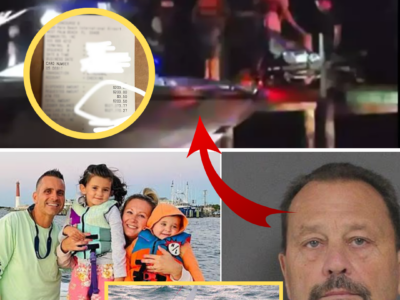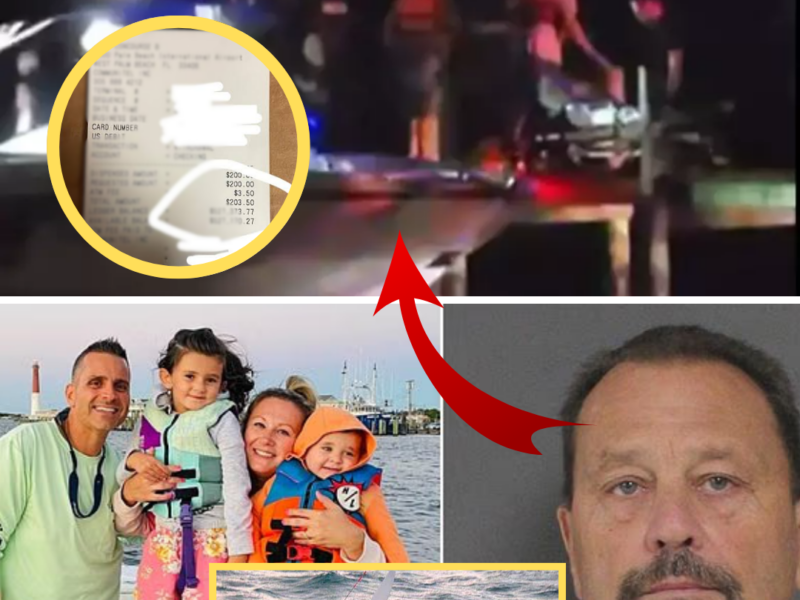
A witness might recall a different evening: Stephen Schneider claims there were three bottles of beer, but he wasn’t the only person at the table! Stephen Schneider has his own version of events. However, before Mya and Sigmund boarded the boat, several other people had been present at dinner with him. This creates a major issue for both sides: Stephen Schneider’s testimony can be cross-referenced with the recollections of others. If even a single witness remembers a different timeline, the story of the “three bottles of beer” could spark a fierce battle in court.

The idyllic summer evening shared by the family along the waterfront restaurant in Berkeley Township was meant to be a simple celebration, yet the hours leading up to the fatal voyage on Barnegat Bay have since become the focal point of an intense legal and investigative battle. While sixty-four-year-old Stephen Schneider offered investigators a specific tally of his alcohol consumption—claiming he had consumed two Guinness beers and one Miller Lite over the course of dinner—the existence of multiple dining companions introduces a critical vulnerability into his defense strategy. A witness might recall a different evening: Stephen Schneider claims there were three bottles of beer, but he wasn’t the only person at the table. Stephen Schneider has his own version of events, but before nine-year-old Mya and seven-year-old Sigmund boarded the vessel for what would be their final ride, several other family members, including his wife Laurie and the children’s parents, had been present at dinner with him. This creates a major issue for both sides: Stephen Schneider’s testimony can be cross-referenced with the recollections of others. If even a single witness remembers a different timeline, the story of the “three bottles of beer” could spark a fierce battle in court.
The introduction of third-party testimony transforms the evidentiary landscape before the Ocean County Superior Court. In driving and boating under the influence prosecutions, establishing an accurate timeline of alcohol ingestion is paramount for both prosecutors seeking to prove recklessness and defense attorneys attempting to establish the defendant’s sobriety or lack of impairment. When a suspect provides a precise numerical figure like three bottles, investigators immediately look for corroborating or contradicting statements from anyone who shared the physical space. If restaurant servers, family members, or other patrons seated at the table recall a higher volume of drinks, additional rounds ordered, or a timeline of consumption that extends far beyond Schneider’s stated window, the discrepancy becomes a devastating tool for the state. Conversely, if witnesses corroborate that he consumed only the stated amount, the defense gains a stronger foothold to challenge how a mere three beers could yield a staggering blood alcohol concentration of 0.16 percent—exactly double the legal limit.
This divergence between self-reported memory and multi-party witness testimony sits at the heart of the broader friction between subjective recollection and objective forensic data. Human memory under acute stress or following a traumatic event is notoriously malleable, and individuals frequently misjudge portion sizes, pacing, and total quantities consumed over an extended meal. However, when multiple individuals share the same environment, their collective observations form a mosaic of truth that investigators can piece together to reconstruct the evening. The statements provided by family members who dined with Schneider just moments before the tragedy will be heavily scrutinized during depositions and potential trial testimony, as prosecutors weigh every recalled detail against the unyielding metrics of the toxicology report from DrugScan Labs.
As the legal proceedings before Judge Wendel Daniels advance, the defense team led by William P. Cunningham must navigate the treacherous waters of witness cross-examination while managing the strict Level 3 pretrial monitoring conditions imposed on Schneider. Assistant Prosecutor Kate Burke and the state’s legal team are poised to leverage any inconsistencies between Schneider’s narrative and the testimonies of his dining companions to dismantle the credibility of the three-beer defense. Ultimately, the question of what transpired at that dinner table encapsulates the profound human tragedy of the case: a family fractured by a sudden disaster, now forced to watch private moments of a summer evening get picked apart under the merciless spotlight of a courtroom seeking absolute accountability.
The potential discrepancies among witnesses seated at the waterfront table introduce a complex layer of psychological and tactical maneuvering for both the prosecution and the defense in the Ocean County courtroom. When investigators interview dining companions following a fatal accident, they are not merely looking for a headcount of bottles; they are probing for behavioral cues, speech patterns, pacing of orders, and the visibility of the drinks exchanged throughout the meal. If other family members recall Schneider nursing his beverages slowly over two hours, it aligns with a narrative of moderation. However, if waitstaff or relatives remember rounds being ordered more rapidly, shared pitchers, or additional drinks purchased outside of Schneider’s initial recollection, the foundation of his voluntary statement crumbles under cross-examination. This friction between individual perception and collective memory forces defense attorneys to carefully vet every witness statement before placing them on a witness stand, knowing that a single contradictory detail from a family member could irreparably damage the defendant’s credibility in the eyes of a judge and jury.
Furthermore, the legal implications of conflicting testimonies extend directly into the realm of expert toxicological reconstruction. Expert witnesses for the state will inevitably attempt to model retroactively how a human body processes alcohol, taking into account Schneider’s body weight, metabolic rate, the specific alcohol-by-volume percentages of Guinness and Miller Lite, and the exact window of time between the first sip at the restaurant and the fatal impact on Barnegat Bay. If witness testimony expands that drinking window or introduces additional alcohol into the equation, the scientific models shift accordingly, closing the gap between the self-reported three beers and the recorded 0.16 percent blood alcohol concentration. On the other hand, if witnesses staunchly defend Schneider’s stated timeline, the defense gains ammunition to question the reliability of the chemical testing itself, probing into potential variables such as blood sample handling, post-collection fermentation, or testing instrument calibration at DrugScan Labs.
This high-stakes legal chess match underscores the profound tragedy of a family caught in an inescapable crossfire of accountability and grief. The very people sitting across the table from Stephen Schneider that evening—the same relatives who later submitted heartfelt letters pleading for his pretrial release and mourning the heartbreaking loss of young Mya and Sigmund—now find their memories and statements dissected as crucial legal evidence. Every recollection of a shared meal is weighed against the unyielding standards of maritime law and forensic science, turning private family moments into public exhibits. As pretrial preparations press forward under the watchful eye of the judicial system, the confrontation between Schneider’s version of events and the collective memory of his dining companions remains a decisive battleground, proving that in the wake of such irreversible devastation, even the simplest dinner table conversation can become the key to unlocking the truth.