Seven years before Erin Piacenti’s death, Pamela Cisneros was already fighting for her life: In 2019, she allegedly attempted suicide by throwing herself onto the subway tracks in Queens
Seven years before Erin Piacenti’s de@th, Pamela Cisneros was already fighting for her life: In 2019, she allegedly attempted suicide by throwing herself onto the subway tracks in Queens.
Following that incident, her father began taking her for regular treatment.
Her family says the medication seemed to keep Pamela stable for years.
Her brother even described her as someone who was “never aggressive.”
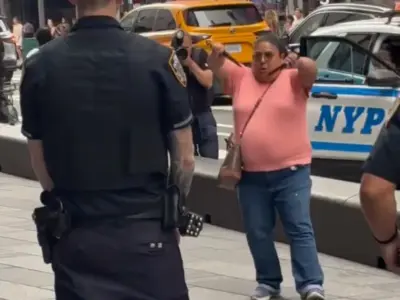
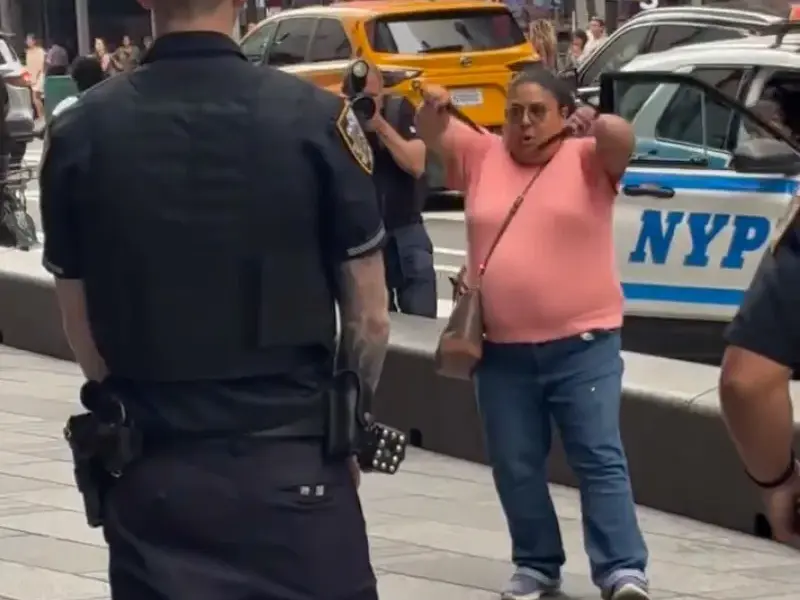
Yet, by late August 2026, she appeared in Times Square wielding two knives.
What haunts her family the most may not be what Pamela did that day—but rather what had changed since her 2019 crisis…
*********************
**Seven Years Before Erin Piacenti’s Death: Pamela Cisneros’s 2019 Crisis, Years of Apparent Stability, and the Unexplained Change That Followed**
Seven years before the random stabbings that killed Erin Piacenti in Times Square, Pamela Cisneros was already fighting for her life. On March 6, 2019, according to police sources and consistent family accounts, she attempted suicide by jumping onto the tracks of the E train at the Union Turnpike station in Queens. The incident marked one of the most acute crises in a long history of mental health struggles and led to a period of more structured family involvement and medical treatment. For several years afterward, relatives said, monthly psychiatric injections appeared to keep her stable. Her brother described her during that time as someone who was “never aggressive.” Yet by the afternoon of August 31, 2026, Cisneros appeared in Times Square holding two knives. What continues to haunt her family is not only the violence of that day, but the question of what had changed since the 2019 crisis that once seemed to mark a turning point.
Patrick Peralta, Cisneros’s brother, has given the most detailed public account of her background and the years that followed the subway incident. He said her mental health difficulties began roughly two decades earlier, after the birth of her second daughter, when she experienced postpartum depression. He believed the condition later involved bipolar disorder, though he has been careful to note that he does not know the complete clinical diagnosis. Over the years she had been hospitalized multiple times, including at Jamaica Hospital and Bellevue Hospital. In December 2018, only months before the suicide attempt, she had a documented mental-health-related encounter with the New York Police Department. Officers found her belligerent, intoxicated, and screaming along Lexington Avenue near East 49th Street in Midtown Manhattan. The March 2019 attempt to jump in front of a train followed less than four months later.

The 2019 crisis prompted a change in the management of her treatment. Because Cisneros had difficulty maintaining a daily medication schedule, doctors prescribed monthly psychiatric injections. Her father, Mario Cisneros, began taking her to the appointments. He has said he believed the consistent treatment helped her turn a corner. For the next several years, according to both her father and her brother, the injections appeared to provide a measure of stability that had previously been elusive. Peralta stated that for the previous four to six years, while she received the medication, “nothing was wrong” and “she was fine.” He emphasized that she never showed aggression or violence toward other people during that period. “As long as she got the medication, she was fine … She never showed any violence towards anybody,” he said in interviews in the days after the Times Square incident.
During those years of relative calm, Cisneros lived alone in an apartment on a quiet, tree-lined block in Woodside, Queens. The building manager later told reporters that she paid her rent on time, exchanged brief greetings, and never caused any problems. A neighbor who said he had known her since the day she was born described her as “an excellent woman” and said he did not know what had happened to her. She held intermittent employment, including recent work as an administrative assistant for an attorney who specialized in immigration cases. She had earned a master’s degree in psychology, a detail confirmed by both her brother and the longtime neighbor. She maintained regular contact with her mother and stepfather, joining them for meals on most afternoons and on weekends—a routine that continued until the final week of her life.
Cisneros was the mother of three daughters. One, who is autistic and nonverbal, lives in a group home in Brooklyn and was visited by her mother. The other two daughters live in Florida with their father after the end of Cisneros’s marriage. Court records show that she married Jose Lopez in September 1999. The couple had three children together and later lived for a period in Florida. By 2018 they had separated, and Cisneros had returned to Queens. Lopez filed for divorce in Hillsborough County, Florida, in 2020. The case, which included custody proceedings, was finalized in 2025. Peralta has said he faced the painful task of informing the two daughters in Florida of their mother’s death by telephone in the days after August 31.
In the months leading up to the attack, family members began to notice shifts that, in retrospect, stand out more clearly. According to her father, Cisneros had in recent months expressed a desire not to remain dependent on the medication. “She didn’t want to continue them,” Mario Cisneros said. “She was fighting to not be on the medicine, to not have to depend on it.” In April 2026 she declined his offer to drive her to a scheduled appointment at Jamaica Hospital Medical Center, telling him she could go alone. “No, Dad, don’t worry,” he recalled her saying. “I’m good. Don’t worry about me.” About ten days before the incident he had seen her for dinner and observed nothing unusual. In the week immediately before August 31, however, she stopped making her customary visits to the family. Relatives noticed the absence and began calling. On Saturday, two days before the attack, her mother succeeded in speaking with her by telephone. According to Peralta, Cisneros said she was fine. Peralta has raised the possibility that she may have missed recent injections after she began administering them herself rather than receiving them under clinical supervision. “That’s the only thing I can suggest,” he said, “that maybe she didn’t get the last couple of months of injections.”

On the afternoon of Monday, August 31, 2026, according to official accounts from the New York Police Department, Cisneros pulled two kitchen knives from a red Target shopping bag near West 41st Street and Seventh Avenue at approximately 4:24 p.m. She stabbed a 68-year-old man from Rhode Island in the abdomen. Roughly twenty seconds later she moved north and fatally stabbed 32-year-old Erin Piacenti near West 42nd Street. Piacenti, a Bank of America vice president, was on her first day back at work after five months of maternity leave. She and her husband, Frank, had welcomed their daughter Madison five months earlier and had recently celebrated their second wedding anniversary. Officers located Cisneros near an NYPD substation in the area of West 43rd Street. Police Commissioner Jessica Tisch stated that officers spent about four minutes engaging her in dialogue and issuing repeated commands to drop the knives. Cisneros refused, stating that she would rather kill the officers and repeating that she would kill them. She waved the knives and advanced. Multiple officers deployed Tasers. The devices proved ineffective. Two officers then fired their service weapons. Cisneros was transported to Bellevue Hospital, the same hospital where Piacenti was taken, and was pronounced dead.
A retired NYPD detective and Taser expert later analyzed available video and identified several factors that may have limited the effectiveness of the less-lethal devices, including body composition, a probe that struck Cisneros’s handbag, the distance between officers and the subject, and her continuous movement. Those technical observations form part of the public discussion of the final confrontation but do not address the larger question that family members continue to ask: what changed between the years of apparent stability that followed the 2019 crisis and the violence of August 31, 2026.
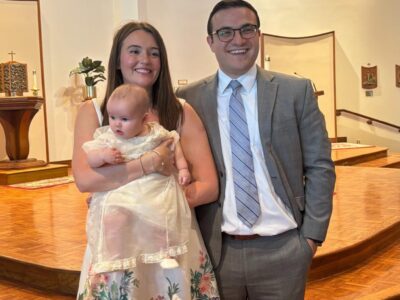
Erin Piacenti’s family released a statement in the days after the attack describing their devastation. They remembered a 32-year-old wife, new mother, daughter, sister, and friend whose life was defined by devotion, warmth, and the profound joy of motherhood rather than by the circumstances of her death. Becoming a mother, they said, had been Erin’s lifelong ambition, and Madison had given her the greatest possible joy. The couple had been preparing to build a life together with their new daughter when that life changed incomprehensibly in an instant. A GoFundMe was established to support Madison’s future, with funds directed to Frank Piacenti.
Cisneros’s relatives have expressed sorrow for the victims while continuing to search for an explanation that still eludes them. Peralta has said the entire family feels deep regret for the person who died and the person who was injured. He has described the change in his sister as sudden, “like a switch,” and has said he does not know what was in her head. Her mother has publicly questioned why the officers present did not physically restrain her daughter by grabbing her arm given the number of police on the scene. Her father has said the actions do not fit the daughter he knew and has asked forgiveness from the victims’ families, stating that he is suffering as they are suffering.
The investigations into the stabbings and the officer-involved shooting remain open. The NYPD Force Investigation Division and the New York Attorney General’s Office of Special Investigation are reviewing the case. Body-worn camera footage from the confrontation is expected to be released as part of the standard process governing critical incidents. No official finding has determined whether a disruption in Cisneros’s medication regimen, a deterioration in her underlying mental health condition, or any other specific factor accounted for the events of that Monday afternoon.

What haunts the family most, according to the statements they have given, is the distance between the woman who emerged from the 2019 crisis into a period of relative stability and the person who appeared in Times Square seven years later. They have described years in which the monthly injections seemed to work, in which she was never aggressive, in which she maintained ordinary routines of work, family contact, and quiet residence in Queens, and in which, only two days before the attack, she told her mother she was fine. The gap between that history and the sudden violence of August 31 remains the central unresolved element in their accounts. The formal investigations continue, and additional information may yet emerge from official reviews and the release of body-camera footage. For now, the documented sequence—from the acute crisis of March 2019, through years of treatment and apparent stability, to the recent shifts in behavior and attitude toward medication, the final ordinary telephone call, and then the events in Times Square—stands as the factual outline of a change her family says they did not see coming and still cannot fully explain.