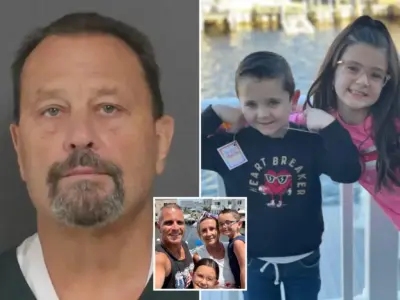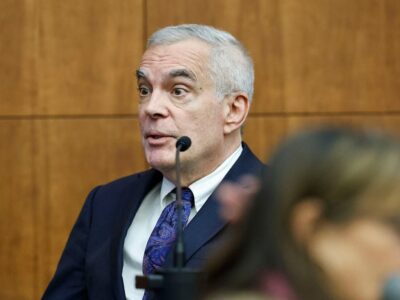
“I’VE TRAVELED THIS ROUTE MANY TIMES”: Stephen Schneider says he was very familiar with the waters prior to the crash!
“I’VE TRAVELED THIS ROUTE MANY TIMES”: Stephen Schneider says he was very familiar with the waters prior to the crash!
In his statement to the police, Schneider said he had spent his entire life on boats and on the water and had traveled this route many times.
He also stated that the radar and infrared camera were operational as the boat entered the bay at night.
However, this particular trip ended in a collision that claimed the lives of 9-year-old Mya and 7-year-old Sigmund.
Schneider’s account of his experience is now being weighed against the events of the final few seconds.
**************
“I’ve Traveled This Route Many Times”: Experience, Familiarity, and the Final Seconds of a Deadly Collision
In the aftermath of the July 19, 2026, boat crash on Barnegat Bay that killed his two young grandchildren, Stephen Schneider told investigators he was no stranger to these waters. “I’ve traveled this route many times,” he said, according to his statement to police. He described a lifetime spent on boats and on the water, asserting that the path he was following that night was one he knew well. He also maintained that the boat’s radar and infrared/low-light camera were both operational as the vessel moved through the bay in darkness.
Yet this particular trip ended in catastrophe. Schneider’s 28-foot Tidewater Custom 280 struck an illuminated Intracoastal Waterway channel marker—identified as marker No. 39—shortly after 9 p.m. The impact ejected 9-year-old Mya Bella Golabek and 7-year-old Sigmund “Siggy” Paul Golabek into the water. Both children, who were wearing life jackets and seated at the front of the boat, were later pronounced dead at a hospital.
Schneider’s account of long experience and active navigation aids is now being weighed against the events of those final few seconds, against toxicology results showing significant alcohol impairment, and against the physical reality of a collision with a fixed, lighted navigational aid on a route he claimed to know intimately.
A Lifetime on the Water
According to statements attributed to Schneider in the investigative record, he had spent his entire life around boats. The family lived in the Bayville section of Berkeley Township, with a waterfront home valued at approximately $1 million. The Intracoastal Waterway and the channels of Barnegat Bay were, by his own description, familiar territory. He told police he had navigated the same general route on many previous occasions.
Familiarity with local waters is often cited by experienced boaters as a significant safety advantage. Knowledge of marker locations, typical traffic patterns, shallow areas, and the visual appearance of aids to navigation under different lighting conditions can reduce the cognitive load of nighttime operation. Schneider’s assertion that he knew the route well therefore places particular emphasis on the question of what went wrong in the moments before impact.
Investigators will examine whether that claimed familiarity translated into accurate real-time awareness on the night of July 19. Channel markers can appear different at night depending on background lighting, weather, sea state, and the operator’s position and attention. Even a well-known marker can be missed if the operator’s focus is elsewhere, if speed reduces reaction time, or if impairment dulls perception and decision-making.
The Navigation Systems
Schneider told police that both the radar and the infrared/low-light camera were turned on as the boat entered the bay that night. These systems are designed precisely for conditions of limited visibility. Radar detects hard objects such as channel markers and returns them as targets on a display. Infrared or low-light cameras can reveal the thermal or amplified visual outline of structures that might otherwise be difficult to distinguish against the night sky or shore lights.
The fact that Schneider reported both systems as active raises a series of technical and operational questions that crash reconstruction experts are expected to address. Were the systems properly adjusted for the range and conditions? Was the radar range scale appropriate for detecting a nearby fixed marker? Was the infrared camera oriented and focused in a way that would have shown the marker in the boat’s path? Were the displays positioned so that the operator could monitor them while also scanning the physical environment? And critically, given the documented level of alcohol in Schneider’s system, was his ability to interpret and respond to the information from those systems compromised?
At approximately 20 mph—the speed Schneider reported—the boat was covering nearly 30 feet per second. In the time it takes to glance from a display to the horizon and back, or to process an unexpected radar return, the distance to a fixed object can close rapidly. Schneider stated that he saw the marker only at the last second. That description suggests either that the marker did not register effectively on the systems he said were operating, or that the information they provided was not acted upon in time.
The Night of the Crash
The sequence of events leading to the collision has been pieced together from Schneider’s statements, 911 recordings, and police reports. Earlier that evening, Schneider and his wife, Laurie, had taken the Tidewater to MJ’s Restaurant Bar & Grill in Bayville, where they met their daughter, son-in-law, and the two grandchildren for dinner. After the meal, Mya and Sigmund chose to ride back with their grandparents rather than return in their parents’ boat. The children were seated forward and were wearing life jackets.
Schneider was at the helm as the boat moved through the Intracoastal Waterway. According to the affidavit of probable cause, he was traveling at about 20 mph when the boat’s starboard bow struck the illuminated channel marker. The force of the impact threw both children into the water. Schneider and his wife located the children, who were found face-down and unresponsive. CPR was begun. Emergency responders transported the children to Community Medical Center in Toms River, where they were pronounced dead.
Toxicology testing later determined that Schneider’s blood alcohol content was approximately 0.16 percent—twice the legal limit of 0.08 percent for operating a vessel in New Jersey. He had told investigators he consumed three beers (two Guinness and one Miller Lite) over roughly two hours before the crash. A toxicology analysis concluded that his alertness, judgment, and response time were markedly impaired by alcohol.
Experience Versus Impairment
Schneider’s claim of lifelong experience and repeated travel on the same route sits in tension with the evidence of impairment. Experience can create a sense of confidence that, when combined with alcohol, may lead an operator to underestimate risk or overestimate their ability to respond to sudden hazards. Familiarity with a route can also produce a form of automaticity—navigating by habit rather than by continuous, active scanning—which becomes dangerous when conditions or the operator’s capacity change.
Prosecutors have charged Schneider with two counts of reckless vessel homicide, operating a vessel under the influence, and reckless operation of a vessel. The homicide charges are second-degree offenses carrying a potential maximum sentence of 20 years. Schneider was arrested in mid-August, held briefly, and then released on conditions after a detention hearing at which prosecutors cited the blood alcohol level and the fatal outcome. The children’s parents submitted letters supporting their grandfather’s release pending trial. Schneider’s attorney has emphasized that the crash was not intentional and that questions remain about the marker and the boat’s equipment.
Reconstruction and the Final Seconds
The legal and investigative focus now centers on reconstructing the final seconds before impact. Key questions include:
What did the radar display show in the moments leading up to the collision?
What image, if any, appeared on the infrared/low-light camera?
At what distance and bearing did the marker first become detectable by the systems or by the naked eye?
How did Schneider’s reported speed and course interact with the geometry of the marker and the boat’s path?
To what extent did alcohol impairment affect his perception, attention, and reaction time?
Channel marker No. 39 is described in investigative documents as a single-stanchion illuminated navigational aid. Police stated that its lights were functioning properly. An illuminated marker should, under normal circumstances, be visible at a sufficient distance for an attentive, unimpaired operator traveling at moderate speed to detect and avoid it—particularly an operator who claims long familiarity with the route.
The presence of active radar and infrared systems was intended, according to Schneider’s own account, to enhance that detection capability. Their reported activation therefore becomes both a potential mitigating factor in the narrative of an experienced boater taking precautions and a point of scrutiny regarding whether those precautions were effectively used.
Broader Implications for Nighttime Boating
The Barnegat Bay collision has renewed attention to the risks of nighttime operation on congested coastal waterways. Even experienced boaters face reduced visual cues after dark. Background lights from shore can mask or compete with the lights of navigational aids. Speed that feels moderate in daylight can become excessive when reaction windows shrink. Alcohol, even in amounts that an individual might consider modest, measurably degrades the very cognitive functions—attention, judgment, divided attention between displays and the environment, and rapid decision-making—that nighttime navigation demands.
Technology such as radar and thermal imaging can significantly improve safety when properly used. Yet technology does not eliminate the need for sober, continuous vigilance. Schneider’s statements place both his experience and his use of available technology at the center of the factual record. The collision itself, and the deaths of Mya and Sigmund, stand as the tragic measure against which those statements are now being evaluated.
As the case moves forward, prosecutors will argue that impairment and recklessness led directly to the fatal impact. The defense is expected to examine the performance of the navigation systems, the characteristics of the marker, and the precise sequence of events in the final seconds. Schneider’s own words—that he had traveled the route many times, that he had spent a lifetime on the water, and that the radar and infrared camera were operating—will remain central to both sides’ presentations.
Those words describe a man who believed he was prepared for the conditions. The outcome of the voyage describes a different reality: a sudden collision, two children thrown into the dark water, and a family forever altered. The gap between the claimed familiarity and the final result is the space in which investigators, attorneys, and ultimately a jury will seek answers.