My Mother-in-Law Hid Her Diamond Necklace In My Purse… Then Asked Everyone To Search My Bag
Chapter 1: The Disappearing Heirlooms
The grand estate of Blackwood had stood as a monument to timeless elegance for over a century, its corridors lined with priceless oil portraits and heavy velvet draperies that muffled the whispers of Charleston’s elite. But beneath the polished mahogany and the shimmering crystal chandeliers, a quiet rot had begun to eat away at the foundation of the household.
Richard Blackwood, the patriarch whose sharp business acumen had multiplied the family fortune threefold, sat in his private study late into the night. The room smelled of aged leather, pipe tobacco, and old paper. On his mahogany desk lay a velvet-lined jewelry case that had once belonged to his great-grandmother—a heavy, intricately carved box containing generations of family history.
For three months, Richard had noticed a disturbing pattern. He was a man of meticulous habits, possessing an almost photographic memory for the estate’s inventory. First, a pair of diamond-encrusted sapphire earrings had vanished for a fortnight before reappearing neatly in the velvet slots with a vague, dismissive explanation from his wife, Margaret, about them being sent out for professional cleaning. A week later, a sixteenth-century gold brooch had gone missing, only to materialize on Margaret’s dressing table with an equally flimsy excuse regarding a charity exhibition.
At first, Richard had dismissed these anomalies as forgetfulness or harmless vanity. Margaret had always managed the social calendar and the public presentation of the family jewels with an iron fist. But as the weeks passed, the excuses stopped aligning with reality. When Richard inquired with the estate’s preferred jeweler in downtown Charleston, the manager had looked blankly at him and confirmed that no such pieces had been brought in for cleaning or repair in over two years.
A cold, hard realization had settled into Richard’s chest. Someone inside the household was systematically siphoning off the family’s historical collection.
Acting with the silent precision of a man who had built an empire through calculated caution, Richard decided not to confront anyone. Instead, he set a trap. He took the crown jewel of the collection—a breathtaking diamond tennis necklace handed down through four generations of Blackwood women—and quietly drove it to the downtown branch of First Charleston National Bank. He deposited the original piece into a heavily guarded safety deposit box, out of reach of anyone in the mansion.
Then, he commissioned one of the finest private jewelers in the city to create an almost indistinguishable replica. To the naked eye, under the twinkling lights of a ballroom or the dim lamps of a hallway, the fake necklace was flawless. Only a jeweler’s loupe and a microscopic inspection could reveal the subtle variance in the alloy stamp.
Richard brought the duplicate home, locked it back in the velvet case, and waited. He told no one—not his children, not the estate staff, and certainly not his wife. He wanted to see who would take the bait, and how far they were willing to go to cover their tracks.
Chapter 2: The Shadows of the Pawnshop
The annual Blackwood Autumn Gala arrived three months after Richard initiated his quiet investigation. It was the premier social event of the season, drawing politicians, corporate titans, and society matrons from across the Carolinas. The ballroom was a swirling vortex of silk, tuxedos, and polite, superficial laughter.
Yet, beneath the glittering surface, the trap was about to spring.
Earlier that afternoon, Richard had received an encrypted package delivered directly to his study by a courier he had hired himself. Inside the thick manila envelope were two items that confirmed his darkest suspicions: a certified report from a private detective agency he had retained, and a stack of authenticated transaction logs from three separate, high-end pawnshops located in the historic district of Savannah and Charleston.
The pages detailed a devastating financial reality. Margaret Blackwood, the woman who commanded absolute social deference and preached incessantly about family honor and fiscal responsibility, had been secretly liquidating the family’s portable wealth for over two years.
The detective’s report laid out the motive with brutal clarity. Margaret had engaged in speculative, high-risk real estate ventures and unauthorized offshore investments through a discredited brokerage firm. When those ventures collapsed, they triggered a cascading series of margin calls and mounting debts that threatened to bankrupt her personal accounts. Terrified of facing Richard’s wrath and losing her exalted position in high society, she had turned to the family vault.
Piece by piece, she had smuggled the historical heirlooms out of the estate, pawning them for fractions of their true value to keep her disastrous financial house of cards from collapsing.
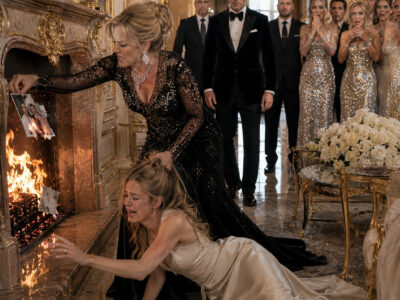
As Richard sat in his study reviewing the pawnshop receipts—complete with Margaret’s signature disguised under a maiden alias—a sharp knock sounded at the door. It was the estate housekeeper, breathless and visibly agitated. She reported a frantic scene unfolding upstairs in the grand dressing suite: Emily, Julian’s gentle and soft-spoken wife, had been accused of stealing the family diamond necklace from Margaret’s private vanity.
Richard’s blood ran cold. Margaret hadn’t just been stealing; she had set up a scapegoat. With the gala hours away, and the replica necklace slipped into Emily’s embroidered evening bag by design, Margaret had engineered a crisis to divert all suspicion away from herself, sacrificing her innocent daughter-in-law to protect her own ruined reputation.
Chapter 3: The Trap Closes
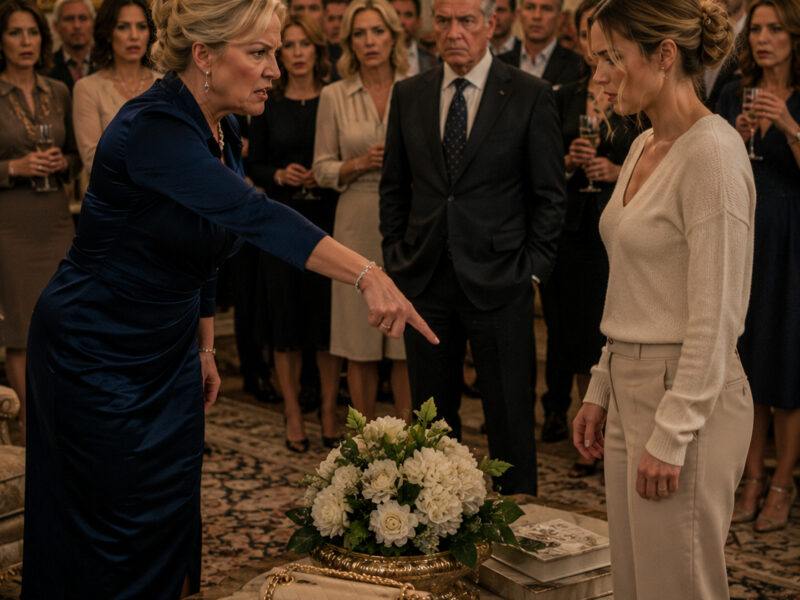
The confrontation in the main drawing-room was designed by Margaret to be a public execution.
When Richard walked down the grand staircase, he found a semicircle of shocked family members and senior estate guests gathered around the antique Persian rug. Margaret stood at the center, tears streaming down her powdered cheeks, holding an open velvet box in trembling hands. Emily stood a few paces away, pale, trembling, and utterly bewildered, her hands clutching her small evening purse as though it were a shield.
“I can’t even look at you, Emily,” Margaret was sobbing, her voice carrying the practiced inflection of a tragic stage actress. “For months I’ve covered for your mistakes, welcomed you into this family despite your humble background, and how do you repay us? You steal a priceless heirloom that has belonged to the Blackwood women for a century!”
“I didn’t take it!” Emily cried out, her voice cracking with sheer panic. “I swear to God, Margaret—I walked into the dressing room to drop off the guest book, and the box was sitting open on the vanity. I didn’t touch the necklace!”
“We found it zipped inside your handbag, my dear,” interjected Julian, his face twisted in a mixture of anger and embarrassment as he stared at his wife. Julian had always been easily manipulated by his mother, and the damning physical evidence made it easy for him to default to doubt. “The maids saw you come out of that room. Just confess, Emily. Why would you do something so reckless?”
“Because she didn’t do it,” a deep, authoritative voice cut through the murmurs of the room like a sheet of ice.
Richard stepped into the center of the circle. The atmosphere in the room shifted instantly. The murmurs died away, replaced by a heavy, suffocating silence. Richard looked older tonight, his shoulders weighed down by a profound weariness, but his eyes burned with an intensity that made even Margaret take an involuntary step backward.
“Richard,” Margaret stammered, her tears faltering for a fraction of a second. “Thank God you’re here. We caught her red-handed. The diamond necklace—”
“The diamond necklace,” Richard interrupted, his voice terrifyingly calm, “is currently locked securely inside a safety deposit box at First Charleston National Bank, where I placed it three months ago.”
Margaret blinked, her breath catching in her throat. “What… what are you talking about? That’s impossible. It’s right here in the box—”
“What is in that box,” Richard said, pointing a steady finger at the velvet container in his wife’s hands, “is an exact replica I had commissioned by a master jeweler after I noticed our heirlooms beginning to vanish into thin air.”
The color drained entirely from Margaret’s face. She looked as though she had been struck across the cheek.
Chapter 4: The Evidence
Without waiting for recovery, Richard reached into the inner pocket of his tuxedo jacket and withdrew the thick manila envelope containing the detective’s report and the pawnshop transaction logs. He didn’t hand them to Margaret; instead, he walked over to the mahogany side table and laid them out under the harsh, direct glare of the brass reading lamp.
“For three months,” Richard said, his voice echoing off the high-ceilinged walls of the drawing-room, addressing the assembled guests as much as his family, “I have conducted a quiet investigation into the missing assets of this estate. I wanted to know who was betraying our family trust. I wanted to know who had the audacity to strip the walls and vaults of history to feed their own secret failures.”
He turned the first page of the pawnshop logs toward Julian and the gathered relatives.
“Here are the transaction receipts for the sapphire earrings, the gold brooch, and half a dozen other pieces that vanished over the past two years. Here are the bank routing numbers linked to speculative real estate accounts in Savannah. And here, signed in your own hand under an assumed name, Margaret, are the pawnshop agreements where you traded our family’s history for pocket change to cover your margin calls.”
The room erupted into absolute chaos. Gasps of shock echoed from every corner. Julian stared down at the documents, his eyes darting across his mother’s forged signatures, his mouth opening and closing without sound as the monstrous truth crashed over him.
Margaret collapsed into a nearby velvet armchair, her composure completely shattered. The tears were no longer an act; they were the desperate, ugly tears of a cornered animal realizing the trap had snapped shut.
“Richard… please,” she wept, clutching at his lapel as he stood over her. “I was desperate! The market crashed, I thought I could make it back before you noticed—I didn’t mean to hurt the family name!”
“You didn’t just risk the family name, Margaret,” Richard said, his voice devoid of all warmth or mercy. “You plotted to frame an innocent young woman—our son’s wife—and destroy her reputation just to buy yourself another week of deceit.”
He turned away from her, refusing to look at her pleas any longer.
Chapter 5: The Trust and the Apology
With a wave of his hand, Richard signaled the estate’s corporate attorney, who had been standing quietly near the double doors.
“Effective immediately,” Richard announced to the room, “all family assets, historical holdings, and estate properties are being transferred into an independent, irrevocable trust managed by a board of financial trustees. My wife’s legal and financial authority over any Blackwood property or asset is revoked permanently, pending a full forensic accounting and resolution of these debts.”
Julian stood frozen, his head bowed in profound shame. He looked across the room at Emily, who was clutching her purse, tears of vindication and lingering shock streaming down her face as she turned toward the double doors, ready to walk out of the estate forever.
Before Emily could take another step, Richard walked swiftly across the Persian rug. He intercepted her near the threshold of the drawing-room. In front of every guest, every family member, and the stunned estate staff, the patriarch of the Blackwood dynasty did something no one in Charleston society had ever seen him do: he bowed his head in deep, sincere remorse.
“Emily,” Richard said, his voice trembling slightly with emotion. “Please wait.”
Emily stopped, looking up at him with cautious, tear-filled eyes.
Richard looked around the room, making sure every single person heard his next words clearly and unmistakably:
“The only priceless thing almost stolen tonight wasn’t the necklace,” Richard said, his voice ringing with absolute conviction. “It was your reputation.”
Emily’s breath caught, and for the first time that evening, the crushing weight on her chest lifted. She gave a small, trembling nod of gratitude.
Without another word to Margaret or Julian, Emily turned and walked out through the grand double doors into the cool Charleston night, leaving behind a crumbling dynasty and stepping into a future where the truth finally reigned supreme.
Chapter 6: The Morning After the Fall
The sun rose over Charleston the following morning, casting long, pale fingers of golden light across the manicured lawns of Blackwood Estate. But the brilliant weather offered no warmth to the cold, fractured atmosphere inside the mansion. The magnificent home, which had stood as an impregnable fortress of old-money dignity for generations, felt hollowed out, as though the very air had been sucked from its high-ceilinged corridors.
In the master suite, Margaret Blackwood sat at her vanity table, staring blankly at her reflection in the gilded triple mirror. Her hair, usually coiffed to perfection, hung limp around her shoulders. The heavy layers of designer makeup could not mask the ravages of a sleepless night spent weeping, panicking, and realizing the absolute permanence of her ruin. The velvet box containing the fake diamond necklace sat discarded near a brush, a pathetic monument to a deception that had unraveled with catastrophic precision.
Downstairs, the estate was gripped by a tense, suspended animation. The senior staff moved in silence, whispering among themselves in the pantries and service hallways. Word of the previous night’s scandal had already begun to leak past the wrought-iron gates, traveling through the quiet, venomous grapevine of Charleston’s high-society circles faster than a brushfire in a dry pine forest. By noon, phones at the estate’s front desk would be ringing off the hook with inquiries from social rivals, journalists, and institutional partners.
Julian sat alone at the long mahogany dining table in the formal breakfast room. A silver coffee pot sat untouched beside a delicate bone-china cup. He had not slept. His tuxedo from the gala still hung loosely over his shoulders, unbuttoned and wrinkled. The shock of discovering his mother’s calculated betrayal—and his own blind complicity in accusing an innocent woman—weighed on him like a leaden shroud.
He realized now why Emily had looked so distant over the past year, why she had hesitated to fully integrate into the suffocating social structures of his family. She had sensed the rot long before the rest of them were forced to look at it.
And Emily was gone.
Hours after the gala ended, while Margaret was still weeping on the drawing-room rug and the guests were scattering into the night like startled birds, Emily had packed a single overnight bag. Julian had tried to stop her at the front door, his voice cracking with desperate apologies, begging her to stay, to talk, to let him fix it. But Emily had looked at him with a quiet, devastating finality that hurt far worse than anger.
“You didn’t believe me, Julian,” she had said softly, her hand resting on the brass door handle. “The moment your mother pointed a finger at me, your default was suspicion. That isn’t a marriage. That’s a courtroom where I’m always on trial.”
With those words, she had stepped out into the night, climbed into her car, and driven away from Blackwood Estate for the last time.
Chapter 7: The Audit and the Exile
While the family picked through the emotional wreckage, the structural dismantling of Margaret’s life proceeded with ruthless efficiency. Richard Blackwood was not a man of idle threats. True to his word, the patriarch had spent the early hours of the morning on the phone with senior partners from the family’s legal counsel and forensic accounting firms.
By ten o’clock, three briefcase-toting auditors from downtown Manhattan stepped through the front doors of the mansion. They did not exchange pleasantries with Margaret or Julian. Accompanied by estate security, they marched straight into the private library where Margaret kept her personal desk and file cabinets.
The audit was comprehensive and brutal. Every bank account, every offshore investment vehicle, every real estate LLC, and every line of credit linked to Margaret’s name was placed under immediate freeze and microscopic examination.
The scope of her financial disaster shocked even the hardened forensic accountants. It wasn’t just a few bad real estate investments in Savannah. Over the course of four years, driven by a compulsive need to maintain appearances in elite charity leagues and high-stakes speculative markets, Margaret had accumulated over four million dollars in compounding debt. She had leveraged properties she didn’t own, forged Richard’s signature on corporate surety bonds, and drained her personal trust funds down to the last cent.
When the lead auditor walked into the drawing-room to present the preliminary findings to Richard, Margaret was sitting stiffly on the sofa, flanked by her stunned and silent son.
“Mr. Blackwood,” the accountant said, adjusting his glasses and keeping his voice entirely professional. “The exposure is substantial. More importantly, several of the transactions involving corporate loan guarantees cross the threshold into criminal financial fraud. If the lenders choose to pursue legal remedies, we are looking at federal jurisdiction.”
Margaret gasped, clutching her chest as though struck by physical pain. “Criminal? Richard, you can’t let them do this! I am your wife! I am a Blackwood!”
Richard did not look up from the tablet where he was reviewing a summary of liquidated assets. His expression was carved from granite—cold, impassive, and utterly unreachable.
“You stopped being a partner to this family the moment you decided to treat our history as your personal ATM, Margaret,” Richard said, his voice terrifyingly steady. “And you crossed a line from which there is no return when you deliberately framed an innocent daughter-in-law to save your own skin.”
He looked up, locking his piercing gaze onto her wide, terrified eyes.
“The legal team will handle the restructuring to protect the core holdings of the estate and shield our grandchildren’s trusts from your liabilities. As for you, your credit cards are canceled. Your access to the estate accounts is revoked. You will be relocated to the guest cottage on the eastern perimeter of the property under supervision of the estate managers until the legal proceedings are resolved. You will not leave the grounds without my express permission.”
“You’re banishing me?” Margaret whispered, the word tasting like ash in her mouth.
“I am saving what is left of this family,” Richard replied coldly. “Be grateful I am not packing your bags for a federal penitentiary.”
Chapter 8: A New Foundation on Maple Street
While the old-money dynasty of Blackwood crumbled under the weight of its own deceit, a quiet, peaceful dawn was breaking thirty miles away in a modest, sunlit neighborhood tucked behind a canopy of ancient maples.
Emily sat at a small, round wooden kitchen table, wrapping her hands around a warm mug of chamomile tea. The sunlight streamed through clean, unpretentious windows, casting golden squares across the hardwood floor. There were no crystal chandeliers here, no velvet draperies smelling of old mothballs, and no ancestral portraits staring down with critical eyes.
It was a rental home—a cozy, three-bedroom craftsman cottage with a wraparound porch and a wild, overgrown garden in the back that smelled of blooming jasmine and damp earth.
The transition had been sudden, but the overwhelming sense of relief drowned out any lingering shock. When Emily had left Blackwood Estate, she hadn’t known where she would go, but a trusted old college friend who worked as a university professor in the city had immediately offered her guest house. Within twenty-four hours, Emily had retrieved her personal belongings, severed her remaining ties to the estate’s administrative networks, and begun the process of reclaiming her life.
A gentle knock sounded at the front door.
Emily set her mug down and walked into the small entryway. She pulled open the wooden door, expecting the morning mail carrier. Instead, standing on the porch, holding a large cardboard box in his arms with a tentative, hopeful expression, was Julian.
He looked different. The arrogant posture of the corporate heir was gone. He wore a simple gray cotton sweater and jeans, his hair slightly rumpled, his eyes carrying a deep, bruised vulnerability.
“May I come in, Emily?” he asked softly, his voice trembling slightly.
Emily stared at him for a long moment, her heart tightening with a complex mix of lingering hurt and reluctant compassion. She didn’t invite him in immediately, but she didn’t slam the door in his face either.
“How did you find me?” she asked quietly.
“It wasn’t hard,” Julian replied, offering a sad, self-deprecating smile. “My father gave me the address. He told me… he told me I needed to face the consequences of my blindness, and that if I ever wanted to earn the right to speak to you again, I had to start by telling you the absolute truth.”
Emily stepped back, opening the door wider. “Come in, Julian. But keep it brief.”
Julian stepped gingerly into the cottage, setting the heavy cardboard box down on the entryway bench. He didn’t try to close the distance between them. He stood respectfully near the door, keeping his hands clasped in front of him.
“What is in the box?” Emily asked, crossing her arms over her chest defensively.
“Everything I could gather from our private quarters at the estate,” Julian said, his gaze dropping to the floor before rising back to meet her eyes. “My personal bank statements, my independent investment portfolios, and a signed petition for a legal separation with full financial autonomy in your name. My father helped me structure it so that every asset I personally earned is placed entirely under your control, independent of the Blackwood trust.”
Emily raised an eyebrow, genuinely surprised. “Julian, I don’t want your money. I never wanted your family’s money.”
“I know,” Julian said earnestly, taking a slow step forward. “That’s why I’m giving it to you. Not to buy your forgiveness, but to prove to you that I am done hiding behind my mother’s apron strings and my family’s bank accounts. I spent my whole life letting them dictate who I was, who I trusted, and how I treated the person who mattered most.”
He swallowed hard, his voice thick with emotion.
“When I watched my father stand up to my mother last night… when I heard him apologize to you in front of everyone… it felt like waking up from a thirty-year coma. I was a coward, Emily. I failed you when you needed me to stand beside me. I don’t expect you to forgive me today, or tomorrow, or even next year. But I needed you to know that I’ve walked away from the estate. I’ve resigned my position at the firm, and I’ve rented a small apartment downtown.”
Emily listened in silence. The fierce anger that had burned inside her chest since the night of the gala slowly softened, replaced by a profound, clarifying stillness. She saw the genuine remorse in his eyes—not the performative panic of a cornered aristocrat, but the raw, painful awakening of a man forced to rebuild his character from the ground up.
“Thank you for being honest, Julian,” Emily said, her voice steady and calm. “It’s a good first step. But you have a very long road ahead of you if you want to rebuild trust.”
“I know,” Julian nodded, a ghost of a relieved smile touching his lips. “I’ll take whatever road it takes. Take care of yourself, Emily.”
He turned, gently opened the door, and stepped back out onto the porch, closing it quietly behind him.
Emily stood in the entryway for a long time, listening to the crunch of his footsteps fading down the gravel path. Then, she walked back to the kitchen, picked up her warm mug of tea, and looked out the window at the bright, unobstructed sunlight filtering through the maple leaves.
Chapter 9: The Patriarch’s Legacy
Back at Blackwood Estate, the autumn leaves were beginning to fall in earnest, carpeting the sweeping lawns in shades of gold and copper. The frantic media storm had slowly subsided, replaced by the quiet, grinding wheels of legal restructuring and financial audits.
Richard Blackwood sat alone in his private study. The room was just as it had been for decades—smelling of aged leather, pipe tobacco, and old paper. But the heavy velvet draperies were pulled wide open now, allowing the crisp, autumn sunlight to flood every corner of the room, chasing away the shadows that had hidden secrets for so long.
On his mahogany desk lay the final, bound prospectus of the newly established Blackwood Independent Educational and Charitable Trust.
Instead of passing the empire down through an unearned, hereditary lineage of entitlement, Richard had radically rewritten the charter of the family enterprise. Fifty percent of the corporate voting shares were now permanently locked into an independent philanthropic endowment dedicated to supporting underprivileged families, maternal healthcare initiatives, and educational scholarships across the Carolinas. The remaining operational control was placed in the hands of a professional executive board composed of outside experts who had earned their positions through merit, not bloodlines.
Julian was working a modest, entry-level consulting job at an architectural firm downtown, slowly learning the value of earned labor. Margaret remained confined to the eastern guest cottage, an isolated relic of a bygone era, surrounded by the ghosts of her own social ambition.
Richard picked up his fountain pen, signing the final authorization page of the trust document with a firm, unhesitating hand.
He leaned back in his leather chair, looking out the sparkling window toward the gardens where the ancient oaks stood tall and proud against the blue sky. He thought of Clara, of Maya, of Emily, and of the quiet courage it took to shatter a gilded cage in order to find the truth.
An empire built on lies will always crumble when the foundation is tested by fire. But a life built on integrity, accountability, and the courage to protect the innocent will always weather the storm.
Richard closed the portfolio, a quiet, profound peace settling over his tired bones for the first time in his life. The secrets were gone. The house was clean. And the true legacy of the Blackwood family had finally begun.