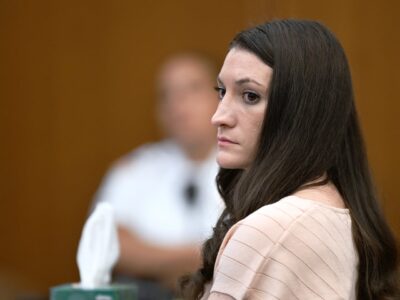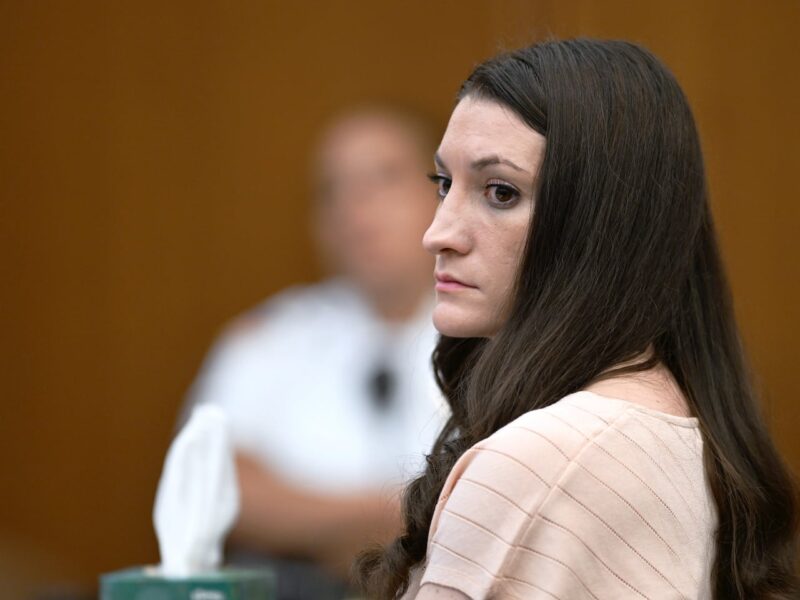
New details have emerged as the final text messages exchanged between Lindsay Clancy and her husband, Patrick Clancy, were shown to the jury. These messages, which reflect their daily family life prior to January 24, 2023, are currently being analyzed, with both sides offering vastly different interpretations of their content
In a courtroom in Plymouth, Massachusetts, the trial of Lindsay Clancy has brought the tragic events of January 24, 2023, into stark and painful clarity as new court proceedings reveal the intricate details of the final hours, private writings, and complex medical history preceding the tragedy. The thirty-six-year-old former labor and delivery nurse stands accused of murdering her three young children—five-year-old Cora, three-year-old Dawson, and eight-month-old Callan—by strangling them with exercise bands in the basement of the family’s suburban home in Duxbury. Immediately following the killings, Clancy inflicted severe cuts on her wrists and neck before jumping from a second-story bedroom window in a suicide attempt that resulted in permanent paralysis from the waist down.

As the proceedings have unfolded, prosecutors and defense attorneys have presented diametrically opposed narratives regarding Clancy’s mental state on that winter afternoon. The prosecution contends that Clancy acted with deliberate calculation, systematically organizing a routine errand for her husband, Patrick Clancy, to ensure she would be left alone in the house long enough to carry out the homicides without interruption. Conversely, defense attorney Kevin Reddington argues that his client was suffering from severe postpartum psychosis and underlying bipolar disorder, driven to commit the act by commanding auditory hallucinations instructing her to harm her children and herself during a severe mental health collapse exacerbated by an unstable regimen of prescribed psychiatric medications.
Among the most heavily analyzed pieces of evidence introduced in recent testimony are the cellphone text exchanges between Lindsay and Patrick Clancy in the hour immediately preceding the tragedy. Testimony delivered by Massachusetts State Police forensic experts, including Trooper Timothy Chiappini, who conducted the forensic analysis of Clancy’s digital devices, revealed a sequence of disturbingly mundane text messages that contrast sharply with the violence that transpired shortly thereafter. Commencing slightly after four-thirty in the afternoon while Patrick was working remotely in the family’s basement and Lindsay was upstairs with the children, the digital communication focused entirely on routine household matters, dinner arrangements, and child schedules.
At 4:53 p.m., Lindsay messaged her husband asking if he wanted to order takeout from ThreeV, a local restaurant in nearby Plymouth, noting that she had not cooked and that it had been a long day. Patrick agreed, prompting Lindsay to suggest he check the menu when he had time. After Patrick asked what she was getting and inquired whether their baby son Callan had woken up from his nap, Lindsay responded that it had been just a short nap. Minutes later, at 5:07 p.m., Lindsay sent a succinct, ten-word text specifying her exact meal request: “Mediterranean Power bowl”. Patrick quickly replied with his own food choice, left the house to pick up pediatric medication at a local CVS, and then drove to the restaurant to collect their order.
When Patrick returned home shortly after six o’clock, he encountered a scene of unimaginable devastation. After discovering his wife lying severely injured in the backyard following her jump from the upper window, he rushed inside to find Cora and Dawson lifeless in the basement, while infant Callan was barely breathing before succumbing to his injuries days later at a Boston hospital. Prosecutors have placed immense weight on the ten-word takeout message and the surrounding exchange, framing it as proof of intentional deceit and operational composure. They argue that Lindsay fabricated a desire for dinner from a restaurant located farther away than closer options to create a extended, predictable window of time in which Patrick would be absent from the home.
However, the defense maintains that the apparent normalcy of the text messages is entirely consistent with the deceptive nature of postpartum psychosis, a rare and sudden psychiatric condition where individuals can mask severe internal disorganization behind a facade of routine behavior. According to defense testimony, Lindsay reported hearing a sudden, commanding voice inside her head around that time telling her that she had to kill her children and then take her own life. Her attorney argues that the ordinary nature of the text messages does not demonstrate cold calculation, but rather illustrates the profound detachment, dissociation, and functional masking characteristic of a psychotic break.

The debate surrounding Lindsay Clancy’s psychological condition has been further complicated by testimonies regarding her web browsing history and digital search logs from December 2022 and January 2023. Forensic extractions revealed that Clancy performed repeated online searches concerning hallucinations, psychosis, the side effects of her specific medications, bipolar disorder, sociopathy, and suicide methods. Prosecutors frame these search logs as evidence of a calculated awareness of psychological symptoms that she later attempted to co-opt for her legal defense, while defense attorneys argue they reflect the desperate search of a mother feeling her sanity slip away without adequate medical guidance.
Excerpts from Clancy’s personal diary, read aloud to the court, offer a vivid look into her internal world in the months leading up to the tragedy. The diary entries reveal a mother deeply tormented by anxiety, maternal perfectionism, and overwhelming guilt. In an October 2022 note, the former labor and delivery nurse recorded deep self-doubt regarding her decision to stop breastfeeding her youngest child and reflected on the pressure modern mothers face from constant information overload. She wrote of being terrified of doing something wrong that would damage her children’s development, lamenting that she had consumed so much parenting media over five years that her mind had become unhealthy.
In other journal entries, she chronicled feeling paralyzed by brain fog, living moment to moment in anticipation of nap times, and feeling consumed by guilt over her inability to feel joyful. In one entry from November 2022, Clancy wrote that she was so desperate to get a mental break from caring for everyone that her mind was attempting to find something physically wrong with her. While the prosecution points to these entries to argue a long-standing resentment toward motherhood and family life, the defense contends they provide real-time documentation of a woman experiencing severe postpartum depression and sleep deprivation.
The medical debate surrounding Clancy’s treatment forms a centerpiece of the trial’s scientific evidence. Crucial testimony was presented by Rebecca Jollotta, a psychiatric nurse practitioner from the South Shore Health Perinatal Behavioral Health Program, who testified to regular portal message exchanges with Clancy starting in late November 2022. In these messages, Clancy repeatedly voiced alarm over intrusive thoughts she had never experienced before, expressed a profound sense of hopelessness, and voiced anxiety about becoming dependent on or adversely affected by her medications. Clancy frequently requested adjustments to her dosages, expressing particular distress over drugs like Remeron, an antidepressant used for anxiety and insomnia.
During this period, Clancy was placed on a rapidly shifting sequence of psychiatric medications, including various antidepressants, mood stabilizers, sleep aids, and antipsychotics such as Seroquel. Court documents indicate that over the course of several months, clinicians adjusted, added, or discontinued nearly thirteen different drugs in an effort to manage her escalating symptoms of depression, panic, and sleep deprivation. Jollotta testified that while she sought to reassure Clancy that intrusive thoughts were common among mothers experiencing severe postpartum depression, she also acknowledged that Clancy had reported suicidal ideation and showed signs pointing toward a possible underlying bipolar disorder.
In late December 2022, Clancy sought emergency medical care and checked herself into McLean Hospital, a psychiatric facility in Massachusetts, after experiencing severe suicidal ideation. Despite receiving inpatient care, she sought early discharge in early January to attend her daughter’s birthday. Records reveal that around this time, Clancy insisted on tapering off Seroquel despite warnings from providers that discontinuing the antipsychotic medication could lead to worsening mood instability and severe sleep disturbances.
Prosecution experts contend that Clancy was not compliant with her prescribed treatment, pointing to evidence of unused medication bottles recovered from the home as proof that she voluntarily stopped taking drugs that might have stabilized her. Prosecutors argue that her refusal to adhere to prescribed therapies reflects intentionality rather than medical mismanagement. In response, the defense asserts that the constant additions, removals, and dosage changes of powerful psychiatric drugs created a destabilizing chemical environment in her brain, worsening her latent bipolar condition and ultimately triggering a drug-induced psychotic state.
Testimony from acquaintances, fellow nurses, and family members further illuminated Clancy’s physical and emotional decline prior to the event. Childhood friend Amy Bevins testified about messages she had received from Lindsay shortly before the killings, in which Clancy revealed experiencing distressing dark thoughts attributed to her medication regimen. Acquaintances Bethany DeCollibus and Andrea Hennigan provided additional insight, recalling that Clancy appeared visibly exhausted at her daughter’s birthday party in early January, confessed to feeling like a zombie, and complained of overwhelming brain fog that made everyday decision-making difficult.
Patrick Clancy’s emotional testimony provided the jury with a personal perspective on the family’s decline during the fall and winter of 2022. Patrick testified that his wife’s mental state began a dramatic downward spiral in December when her medications were changed. He recalled that she suffered from severe weight loss, profound depression, and persistent sleeplessness, which eventually led her to ask him to sleep in the basement to avoid disturbing her sleep patterns. Patrick noted that while Lindsay had expressed suicidal thoughts and mentioned intrusive fears, her overall mood appeared noticeably lighter in the days immediately preceding January 24, leading him to believe she was finally improving.
The trial of Lindsay Clancy has drawn national attention, serving as a focal point for intense debates on postpartum mental health, medical malpractice, and criminal accountability. Advocates for perinatal mental health awareness emphasize that postpartum psychosis is a severe medical emergency that impairs reality testing, rendering afflicted individuals unable to distinguish right from wrong during psychotic episodes. They argue that the case highlights systemic gaps in how maternal mental health crises are identified and managed by medical professionals.
Conversely, legal analysts note the high legal threshold required to establish a defense of criminal insanity under Massachusetts law. To secure an acquittal by reason of lack of criminal responsibility, the defense must prove that at the time of the crime, Clancy lacked substantial capacity either to appreciate the wrongfulness of her conduct or to conform her conduct to the requirements of the law as a result of a mental disease or defect. Prosecutors continue to build their case on the premise that her structured actions, ordinary text messages, and internet searches demonstrate a clear understanding of her actions and an intentional effort to execute them undetected.
As court proceedings move forward in Plymouth Superior Court, the jury is left to weigh the tragic reality of three lost young lives against the complex medical, forensic, and psychological evidence presented over weeks of grueling testimony. Whether Lindsay Clancy is deemed criminally responsible or legally insane, the trial remains a harrowing examination of maternal mental illness, psychiatric drug management, and a tragic afternoon in Duxbury that reshaped multiple lives forever.