“The Day 213 Lives Were Lost: Uncovering the Dark Truth Behind Air India 171”
It was supposed to be just another flight, but within minutes of takeoff, tragedy struck. Survivors’ families reveal chilling accounts, and documents long buried resurface, pointing to shocking negligence.
The Day 260 Lives Were Lost: Uncovering the Dark Truth Behind Air India Flight 171
On June 12, 2025, Air India Flight 171, a Boeing 787-8 Dreamliner, was poised for a routine journey from Ahmedabad’s Sardar Vallabhbhai Patel International Airport to London Gatwick. Carrying 230 passengers and 12 crew members, including 169 Indians, 53 Britons, seven Portuguese, and one Canadian, the flight promised a smooth transcontinental trip. But just 32 seconds after takeoff, at 1:39 PM IST, the aircraft plummeted into the hostel block of B.J. Medical College, 1.7 kilometers from the runway, erupting into a fireball that claimed 260 lives—241 on board and 19 on the ground. Only one passenger, Vishwashkumar Ramesh, survived. As families grieve and investigators probe the wreckage, chilling accounts from survivors’ kin and emerging evidence point to a cascade of failures, raising questions about negligence that turned a routine flight into one of India’s deadliest aviation disasters.

The Fatal Moments: A Timeline of Tragedy
The preliminary report from India’s Aircraft Accident Investigation Bureau (AAIB), released on July 8, 2025, paints a haunting picture of the flight’s final seconds. Cleared for takeoff on runway 23 at 1:38:33 PM IST, the aircraft lifted off at 1:38:39 after a 62-second roll, reaching a peak altitude of 625 feet and a speed of 180 knots. At 1:38:42, both fuel control switches, located on the throttle control module, moved from “RUN” to “CUTOFF” within one second of each other, starving the engines of fuel. The cockpit voice recorder (CVR) captured a pilot’s voice asking, “Why did you cut off?” with the other responding, “I didn’t.” By 1:38:47, the engines lost power, triggering the deployment of the ram air turbine (RAT) for emergency hydraulics. Despite attempts to restore the switches to “RUN” and initiate engine relight, the aircraft crashed at 1:39:11, just 32 seconds after liftoff, into a residential area, killing 19 medical students and injuring 67 others.
The sole survivor, Vishwashkumar Ramesh, a 40-year-old British national of Indian origin, was seated in 11A near an emergency exit. In an interview with The Times of India, he described unbuckling his seatbelt and escaping through a broken fuselage section as flames engulfed the wreckage. “I don’t know how I’m alive,” he said, his voice trembling. “I saw people screaming, then nothing but fire.” His survival, amid a crash that left remains so charred that 253 of 260 victims required DNA identification, has been called miraculous.
Families’ Anguish: Voices of the Bereaved
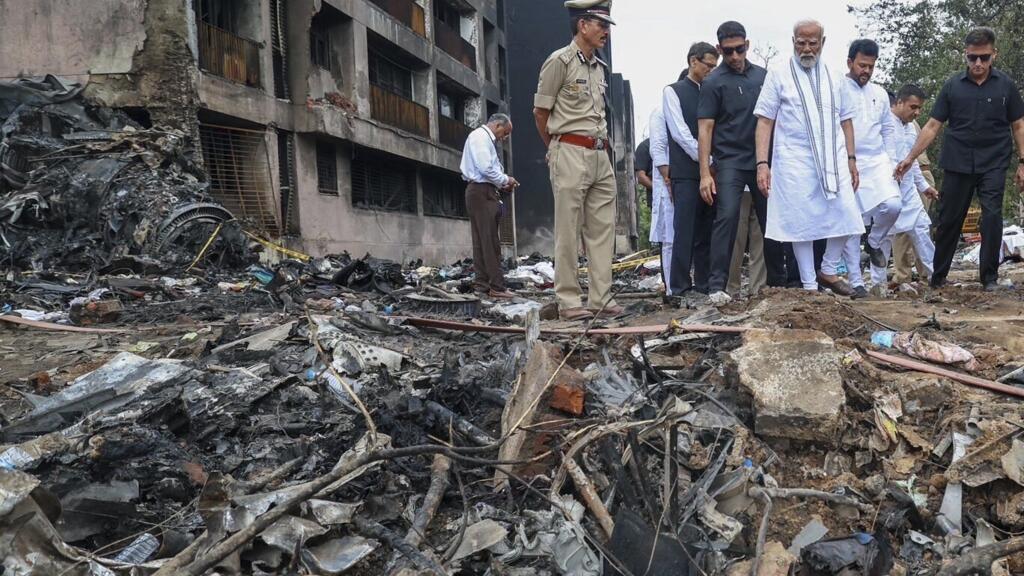
The crash’s toll extended far beyond the wreckage, shattering families across continents. Ravi Thakor, a 32-year-old Ahmedabad resident, lost his daughter Aadhya and mother Sarla Ben. Sitting in his modest home, surrounded by framed photos, he told ABC News, “A whole iron cupboard melted in my mum’s kitchen. Imagine what happened to them. I can still smell the stench of the crash site.” His grief is compounded by the AAIB’s vague report, which he called “a product description” that fails to explain why the switches were moved.
Imtiyaz Ali Sayed, who lost his brother Inayat, sister-in-law, and their two children, expressed frustration to AFP: “Every day without answers deepens our pain.” Representing 60 families, he demanded the immediate release of the black box recordings, arguing that the CVR and flight data recorder (FDR) hold the truth behind the tragedy. “We want to know exactly what happened,” he said, echoing a sentiment shared across X posts calling for transparency.
The Nanabawa family—Akeel, Hannaa Vorajee, and their four-year-old daughter Sara—were among the 53 British victims. Their relatives, in a statement to The Guardian, described them as “widely loved” for their generosity and warmth, noting that the preliminary report was merely a “first stepping stone” toward accountability. Ishan Baxi, a cousin in Ahmedabad, told PA News that the siblings Heer and Dhir, also on board, had “an amazing aura” and global ambitions, their lives cut short in an instant.
The Investigation: A Web of Negligence?
The AAIB’s report, supported by Boeing, GE Aerospace, the US National Transportation Safety Board (NTSB), and UK investigators, found no mechanical or maintenance faults in the aircraft, which was delivered to Air India in 2012. Both pilots—Captain Sumeet Sabharwal, 56, with 15,600 flight hours, and First Officer Clive Kunder, 32, with 3,400 hours—passed breathalyzer tests and were deemed fit to fly. Yet, the unexplained movement of the fuel control switches, designed with a lever-lock mechanism to prevent accidental activation, has raised suspicions of negligence or systemic failure.
A 2018 FAA Special Airworthiness Information Bulletin (SAIB) noted that some Boeing 737 fuel control switches had disengaged locking features, a design shared with the 787-8. Although advisory, not mandatory, Air India did not inspect these switches, a decision now under scrutiny. Aviation lawyer Demetrius Danas told Newsweek that this omission could point to “lapses in protocol,” urging families to explore product liability under the Montreal Convention.
On X, user @pbhushan1 shared an analysis by unnamed “global experts” claiming a system malfunction, not pilot error, caused the crash, alleging a possible cover-up. While unverified, this reflects public skepticism about the official narrative. Conversely, reports of 112 Air India pilots calling in sick on June 16 suggest morale and mental health issues, with Reuters citing a government official warning that Air India was “taking things for granted.”
The Dark Truth: Unanswered Questions

The crash’s aftermath has exposed troubling gaps. The CVR’s ambiguity—failing to identify which pilot spoke—hampers conclusions about human error. The absence of cockpit video recorders, a long-standing NTSB recommendation, leaves investigators reliant on incomplete data. Former pilot Terry Tozer called the switch cutoff “absolutely bizarre,” noting the low altitude left no time for recovery.
Families like the Nanabawas demand “honesty and transparency” to prevent future tragedies. The Tata Group, Air India’s owner, has pledged ₹1 crore per deceased passenger and established the AI-171 Memorial and Welfare Trust, but for many, compensation cannot replace answers. The crash, the first fatal incident involving a Boeing 787, has intensified scrutiny on Air India’s safety record and Boeing’s systems, with the Indian government calling for better oversight.
A Legacy of Loss and Lessons
Air India Flight 171’s fiery descent into Ahmedabad’s medical college hostel remains a stark reminder of aviation’s fragility. The sole survivor’s escape and the families’ haunting accounts underscore the human cost of systemic oversights. As investigators probe the black boxes, which yielded two hours of audio and 49 hours of flight data, the world awaits a final report to clarify whether negligence, mechanical failure, or an unthinkable act caused the tragedy. Until then, the dark truth behind the loss of 260 lives lingers, urging the industry to prioritize safety over complacency.
Sources:
India’s Aircraft Accident Investigation Bureau Preliminary Report, July 8, 2025
BBC News, “Air India crash report: Cockpit audio deepens mystery,” July 12, 2025
The Guardian, “Families of Air India crash victims demand black box recordings,” August 10, 2025
Times of India, “Air India crash: Stories of lives lost and miraculously spared,” June 13, 2025
Newsweek, “New Cockpit Audio from Air India Plane Crash Deepens Mystery,” July 12, 2025
News
“I STILL HAVE THE VOICEMAIL…” A childhood friend says a 17-second message from James “Weston” Higginbotham is saved on an old phone, ending with the sound of Weston laughing before the call cuts off.
The laughter of a young man who embraced life with quiet enthusiasm can echo long after he is gone. For one childhood friend of James “Weston” Higginbotham, that echo lives on in a preserved 17-second voicemail — a casual message…

💔 “He still waved every time he drove by…” A longtime neighbor says the hardest part of losing James “Weston” Higginbotham is seeing the empty basketball hoop in the driveway where he used to stop and shoot 3 quick shots before heading inside
In the quiet suburban streets of Hoover, Alabama, daily routines carry the weight of memory now more than ever. For neighbors who watched James “Weston” Higginbotham grow from a bright-eyed boy into a thoughtful young man, the loss feels profoundly…
In 23 years of teaching, I’ve never forgotten a student like James ‘Weston’ Higginbotham…: A former teacher says Weston always sat in the same seat during first period, and nearly 8 years later, she still remembers the half-finished pencil sketch he left in the corner of his notebook
The quiet impact of a single student can linger in a classroom long after the final bell rings. For one veteran educator in Alabama, James “Weston” Higginbotham was that unforgettable presence. Described as thoughtful, creative, and deeply connected to the…

“WHERE WERE THESE 7 CHILDREN FOR 107 DAYS…?” Makala Pendley disappeared with her children in February and was eventually found in Mexico, but what horrified investigators were the final days before she appeared in that ditch…
The disappearance of Makala Pendley and her seven children from Indianapolis in late February 2026 sparked an intense search that stretched across borders and lasted more than three months. For 107 days, the family seemed to vanish without a trace,…
“WE WARNED HER…” A relative of Makala Pendley has just issued a striking statement following Joseph Butler Jr.’s arrest, but what has many people clicking to read is his unacceptable MOTIVE.
‘I’m sure it’s going to be a little rough’: Family speaks out after pregnant mother found dead in Mexico Relatives of Makala Pendley say she disappeared with her seven children in February. The children are currently under the care of…
“MY SISTER TRIED TO GET AWAY FROM HIM FOR 14 YEARS…” Makala Pendley’s family has just revealed more about her tumultuous relationship with Joseph Butler Jr., but what haunts many the most is the location where her body was found just hours earlier…
The heartbreaking saga of Makala Pendley continues to unfold with new revelations from her devastated family, shedding light on years of struggle in a relationship that spanned more than a decade. Pendley, the 30-year-old Indianapolis mother of seven who was…
End of content
No more pages to load