
“IS HE DEAD?” That’s the phrase many people believe can be heard just 12 seconds into the enhanced 911 call connected to Nolan Wells’ death. Another voice may say “Nolan,” followed seconds later by “Oh my God.” Investigators haven’t confirmed the interpretation, but the recording is fueling fresh debate over Nolan’s final moments.
“IS HE DEAD?”
Just 12 seconds into the enhanced 911 audio tied to Nolan Wells’ death, a voice in the background appears to ask a chilling question that has people listening to the recording over and over.
Moments later, many believe another voice says “Nolan,” followed by the unmistakable words, “Oh my God.”
Authorities have not confirmed what’s being heard, but those few seconds are quickly becoming one of the most talked-about pieces of the case—and they’re raising new questions about what unfolded before help arrived.
Listen to the audio and judge for yourself. Full details in the comments.
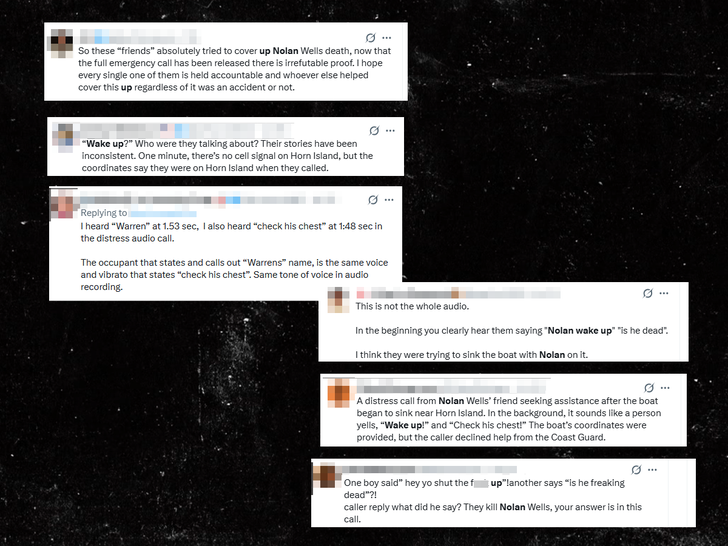
An enhanced recording of a marine assistance call made from the boat linked to Nolan Xavier Wells on the afternoon of July 4, 2026, has become the latest focal point of public scrutiny in the ongoing examination of the 18-year-old’s disappearance and death. The call was placed to Sea Tow, a commercial towing and emergency service for boaters, after the vessel began taking on water and its bilge pump failed while the group was leaving Horn Island. TMZ obtained and enhanced the audio, drawing attention to muffled background speech that some listeners interpret as potentially significant. According to the outlet, certain segments appear to some ears to contain the phrases “Is he dead?”, the name “Nolan,” “Oh my God,” “check his chest,” and “wake up.” TMZ has been explicit that none of these interpretations have been confirmed by forensic analysis or official transcription, and that the quality of the secondary audio leaves substantial room for differing perceptions. The clear, undisputed portions of the call show a panicked primary speaker reporting that the boat is sinking, struggling to answer routine questions from the dispatcher, providing GPS coordinates, and at one point telling someone in the immediate vicinity to “shut the f*** up.”
The recording captures a moment of acute stress during the return trip from Horn Island, the barrier island roughly ten miles off the Mississippi Gulf Coast where Wells was last seen alive. According to statements from Warren Hudson and others who were present, the group had spent the day on the crowded island swimming, socializing, and drinking. Hudson has said he last interacted with Wells around 3 p.m., describing him as cradling a young woman later identified as Katie McCormack and appearing relaxed and in good spirits. Later that afternoon the boat developed a serious bilge-pump problem and began taking on water at a rate that created an emergency. Hudson has maintained that members of the group repeatedly asked Wells to board and leave with them, with at least one person raising his voice and using strong language to urge Wells onto the vessel. According to this account, Wells declined, stating that he would remain on the island with the young woman and return later with another group. The boat then departed around 4:30 p.m. Wells’ body was recovered on the island two days later, on July 6.
The Sea Tow call was made while the vessel was still dealing with the flooding. The primary caller can be heard explaining the mechanical failure and the fact that the boat is taking on water. He appears under considerable pressure, hesitating or struggling when asked for membership details and other basic information before eventually supplying coordinates. The atmosphere on the boat, as reflected in the recording, is chaotic. Multiple voices are audible in the background, though most are indistinct. It is within these secondary layers that online listeners have claimed to detect the phrases that have generated the most discussion. TMZ’s enhancement isolates certain segments and presents them for public evaluation while repeatedly noting that the interpretations remain unconfirmed.
The release of the audio has intensified an already highly charged public conversation. Some observers argue that if the background speech can be verified as containing references to someone being dead or to Wells by name, it would raise serious questions about the timeline offered by those on the boat. In that view, any indication that members of the group were discussing Wells’ condition during the return trip would conflict with the claim that he was left alive and well on the island. Others counter that the audio is simply too degraded to support definitive conclusions, that human perception readily imposes familiar words onto ambiguous sound especially when listeners are already invested in a particular narrative, and that the primary content of the call is consistent with a genuine mechanical emergency. Both perspectives have circulated widely since the enhanced recording became available.
No independent forensic audio analysis has been publicly released that confirms or refutes the suggested background phrases. Professional examination of such recordings typically involves specialized software to filter noise, isolate frequency ranges, enhance speech patterns, and compare results against known voice samples. Until such work is completed and its findings disclosed, the interpretations offered by casual listeners remain speculative. TMZ itself has framed the material as open to individual judgment rather than as settled evidence.
The call sits within a larger body of contested accounts about the final hours of July 4. Hudson has consistently described a sequence in which the group faced a real risk of the boat sinking, made repeated efforts to persuade Wells to leave, and departed only after he chose to stay. The young woman identified as Katie McCormack has been linked to a different recollection through statements by her sister, who has said Katie believed Wells was preparing to board his original boat and assumed the friends would not leave him. Wells’ family and their attorney Ben Crump have publicly noted the conflict between these versions and have called for greater clarity. An independent autopsy commissioned by the family produced inconclusive results on the cause of death. The official investigation by the Jackson County Sheriff’s Department remains open.
The phone recovered from the group has also been a point of contention. Family members reported that when the device was returned it contained no photos or videos from the day on Wells’ Snapchat accounts, which they found inconsistent with his usual behavior. Hudson has stated that neither he nor others in the group knew Wells’ passcode and that no one accessed the phone. Forensic examination of the device has been reported as underway or completed in coordination with authorities, though detailed results have not been released publicly.
Against this backdrop of unresolved questions, the Sea Tow recording offers a rare piece of contemporaneous documentation. Because it was made in real time while the boat was leaving the area, any verified content in the background could, in principle, bear on what members of the group knew or believed at that moment. At present, however, the secondary speech remains too unclear for definitive conclusions. The primary speaker’s panic, the mechanical noise of a distressed vessel, wind, and water all contribute to a difficult listening environment. The instruction to “shut the f*** up” establishes that at least one person on the boat was speaking loudly enough to interfere with the call, but it does not identify the subject of the background conversation.
Public interest in the enhanced audio reflects the intensity of attention that has surrounded every new detail in the case. From the initial report that Wells had not returned with his friends, through the recovery of his body, the statements about his decision to stay on the island, the questions about his phone, the series of interviews given by Hudson, and now the marine distress call, each element has been subjected to close and often polarized examination. The audio fits this pattern. Some hear potential evidence of knowledge that something was wrong with Wells; others hear only the ordinary disorder of an emergency and the tendency of expectation to shape perception.
The investigation continues. Witness interviews, physical evidence from the island and the boat, digital analysis of phones, and medical findings all remain part of the effort to reconstruct what occurred. The Sea Tow call is one artifact among many. Its value as evidence depends on the clarity and verification of any secondary speech it may contain. Until professional analysis produces confirmed transcriptions, the background sounds will remain open to competing interpretations.
For those following the case, the release of the enhanced recording has supplied new material for discussion while simultaneously illustrating the limits of what can be reliably extracted from a noisy, stressed emergency call. Whether further technical examination will resolve the ambiguity or whether the suggested phrases will remain in the realm of speculation is not yet known. What stands as documented is that a marine assistance call was placed from the boat as it took on water, that the primary caller reported a bilge-pump failure and a sinking vessel under evident stress, that he directed someone nearby to be quiet, and that some listeners believe additional phrases referring to death or to Wells can be heard in the background. TMZ has presented the material with the clear qualification that those interpretations are unconfirmed.
The death of Nolan Wells continues to generate sustained public interest because significant questions remain unanswered. The enhanced emergency call is the most recent piece of audio to enter that discussion. It does not independently resolve the discrepancies in the accounts of July 4, but it has given those discrepancies an audible dimension that many listeners are now examining in detail. The investigation will ultimately determine what weight, if any, the recording carries.