The Rich Old Woman Poured Wine Over Her Daughter-in-Law’s Head… Then She Saw the Documents
The Dining Room Tribunal
The crystal chandelier hanging above the long mahogany dining table cast a warm, glittering glow across the polished silver cutlery, the porcelain serving platters, and the vintage Bordeaux pouring into stemmed glasses. To an outsider looking in through the floor-to-ceiling windows of the historic estate known as Oakridge Manor, it was a picture-perfect scene of refined suburban aristocracy.
Inside, the atmosphere was thick with calculated arrogance.
Sitting at the head of the table was my mother-in-law, Victoria Sterling. Dressed in an immaculate emerald silk blouse, her diamond rings catching the light with every sharp hand gesture, Victoria commanded the room with the practiced authority of a monarch. Beside her sat my father-in-law, Richard, a quiet, brooding man who spent most of his life nodding along to his wife’s demands. Across from them sat my husband, Harrison, looking distinctly uncomfortable in his starched shirt, his eyes darting repeatedly to the edge of his plate.
The occasion was touted as a family celebration—a dinner to honor the estate’s sixty-year history. But twenty minutes after the second course was served, the true agenda emerged.
“We’ve finalized the terms with the development firm,” Victoria announced, dabbing her lips with a linen napkin before setting it beside her plate. Her tone was casually triumphant, as if she were announcing a successful afternoon of gardening rather than the destruction of a family legacy. “The preliminary valuation came back at $12.5 million. The bulldozers will be cleared to break ground by the first of next month once the probate paperwork clears.”
Harrison’s younger sister, Beatrice, gasped softly. “Wait… bulldozers, Mom? You said they were going to preserve the main house.”
“Preserving wood and old brick doesn’t pay dividend yields, darling,” Victoria replied with a dry, dismissive wave of her manicured hand. “The land is what matters. Three acres in this zip code means eighteen luxury townhomes. The prospective buyers have already wired the earnest deposit to our family’s escrow account.”
She spoke with absolute, untouchable certainty. The decision was made. The house—a stunning 1920s Tudor revival where Harrison had taken his first steps, where his grandfather had built a massive private library, and where decades of family history were stored in carved oak cabinets—was being treated like an old piece of furniture ready for the scrapyard.
The other six guests around the table—a mix of extended relatives and wealthy family friends—smiled politely, murmuring words of congratulations on the “brilliant financial move.”
“Everyone will receive their respective distribution,” Victoria continued, tilting her wine glass toward the guests. “Richard and I will oversee the primary disbursement. Harrison will receive his share for his firm’s expansion, Beatrice gets her trust top-off… and, of course, we’ll ensure the estate expenses are fully settled.”
She didn’t mention me. She didn’t even glance in my direction. In Victoria’s mind, I was merely the quiet, middle-class girl Harrison had married five years ago—an outsider who worked in real estate law, someone who was permitted to sit at the table but had no right to speak when the Sterling family discussed money.
I sat in silence, my hands folded tightly on my lap, feeling the heavy wooden floorboards beneath my feet. I thought of the attic upstairs, filled with letters from Harrison’s grandmother. I thought of the hand-carved mantle in the study.
More than anything, I thought of the truth.
“We can’t sell this house,” I said.
My voice was not loud, but in the ambient hum of polite dinner conversation, it hit the room like a heavy stone dropped into a quiet pool.
The clinking of silverware instantly ceased.
Victoria slowly turned her head toward me. Her eyebrows arched in an expression of pure, unadulterated disbelief, as though a piece of the dining furniture had suddenly spoken up to object to its placement.
“Excuse me?” Victoria asked, her voice dropping into a dangerous, icy register.
I looked her directly in the eyes, refusing to shrink back. “This house shouldn’t be sold. And it certainly shouldn’t be demolished.”
A dry, performative laugh bubbled up from Victoria’s throat. She looked around the table at the guests, inviting them to join in her amusement at my audacity.
“Clara, sweet heart,” Victoria said, her tone dripping with patronizing sweetness. “This is a Sterling family decision. You are a guest in this family’s history. It is sweet of you to feel sentimental about old walls, but adult matters involving multi-million-dollar real estate portfolios are handled by those who actually own the name.”
“Then why has the decision already been made without everyone seeing the actual legal chain of title?” I asked calmly.
The polite smile vanished from Victoria’s face, replaced by a mask of sudden, searing fury. The arrogance that had sustained her for decades flared into open malice.
“You insolent little girl,” Victoria hissed.
She stood up slowly. The entire table fell dead silent. Harrison reached out a hand, his face pale. “Mom, wait—”
Victoria ignored him. She reached down, her fingers wrapping around the stem of her crystal wine glass, heavy with dark, full-bodied Cabernet.
She walked three steps around the head of the table, stopped directly beside my chair, and looked down at me.
“Know your place, Clara,” she said.
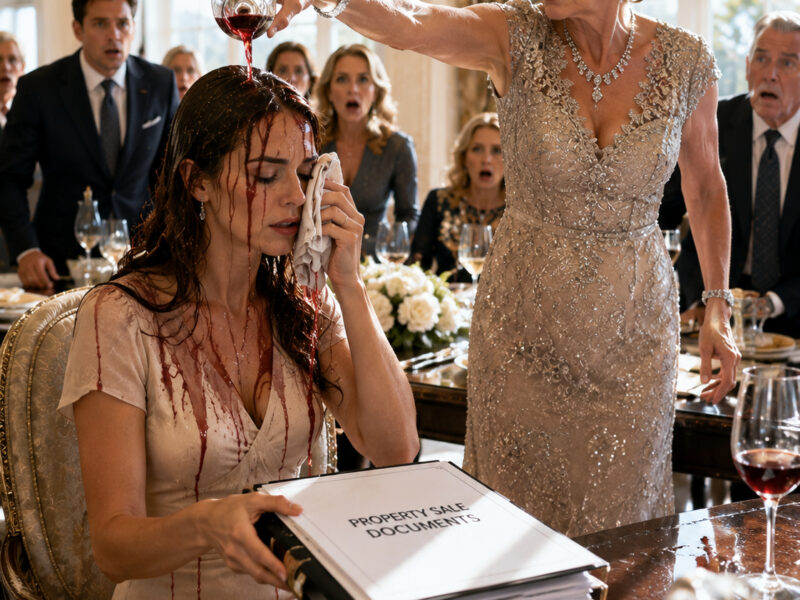
Then, with a smooth, deliberate tilt of her wrist, she inverted the glass.
The heavy, cold red wine poured directly over the crown of my head.
It cascaded down through my dark hair, pooled across my forehead, and ran down my cheeks in thick, crimson streams. The liquid soaked into the collar of my cream-colored silk dress, staining the fabric a deep, bruised purple. It dripped off my chin, spattering onto the pristine white tablecloth and the hardwood floor beside my chair.
Nobody moved. Nobody breathed. Beatrice covered her mouth with both hands, letting out a stifled gasp. Harrison stood up so fast his chair scraped violently against the floor, but he remained frozen, looking between his mother and me in absolute horror.
Victoria placed the empty crystal glass back down onto the table with a sharp, clear clink.
“Now,” Victoria said, smoothing her green silk blouse with absolute composure. “If anyone else has an ignorant opinion regarding my family’s property, speak now.”
The Unfolding Ledger
I didn’t scream. I didn’t burst into tears. I didn’t reach for a wine glass to throw back in her face.
I reached into my lap, picked up a soft linen napkin, and unfolded it. With slow, methodical movements, I wiped the dark wine from my eyes, my cheeks, and my chin. The cold liquid ran down my neck, but my hands remained entirely steady.
In twenty-six years of living and five years of navigating high-stakes real estate law, I had learned a fundamental truth: Rage is loud, but documentation is absolute.
Once my face was clear, I reached down to the floor beside my chair. I picked up a thick, leather-bound legal expansion folder that I had brought into the dining room earlier that evening and set quietly against the chair leg.
I laid the folder directly on the center of the wine-stained table.
Victoria glared at the folder, her lip curling in disdain. “What is that ridiculous theatrical nonsense? If you think showing me some sentimental family photo album is going to stop a twelve-million-dollar commercial closing, you are even more foolish than I thought.”
“You should read it before you call any more bulldozers, Victoria,” I said quietly.
I unclasped the brass lock of the folder and pushed the top document across the mahogany wood, right past her empty wine glass, until it rested inches from her hands.
Victoria rolled her eyes, but the absolute, unflinching silence in the room seemed to compel her. She reached down with two fingers and picked up the first page.
It was an official, certified transcript from the State Land Registry and County Deeds Office, bearing a raised gold seal.
Victoria’s eyes scanned the top line: MASTER PROPERTY TITLE & WARRANTY DEED — OAKRIDGE ESTATE.
She sneered. “I know what a deed looks like, Clara. This house belonged to Richard’s father, Edward Sterling. It was passed down through the family trust.”
“Turn to page three,” I said.
Victoria flipped the page. Her confidence was a rigid structure, but as her eyes hit the middle paragraph of page three, a subtle, almost imperceptible twitch occurred in her right eyelid.
She turned to page four. Then page five.
The room grew so quiet that the rhythmic drip-drip-drip of the red wine falling from my dress onto the floor sounded like a ticking clock.
Harrison stepped closer, leaning over his mother’s shoulder. “Mom? What is it? What does it say?”
Victoria didn’t answer him. Her breath, previously slow and controlled, began to come in shallow, rapid hitches. The color was slowly draining from her face, leaving her green silk blouse looking stark and overly vibrant against her suddenly pale skin.
Her hands—the same hands that had smoothly poured wine over my head two minutes prior—began to tremble.
She reached the final page.
At the bottom of the page sat three signatures, a legal notarization stamp from seven years ago, and a clear, bold statutory declaration.
Victoria froze. Her eyes remained locked on the bottom line of the paper as if the ink had turned into a terrifying, physical threat.
“Mom?” Harrison asked, his voice cracking with rising anxiety. “What is that paper?”
I leaned forward, resting my elbows on the table, completely ignoring the red wine dripping from my hair onto my collarbones.
“You can’t sell this house, Victoria,” I said, my voice carrying clearly to every guest in the room.
Harrison looked from his mother’s paralyzed face to mine. “Clara, please… just explain it! Why can’t we sell it? It’s my family’s house!”
I reached out and placed my finger directly over the primary name listed under CURRENT SOLE FEE SIMPLE OWNER on the final page.
“Because the house doesn’t belong to the Sterling Family Trust,” I said softly. “It is legally, entirely, and irrevocably mine.”
The Truth Behind the Walls
The silence that followed was suffocating.
Victoria’s husband, Richard, who had remained silent all evening, suddenly sat up straight, his face flushed. “That’s preposterous! That’s legally impossible! My father built this house! I am the primary trustee of the Sterling Estate!”
“You were the primary trustee, Richard,” I corrected, turning my eyes to my father-in-law. “Until eight years ago, when the Sterling Family Trust went into severe, unreported tax default with the federal government due to mismanaged commercial loans in Chicago.”
Richard’s mouth opened, then snapped shut. His face turned from red to an ashen grey.
Harrison stared at his father in total shock. “Dad? What is she talking about? What tax default?”
“Ask your mother,” I replied calmly.
The story was one that Victoria had spent nearly a decade suppressing through intimidation, hidden accounts, and quiet panic.
Eight years ago, long before Harrison and I were married, Victoria and Richard had engaged in a series of reckless, high-interest speculative land investments in the Midwest. When the market collapsed, the Sterling Family Trust faced total financial ruin. The IRS had placed a massive, encumbering tax lien against Oakridge Manor, preparing to seize the property and put it up for public foreclosure auction.
In a state of absolute desperation, Victoria had turned to an old family friend and master estate planning attorney—my late grandfather, Arthur Vance.
Arthur Vance was a legend in real estate law. He agreed to pull the Sterling family out of the fire, but he was no fool. He knew Victoria’s pattern of financial recklessness.
My grandfather had used a legal mechanism known as a Private Equity Equity-Clearing Trust. He personally paid off the $3.2 million federal tax debt out of his private reserve fund, saving Oakridge Manor from public auction and preserving the family’s public reputation.
In exchange, Richard and Victoria had executed a binding, recorded legal agreement: the title of Oakridge Manor was deeded directly to Arthur Vance as the primary lien-holder, with a strict eight-year buyback clause. If the Sterling trust repaid the $3.2 million plus interest within eight years, the title would revert to them. If they failed to pay, full, unencumbered fee-simple title would transfer permanently to Arthur Vance or his designated legal heir.
Three years ago, my grandfather passed away. In his finalized, ironclad will, his entire private property trust—including the deed to Oakridge Manor—was left solely to his only granddaughter.
Me.
The eight-year buyback deadline had expired precisely sixty days ago. Victoria had failed to make a single principal payment toward the debt, believing that because my grandfather had passed away, the old paperwork would simply remain buried in an obscure county archive, forgotten by time.
She had assumed that a young woman who married her son would never bother to audit her late grandfather’s commercial trust ledgers.
She was catastrophically wrong.
The Final Document
Harrison slowly picked up the document stack from his mother’s limp fingers. He read through the deed transfer, the tax lien settlement, and the probate court confirmation bearing my grandfather’s name and mine.
“Mom…” Harrison whispered, his voice trembling with a mixture of heartbreak and disbelief. “Is this real? Did Grandfather Vance pay off Dad’s tax debt? Do we… do we not own this house?”
Victoria couldn’t answer. She sat frozen in her chair, her emerald silk blouse suddenly looking like an armor that had completely failed to protect her. The woman who had spent five years treating me like a penniless intruder was sitting in a dining room where she was, quite literally, a tenant living on my grace.
“She knew,” I said, looking around the table at the silent guests. “She knew the title wasn’t clear. That’s why she was rushing this development sale through an offshore escrow company. She was planning to take the twelve million dollars, split the cash, pay off her personal debts, and leave before the title search revealed that she was selling a property she didn’t own—which would have resulted in federal wire fraud charges.”
The guests around the table began to fidget uncomfortably. Two of the extended relatives quietly pushed their chairs back, looking thoroughly horrified to be caught in the middle of a legal crime scene.
“You… you quiet little snake,” Victoria whispered, her voice shaking with a terrifying blend of rage and humiliation. “You sat at my table… you let me host dinners… you let me live here knowing this?”
“I sat at this table hoping you would be honest with your children,” I replied, standing up slowly. The red wine had dried somewhat, but I stood tall, my posture rigid, looking down at her from the head of the floor. “I kept this file quiet for two years because I loved Harrison, and I didn’t want to destroy his belief in his family. I was willing to work out a private, quiet agreement where you could continue living here for the rest of your lives.”
I reached back into the folder and pulled out a second, thinner document—a single piece of paper printed on official legal stock.
I laid it gently on top of the deed, right next to her empty wine glass.
“What is that?” Harrison asked, his eyes wide.
“That,” I said, “was the document I brought to dinner tonight. It was a formal, zero-cost life-estate lease agreement. It would have allowed your mother and father to live in this house, fully protected, for the rest of their natural lives, without ever paying a dime of rent, while preserving the historic house for our children.”
Victoria looked at the paper, then up at my wine-stained face.
“And now?” Victoria rasped, her voice barely a breath.
I took the linen napkin, folded it neatly, and placed it beside the legal file.
“Now,” I said, my voice cold, clear, and completely absolute, “the offer is revoked.”
I looked around the grand dining room—at the crystal chandelier, the oak paneling, the historic mantle—and then down at the woman who had poured wine over my head to prove her dominance.
“You spent the entire night telling me to know my place, Victoria,” I said softly. “My place is the owner of this estate. And you have thirty days to pack your things and vacate my property.”
EPILOGUE: THE CLEAN CANVAS
By 9:00 AM the following morning, the news of the title dispute had torn through the Sterling family network like a wildfire.
The prospective development firm, notified by my legal counsel of the fraudulent title attempt, instantly withdrew their $12.5 million offer and cancelled the escrow agreement, threatening civil litigation against Victoria and Richard for misrepresenting property ownership.
Faced with undeniable, ironclad county records and the threat of an immediate federal fraud investigation, Victoria’s resistance collapsed completely.
The Eviction & Settlement: Through an intermediary attorney, I offered a modified exit agreement to prevent a public criminal prosecution: Victoria and Richard were given sixty days to quietly pack their personal belongings and move into a luxury two-bedroom condominium funded by Richard’s modest remaining pension. They were barred from ever entering the grounds of Oakridge Manor without my written consent.
Harrison: The revelation of his mother’s years of deceit—and his own passive compliance in her cruelty—forced a profound reckoning. We entered intensive marital counseling. Harrison resigned from his family’s commercial firm and took a position at an independent engineering firm, finally stepping out from beneath his mother’s suffocating shadow.
Oakridge Manor: The historic estate was saved from the bulldozers. I initiated a complete historical restoration of the main house, placing the three surrounding acres into a permanent community land trust so that no developer could ever threaten its grounds again.
Six months after that infamous dinner, I stood on the wide front porch of Oakridge Manor on a warm summer morning.
The dining room inside had been completely renovated. The wine-stained floorboards had been sanded down, refinished, and polished until they gleamed like amber in the sunlight.
A car pulled up the long gravel driveway—a courier delivering the final, updated historical landmark registry documents bearing my name as the founding trustee of the Oakridge Heritage Foundation.
I signed the delivery slip, set the pen down, and looked out across the pristine, green lawn.
Cruelty often disguises itself as authority, and greed frequently pretends to be legacy. But when the noise of arrogance fades, only the cold, unshakeable truth remains—written in ink, sealed by law, and anchored in the places we choose to defend.