The Old Heiress Threw a Waitress’s Shoes Into the Trash… Then She Came Back With Someone
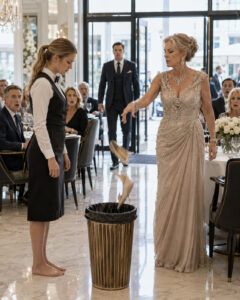
The Table of Sovereigns
The grand dining hall of L’Hermitage was a soaring cavern of white-glove excess, perched thirty floors above the glowing financial district.
Under seven multi-tiered Baccarat crystal chandeliers, the city’s upper crust moved through their customary rituals. The air was thick with the scent of roasted truffles, expensive cognac, and rare French perfumes. Silver cutlery clicked against hand-painted Limoges porcelain, and vintage Dom Pérignon flowed into lead-crystal flutes.
Every table was occupied by people who measured human worth strictly by bank accounts, equity stakes, and family names.
At the center of the room sat Table One—the most prestigious booth in the establishment.
Seated there was Madame Genevieve Vance-Vane. At seventy-two, Genevieve was the matriarch of the Vance-Vane Real Estate Trust, a legacy dynasty that owned nearly a third of the city’s historic commercial district. Wrapped in a custom $90,000 emerald-green silk gown with a three-carat diamond brooch pinned to her collar, Genevieve radiated an icy, untouchable arrogance.
To Genevieve, the world was divided neatly into two categories: those who owned the land, and those who served the owners.
Standing nearby, carrying a heavy silver tray laden with espresso cups and sparkling water, was a twenty-four-year-old floor staff member named Clara.
Clara wore the standard uniform of the establishment: a high-collared black button-down, a fitted black apron, and dark leather dress shoes. She was quiet, meticulous, and unfailingly polite. For four months, she had worked the evening shifts at L’Hermitage, blending seamlessly into the background of high society. She never dropped a plate, never engaged in gossiping with guests, and never spoke unless spoken to.
The dining room was particularly packed that evening. As Clara stepped carefully around Table One, a hedge-fund manager at the adjacent booth suddenly pushed his chair backward to stand up.
The wooden leg of his chair struck Clara’s ankle.
Clara gasped softly, lurching forward as her balance gave way. She managed to keep the heavy tray level, saving the crystal glasses from shattering onto the floor, but a single, tiny drop of sparkling mineral water splashed off the rim of a bottle, landing squarely on the hem of Genevieve’s custom silk gown.
The stain was no larger than a dime. It was water. It would dry in less than three minutes without leaving a trace.
Genevieve froze.
She looked down at the hem of her gown as if a bucket of toxic sludge had been dumped over her head. She slowly stood up, her face contorting into an expression of raw, unbridled fury that silenced the surrounding tables instantly.
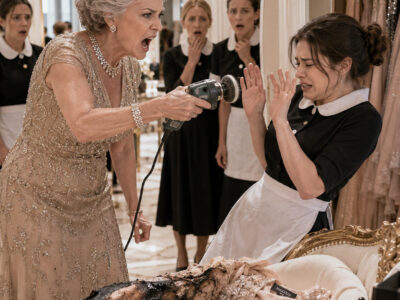
“Do you have any idea what this dress costs, you clumsy little girl?” Genevieve’s voice echoed sharply off the marble pillars.
Clara immediately set the tray down on a nearby side table and folded her hands, her expression filled with genuine professional regret. “I am so sorry, Madame. A guest stepped back into my path. Let me fetch a warm microfiber cloth from the pantry immediately—”
“A cloth?” Genevieve sneered, her voice dropping into a razor-sharp rasp that held the attention of fifty nearby guests. “You think a damp rag fixes your incompetence? You don’t touch this silk with your filthy hands.”
“Madame, I apologize,” Clara repeated calmly. “I can also speak to the general manager to ensure your garment is professionally dry-cleaned at our expense.”
Genevieve didn’t answer with words. She looked down at Clara’s feet.
Clara was wearing a simple, sturdy pair of black leather lace-up shoes—sensible footwear designed for standing during ten-hour restaurant shifts.
Genevieve’s eyes narrowed with venomous creativity. Without warning, the seventy-two-year-old heiress crouched down.
Before Clara or anyone else in the room could comprehend what was happening, Genevieve grabbed the heel of Clara’s right shoe and yanked it off her foot.
“Madame! What are you doing?” Clara gasped, taking a step back on one foot.
Genevieve ignored her, grabbed Clara’s left shoe, and pulled it free as well.
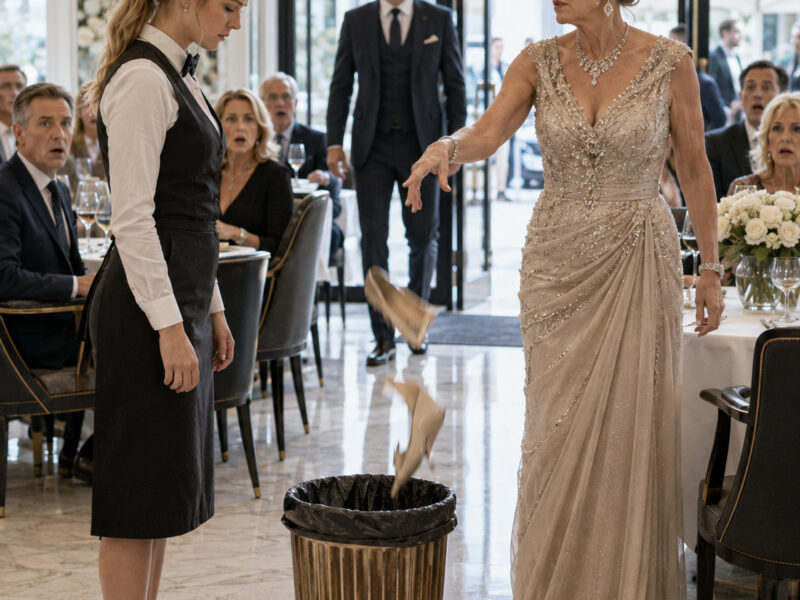
She stood up holding both worn leather shoes by their laces. With a cruel, triumphant smile, Genevieve walked three steps toward the service station, raised her arms, and dropped both shoes straight into a tall, stainless-steel trash receptacle filled with discarded food scraps and wet coffee grounds.
THUD.
The restaurant went utterly, suffocatingly quiet.
Clara was left standing barefoot on the cold, polished Italian marble floor, her black socks exposed to the entire dining room.
Genevieve dusted off her manicured fingers with a cloth napkin, stepped back to her table, and pointed a rigid index finger toward the grand front entrance.
“Leave,” Genevieve commanded loudly. “And don’t you dare put those shoes back on in my presence. Walk home barefoot so you remember your place.”
The Silent Exit
A heavy, uncomfortable hush hung over L’Hermitage.
Several guests looked down at their plates in awkward discomfort. A corporate executive lowered his wine glass, his jaw tight. A woman at a corner table whispered something urgent to her husband.
Yet, nobody stood up. Nobody said a word.
Genevieve Vance-Vane was simply too wealthy. Her family held the commercial leases for half the luxury businesses in the city. Confronting her meant risking corporate retaliation, canceled contracts, or social banishment.
Clara stood barefoot on the marble floor for five long seconds.
Her face was flushed, but her posture remained straight. She didn’t burst into tears. She didn’t scream at Genevieve. She didn’t reach into the trash can to retrieve her ruined footwear.
Instead, she looked directly into Genevieve’s cold, triumphant eyes with an expression that was shockingly, eerily calm.
Without saying a single word, Clara turned around. She walked smoothly across the marble floor in her black socks, pushed through the heavy mahogany doors, and vanished into the autumn night.
Genevieve sat back down, smoothing her emerald gown, and picked up her champagne flute with a satisfied smile. “Now, as I was saying about the harbor development deal…” she began, continuing her conversation as if she had merely swatted a fly.
She believed she had put an impudent waitress in her place.
She had no idea that the ticking clock on her entire family empire had just accelerated to its final ten minutes.
The Return
Ten minutes passed.
The noise level in the restaurant had just begun to return to its normal, muted hum when the heavy double doors of L’Hermitage swung open once again.
The shift in the room was instant.
Conversations didn’t fade—they stopped dead in their tracks.
Clara walked into the dining room. She was still wearing her server’s uniform, and she was still barefoot.
Walking beside her was an elderly man in his late sixties. He was tall, silver-haired, and dressed in an impeccably tailored charcoal Savile Row suit. He carried a sleek, black leather document portfolio under his arm.
He did not raise his voice. He did not look around in anger. He didn’t need to.
The moment he crossed the threshold, three chief executive officers sitting at different tables immediately stood up from their chairs in deference. The executive general manager of L’Hermitage turned pale, dropped his tablet, and rushed forward so fast he nearly tripped over a server’s station.
A venture capitalist at Table Four leaned toward his associate and whispered in a terrified voice: “Is that Sterling Mercer?”
It was.
Sterling Mercer was the chief executive and founder of Mercer Global Capital—a multi-billion-dollar private equity firm that held controlling interests in commercial banks, shipping lines, and hospitality conglomerates across the globe. He was a man whose private board decisions could reshape the regional stock exchange before breakfast.
And he was a man who rarely, if ever, appeared in public without a security detail.
Genevieve turned her head toward the entrance, a sharp remark about “unauthorized visitors” forming on her lips.
The moment her eyes met Sterling Mercer’s face, her expression shattered.
The champagne glass slipped from her manicured fingers. It hit the hardwood floor, shattering into dozens of sparkling crystal shards, splashing wine across her shoes. She stared at the silver-haired man as if an apparition had walked out of the floorboards.
Sterling Mercer walked slowly across the dining room, his leather soles clicking softly on the floor. Beside him, Clara walked barefoot, her steps silent.
He stopped at Table One.
Sterling looked down at his daughter’s bare feet. Then he raised his icy blue eyes to look directly into Genevieve’s face.
His voice was terrifyingly soft, yet every person in the silent room heard every word.
“You threw away her shoes?”
Genevieve’s lips parted, but no sound came out. Her legendary composure—built on fifty years of unquestioned wealth—evaporated in a single second.
“Sterling…” Genevieve stammered, her voice shaking uncontrollably. “I… I didn’t recognize… I had no idea this young woman was your daughter.”
Sterling Mercer didn’t blink. His expression remained as cold as carved granite.
“Now you do.”
The Folder on the Table
Genevieve swallowed hard, her throat dry, her heart hammering against her ribs.
The room around them was frozen. Nobody touched their food. Nobody drank their wine.
Genevieve desperately tried to formulate an exit strategy. “Sterling, please… it was a misunderstanding. A minor collision. She spilled liquid on a custom dress, and I… I lost my temper. I will personally write a check to replace her footwear ten times over. I will apologize—”
“My daughter doesn’t need your money for shoes, Genevieve,” Sterling said, his voice flat. “And she didn’t work here because she needed a job.”
Genevieve blinked, utterly lost. “Then why… why was she working as a server?”
Clara stepped forward. She looked down at Genevieve with a quiet, analytical pity.
“I didn’t work here to earn a paycheck, Madame Vance-Vane,” Clara said softly. “I worked here for four months because L’Hermitage is the primary commercial property in your family’s portfolio. I needed to observe how you operated this establishment from the inside.”
Sterling Mercer unzipped his document portfolio, pulled out a thick, navy-blue folder bearing a red corporate audit seal, and placed it flat on the table, right beside Genevieve’s shattered champagne glass.
Genevieve stared at the folder as if it were a unexploded bomb. “What is that?”
“Open it,” Sterling commanded softly.
With trembling hands, Genevieve opened the cover.
Her eyes scanned the top page—a certified forensic accounting audit conducted by the State Department of Revenue and the Federal Tax Fraud Division.
Page two contained bank transfer records from offshore accounts in the Cayman Islands.
Page three contained property title deeds, forged lease assignments, and a master list of unrecorded cash transactions spanning fifteen years.
For four decades, the Vance-Vane family had maintained their high-society status by operating a massive, illegal commercial lease-inflation scheme through L’Hermitage and twelve other historic properties. They had systematically falsified occupancy records, understated commercial revenue to tax authorities, and inflated property valuations to secure $400 million in fraudulent bank loans.
Clara’s father hadn’t brought the folder to avenge a thrown pair of shoes.
Clara had spent four months working covertly inside the restaurant, gathering internal ledger copies, server shift logs, and off-the-books cash receipts to complete a two-year federal investigation led by her father’s private compliance firm.
Clara had possessed the evidence to destroy Genevieve’s empire for over three weeks. But out of respect for the old woman’s late husband—who had been an honorable businessman—Clara had hesitated to submit the final report to the United States Attorney’s Office.
Until Genevieve threw her shoes in the trash to prove her superiority.
Clara leaned forward slightly, resting her hands flat on the edge of the table.
“I didn’t come back for my shoes, Genevieve,” Clara said quietly. “I came back because when you threw them away, you gave me a reason to stop protecting your family’s legacy.”
Genevieve’s face went completely ash-white. She looked from the certified audit papers to Clara’s bare feet, realization crashing over her like a tidal wave.
She hadn’t just humiliated a waitress. She had humiliated the sole investigator holding the key to her freedom.
The Final Reckoning
By 9:00 AM the following morning, the dominoes began to fall with absolute, unyielding precision.
Federal Action: The United States Attorney’s Office issued a formal indictment charging Genevieve Vance-Vane and two executive officers of the Vance-Vane Trust with grand larceny, bank fraud, and systemic tax evasion.
Commercial Foreclosure: Mercer Global Capital, exercising its rights as the primary debt holder on the commercial parcel, initiated immediate emergency foreclosure proceedings on L’Hermitage and the surrounding real estate holdings.
Public Ruin: The story of the barefoot heiress and the thrown shoes dominated regional and national news outlets. Within forty-eight hours, Genevieve’s name was removed from two hospital wings and a university board of trustees.
Three weeks after that infamous evening, L’Hermitage closed its doors for a complete corporate restructuring under new ownership.
On a quiet Tuesday afternoon, Clara stood inside the empty dining room. The crystal chandeliers were dimmed, and the tables were bare.
She was dressed in a tailored wool coat and comfortable leather boots. Beside her stood her father, holding two cups of coffee.
“Are you satisfied with how it ended, Clara?” Sterling asked softly, handing her a cup.
Clara looked across the polished marble floor toward Table One—the table where a woman had once believed that money gave her the right to strip away another person’s dignity.
“People like Genevieve spend their whole lives believing that status is built on what you wear and who you can crush,” Clara said, taking a sip of coffee. “They forget that the floor beneath their feet isn’t made of marble. It’s made of truth.”
She turned toward the entrance, walking beside her father into the afternoon sun—her steps firm, grounded, and entirely her own.