I’M GOING TO TELL THE TRUTH: Patrick Clancy Makes Unusual Decision As Lindsay’s Trial Begins In an unexpected courtroom move, Patrick Clancy, husband of 35-year-old Lindsay Clancy, is expected to take the stand for the defense as her trial over the deaths of their 3 children unfolds. His decision could give jurors a firsthand account of Lindsay’s mental state and the events surrounding the tragedy. It also places Patrick at the center of one of the most emotionally difficult moments of a trial where her state of mind is expected to be a central issue. Full story in the comments👇
**TAKE THE STAND: Lindsay Clancy’s Husband Testifies as She Faces Trial in the Deaths of Their Three Children**
In a Plymouth Superior Court courtroom in Massachusetts, Patrick Clancy took the witness stand in the murder trial of his former wife, Lindsay Clancy. The 35-year-old former labor and delivery nurse is charged with the first-degree murders of their three children—Cora, 5; Dawson, 3; and 8-month-old Callan—who were found strangled in the family’s Duxbury home on January 24, 2023. Lindsay Clancy does not deny that she killed the children. Her defense argues that she lacked criminal responsibility at the time because she was suffering from severe postpartum mental illness, including psychosis.
Patrick Clancy’s appearance as a witness has drawn particular attention. He was called first by the prosecution and later faced questioning from the defense. In public comments before and during the proceedings, he has described his former wife as ill rather than evil and has spoken of forgiveness. His decision to testify, and the nature of his accounts under both direct and cross-examination, has become a central element of a case that turns on the distinction between deliberate action and a profound break from reality.
The events of January 24, 2023, form the core of the evidence. According to testimony and court records, Lindsay Clancy asked Patrick to leave the house that evening to pick up a stool softener for one of the children at a CVS pharmacy and then to collect dinner from a restaurant in Plymouth. Patrick testified that he left while the children were in ordinary circumstances: he rocked the baby, kissed his daughter, and saw his middle son eating chicken nuggets and green beans on the couch. He described Lindsay as appearing to be having one of her better days.
While he was gone, Lindsay Clancy strangled the three children with exercise resistance bands in the basement of the home. She then attempted suicide by cutting her wrists and neck and jumping from a second-story window. When Patrick returned, he found blood in the bedroom, an open window, and Lindsay lying injured on the ground outside. According to his testimony, she told him she had tried to kill herself. When he asked where the children were, she directed him to the basement. He called 911. The recording of that call, played for the jury, captured his screams as he discovered the children. First responders later described hearing him cry out that she had killed the kids.
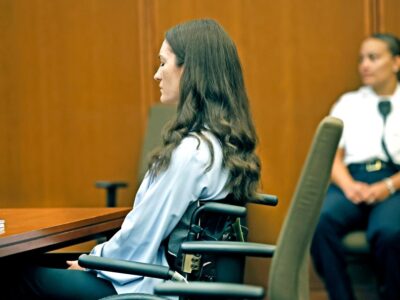
Lindsay Clancy survived the fall but was left paralyzed. She has remained in a wheelchair during the trial. In court she has been seen sobbing during particularly difficult moments of testimony, including when the 911 audio was played. Her attorney, Kevin Reddington, has placed a hand on her shoulder at times of visible distress.
The legal question before the jury is not whether Lindsay Clancy caused the deaths of her children. The defense has acknowledged the act. The issue is whether, at the moment she committed it, she possessed the capacity to appreciate the wrongfulness of her conduct or to conform her behavior to the requirements of the law. Massachusetts law allows a defendant to be found not guilty by reason of lack of criminal responsibility if a mental disease or defect deprived her of that capacity. If the jury accepts the defense theory, she would be committed to a state psychiatric facility rather than sentenced to prison.
Patrick Clancy’s testimony has supplied both the prosecution and the defense with material. On direct examination he provided a detailed timeline of the errands that took him out of the house, the phone calls and texts exchanged while he was away, and the scene he encountered upon his return. Legal observers have noted that the precision of that timeline may help prosecutors argue that Lindsay was functioning with sufficient clarity to plan the children’s isolation and the subsequent acts. He also testified that she had not previously told him she was hearing voices commanding her to kill the children, though she later described such a voice to him and to medical personnel.
Under cross-examination by the defense, Patrick described Lindsay’s efforts to seek mental health care in the months before the killings. He spoke of her struggles with anxiety, depression, insomnia, and what she called “brain fog.” He recounted periods in which she appeared to improve after treatment, including a short stay in a mental health facility in early January 2023. Defense questioning sought to portray her as a dedicated mother whose social media posts and daily care of the children reflected love rather than premeditation. Patrick has said no one ever warned him not to leave the children alone with her, and that she never told him she intended to harm them.
The contrast between the two lines of questioning underscores the central tension of the case. Prosecutors contend the killings were deliberate. They point to the request that Patrick leave the home, the methodical use of exercise bands, and the absence of any contemporaneous warning that the children were in danger. The defense points to a documented history of postpartum mental illness, multiple attempts to obtain help, journal entries describing distress, and subsequent statements about command hallucinations. Hospital staff and a chaplain who spoke with Lindsay after the incident have testified about her descriptions of a male voice that urged her to kill the children and herself, warning that failure to act would leave them all unsafe.
Patrick Clancy’s willingness to testify for both sides, or at least to answer questions from both, is unusual in its emotional and legal context. He has remarried and lives outside Massachusetts. The trial marks the first time he has seen Lindsay in person since the night of the killings. His public posture has been one of grief mixed with a refusal to reduce the events solely to malice. In earlier interviews he described her as someone who was suffering from serious mental illness. That stance has not prevented him from providing the prosecution with a chronological account that some legal analysts view as helpful to the state’s case. Nor has it prevented the defense from eliciting details about her treatment history and parenting.
The broader backdrop of the trial includes extensive medical and digital evidence. Journals kept by Lindsay Clancy document insomnia, anxiety, and suicidal thoughts in the months after the birth of her youngest child. Electronic records and internet activity have also been introduced. Prosecutors have called dozens of witnesses. The defense has focused on the severity of postpartum psychosis, a rare but recognized condition that can involve hallucinations, delusions, and profound impairment of judgment. Experts on both sides are expected to address whether Lindsay Clancy’s symptoms rose to the level that would negate criminal responsibility under Massachusetts law.
The children themselves remain the emotional center of the proceedings. Cora was five, Dawson three, and Callan only eight months old. Patrick’s descriptions of their ordinary evening routines—meals, play, affection—have been among the most difficult moments of testimony. The 911 recording, with its raw expressions of discovery and horror, left jurors and others in the courtroom visibly shaken. Lindsay Clancy’s physical condition, the result of her own attempt to end her life that same night, is a constant visual reminder of the violence that occurred inside the Duxbury house.
As the trial continues, Patrick Clancy’s testimony stands as one of the most closely watched elements. A husband who lost his three children in a single evening has described both the ordinary details of that day and the catastrophic discovery that followed. He has answered questions about his wife’s mental health struggles and about the apparent normalcy of the hours before he left the house. His decision to take the stand, and to remain available for examination by both parties, reflects the unusual intersection of personal loss, public accountability, and the legal determination of whether a mother who killed her children can be held criminally responsible.
The jury will ultimately decide whether Lindsay Clancy’s actions on January 24, 2023, were the product of a mind so disordered by postpartum psychosis that she could not appreciate their wrongfulness, or whether she retained sufficient capacity to be held fully accountable under the law. Patrick Clancy’s account of the timeline, the children’s last ordinary moments, the discovery of their bodies, and his former wife’s earlier efforts to obtain help will form part of the evidence the jurors must weigh. The case has already forced a public confrontation with the realities of severe postpartum mental illness, the limits of treatment, and the irreversible consequences that followed one family’s tragedy in a quiet Massachusetts suburb.