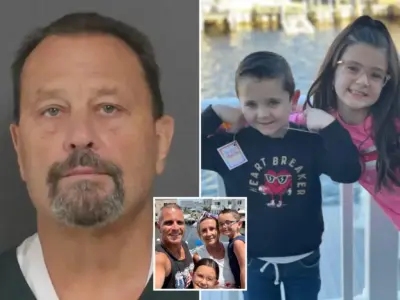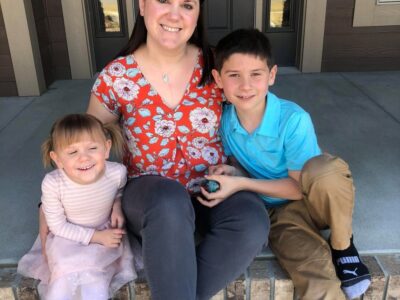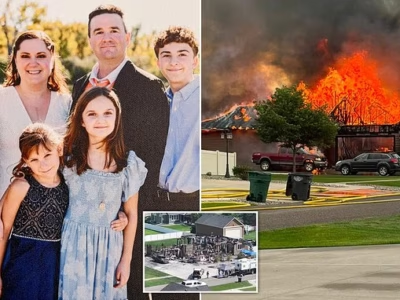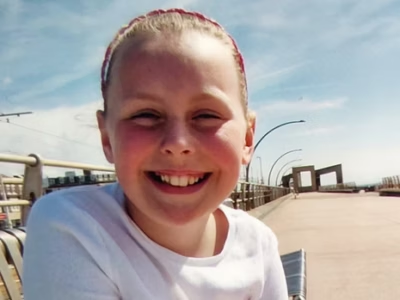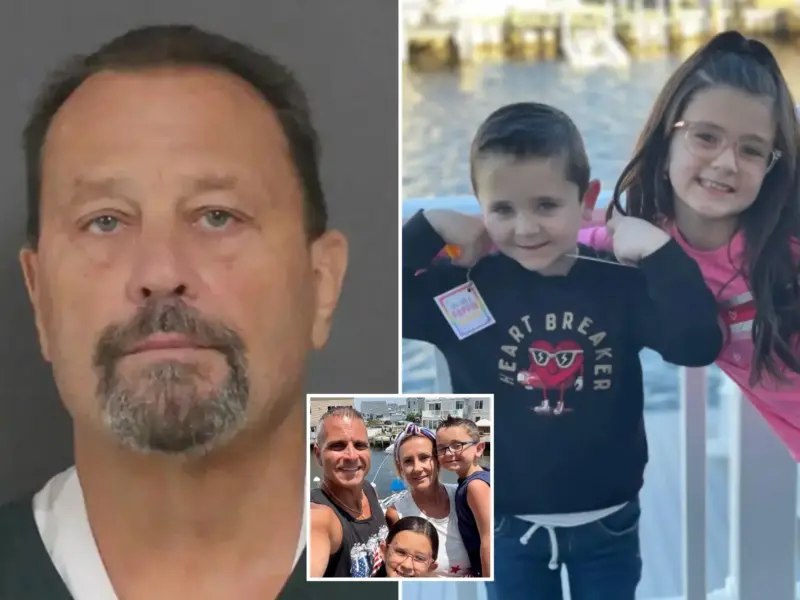
“I DIDN’T KNOW THEY WERE GONE”: Stephen Schneider only realized his two grandchildren had fallen from the boat after the collision! According to reports, the crash occurred while Mya and Sigmund were at the bow of the Tidewater Custom 280. After the boat struck a marker, the two children were no longer on board, and the family began searching in the darkness. Schneider reportedly then entered the water to search for his grandchildren. The moment the grandfather realized the two children were missing is emerging as a crucial detail in the timeline of the crash.
In the chaotic moments after his boat struck a channel marker on Barnegat Bay, Stephen Schneider did not immediately understand that his two young grandchildren were no longer on board. According to investigative reports and statements he later gave to police, the realization came only after the collision, when he and his wife discovered that 9-year-old Mya Bella Golabek and 7-year-old Sigmund “Siggy” Paul Golabek had disappeared from the Tidewater Custom 280. 
The children had been seated at the bow. The impact with the illuminated Intracoastal Waterway marker ejected them into the dark water. What followed was a frantic search conducted in darkness, with Schneider himself entering the water to look for the grandchildren he had been transporting home only moments earlier.
That delayed recognition—the interval between the violent collision and the understanding that the children were missing—has become one of the most significant details in the timeline of the July 19, 2026, crash. It raises fundamental questions about the force of the impact, the positioning of the young passengers, the operator’s awareness in the immediate aftermath, the influence of alcohol impairment, and the narrow window of time available for rescue once the children entered the water.
The Evening Leading to the Collision
The night began as an ordinary summer gathering on the New Jersey shore. Schneider and his wife, Laurie, had taken their 28-foot Tidewater center-console boat to MJ’s Restaurant Bar & Grill in Bayville. There they met their daughter, son-in-law, and the two grandchildren for dinner. After the meal, Mya and Sigmund asked to ride back with their grandparents rather than return in their parents’ separate boat. Both children were wearing life jackets and took seats at the front of the vessel.
Schneider, then 63, was at the helm as the boat moved through the Intracoastal Waterway shortly after 9 p.m. He later told investigators the boat was traveling at approximately 20 miles per hour. He also stated that both the radar and the infrared/low-light navigation camera were operating, systems he said he had activated to assist with nighttime visibility. According to his account, he saw channel marker No. 39 only at the last second.
The starboard bow of the Tidewater struck the marker. Investigators confirmed that the marker was a single-stanchion illuminated navigational aid and that its lights were functioning properly at the time. The force of the collision was sufficient to throw both children from their forward seats into the water.
The Moment of Realization
In the immediate aftermath, according to the investigative record, Schneider did not at once grasp that the children were gone. The impact would have produced a sudden jolt, noise, and possible change in the boat’s motion. In darkness, with the vessel potentially still moving or turning, the absence of two small passengers seated forward might not have been instantly obvious to those remaining on board.
Only after the adults began to assess the situation did it become clear that Mya and Sigmund were no longer on the boat. The family began searching the surrounding water in the dark. Schneider entered the water. He later described locating his grandson first and then his granddaughter. Both children were found face-down and unresponsive. CPR was initiated at once. Emergency calls were placed. The children were brought to shore and transported to Community Medical Center in Toms River, where they were pronounced dead.
The 911 recordings later released capture the urgency and distress of those moments. The children’s grandmother can be heard reporting that the children were unconscious and that her husband was in the water attempting to recover them. The recordings also reflect the difficulty of pinpointing the exact location near the channel marker in the darkness.
Why the Delay Matters
The fact that Schneider did not immediately know the children had been ejected carries several layers of significance for investigators and for the legal case.
First, it underscores the suddenness and severity of the impact. A collision powerful enough to eject two children—both wearing life jackets—from the bow of a 28-foot boat indicates a substantial transfer of force. The geometry of a starboard-bow strike against a fixed marker would have created abrupt deceleration and rotational forces capable of unseating passengers who were not restrained beyond standard life jackets.
Second, the delay raises questions about operator awareness and the effects of impairment. Schneider’s blood alcohol content was measured at approximately 0.16 percent—twice New Jersey’s legal limit of 0.08 percent for operating a vessel. Toxicology analysis concluded that his alertness, judgment, and response time were markedly impaired by alcohol. Impairment can slow the recognition of unexpected events, delay the processing of changed circumstances, and hinder the rapid prioritization of emergency actions. Whether alcohol contributed to the time that elapsed between impact and the realization that the children were missing is a question that forms part of the broader examination of his conduct that night.
Third, the timeline of the search is critical to understanding the limited opportunity for effective rescue. Once the children were in the water, every second counted. Life jackets provide flotation, but they do not ensure that an unconscious or injured child will remain face-up or that the person will be quickly located in dark water with limited visibility. Schneider’s decision to enter the water reflects the urgency once the absence was understood, yet the interval before that understanding occurred remains a focal point of the reconstruction.
Positioning at the Bow and the Dynamics of Ejection
The children’s location at the bow of the Tidewater is a central element in analyzing how the ejection occurred. Forward seating on a center-console boat places passengers closer to the point of impact in a collision with a fixed object. It also leaves them more exposed than those seated farther aft near the console or behind the windshield. When a boat strikes a marker with its starboard bow, the forces transmitted through the hull and the sudden change in velocity can readily unseat occupants in the open forward area.
Recreational boats of this type typically do not have seat belts or other restraints in the bow seating positions. The combination of the reported speed of approximately 20 mph, the geometry of the collision, and the open seating arrangement created conditions in which ejection became highly likely once the boat hit the marker. Both children were wearing life jackets, a fact that may have aided their flotation but could not prevent them from being thrown from the vessel or protect them from the trauma of the impact and subsequent immersion.
Experience, Technology, and the Unseen Hazard
Schneider had told police he was highly experienced on the water and had traveled the same route many times. He described a lifetime spent on boats. He stated that the radar and infrared camera were active specifically to aid navigation in the dark. These claims of experience and the use of technology stand in contrast to the outcome: a collision with an illuminated marker that the operator said he saw only at the last second, followed by a delayed recognition that the children had been ejected.
Familiarity with a route can be a protective factor, reducing the cognitive demands of navigation. At the same time, it can foster a sense of automaticity—operating by habit rather than continuous active scanning—that becomes dangerous when conditions change or when the operator’s capacity is reduced by alcohol. Technology such as radar and thermal imaging can significantly improve detection of fixed objects at night, but only if the systems are properly configured, monitored, and interpreted in time to allow corrective action. At 20 mph, a boat covers nearly 30 feet every second. The window for detecting a hazard and executing an avoidance maneuver is measured in seconds or less.
The Legal Framework and Ongoing Examination
Schneider has been charged with two counts of reckless vessel homicide, operating a vessel under the influence, and reckless operation of a vessel. The homicide charges are second-degree offenses that carry a potential sentence of up to 20 years in prison. He was arrested in mid-August 2026, held briefly, and then released on conditions after a detention hearing. Prosecutors had argued for continued detention, citing the elevated blood alcohol level and the fatal results. The defense noted that the crash was not intentional and that questions remained about the marker and the boat’s equipment. The children’s parents submitted letters supporting their grandfather’s release pending trial.

Crash reconstruction efforts are expected to focus intensively on the critical interval between impact and the realization that the children were missing. Investigators will seek to determine how much time elapsed, what actions the adults took in those seconds, whether the boat remained under power or control, and how the darkness, the physical jolt, and any disorientation affected the ability to account for all passengers. Electronic data from the radar and camera systems, if recoverable, may provide additional insight into what information was available to the operator in the moments before and after the collision.
Broader Context of Nighttime Boating Risks
The Barnegat Bay collision has drawn renewed attention to the hazards of nighttime operation on congested coastal and bay waters. Even experienced boaters face reduced visual information after dark. Shore lights can mask or compete with the lights of navigational aids. Speeds that feel moderate in daylight become far less forgiving when reaction times shrink. Alcohol, even in quantities an individual might regard as limited, degrades the cognitive functions most needed for safe nighttime navigation: sustained attention, rapid decision-making, divided attention between electronic displays and the physical environment, and accurate judgment of distance and closing speed.
The presence of active radar and infrared systems was intended, according to Schneider’s account, to mitigate those risks. Their reported activation, combined with his claimed familiarity with the route, forms part of the factual narrative he provided to police. The collision, the ejection of the children, and the delayed recognition that they were gone form the tragic counterpoint to that narrative.
A Family Forever Changed
Mya and Sigmund were the only children of Schneider’s daughter. Their deaths have left multiple generations of a family grieving while simultaneously confronting a criminal case in which the grandfather is the defendant. The image of a man entering dark water to search for the grandchildren he did not at first realize were missing captures both the human desperation of the moment and the severity of the events that preceded it.
The detail that Schneider “didn’t know they were gone” until after the collision adds a layer of complexity to the reconstruction of the night. It humanizes the confusion that can follow a sudden, violent impact even as it underscores the consequences of the collision itself. A boat strike powerful enough to eject two children, an operator whose recognition of that fact was not instantaneous, and a subsequent search conducted in darkness under the influence of alcohol constitute a sequence that continues to be examined with care by investigators and will ultimately be presented to a court.
As the legal process advances, that sequence—particularly the critical seconds after the boat struck the marker—will remain under close scrutiny. Schneider’s statements about his lifelong experience, his familiarity with the route, the active radar and camera, the speed of the vessel, and the last-second sighting of the marker already form part of the official record. The additional fact that he did not immediately know the children had been thrown overboard supplies another essential piece of the timeline.
The waters of Barnegat Bay that Schneider said he knew so well became, in those final moments, the setting for a collision, an ejection, a delayed realization, and a desperate search in the dark. The investigation and the criminal case now underway will determine how responsibility is assigned for the events that ended the lives of Mya Bella Golabek and Sigmund Paul Golabek. The gap between the claimed preparation and the actual outcome remains the space in which answers are still being sought.