The Groom Threw the Bride’s Father Out of the Wedding… Then the Truth About the Wedding Bill Came Out
*************
**“Take him outside.”**
The groom said that just minutes before the wedding ceremony began.
My father was wearing a suit that was almost ten years old. He said he didn’t need to buy a new one because he wanted to save the money for his daughter’s wedding. I thought no one would notice. But as soon as he entered the ballroom, my fiancé looked him up and down and frowned.
“That suit is embarrassing for my whole family.”
Without waiting for me to speak, he called security.
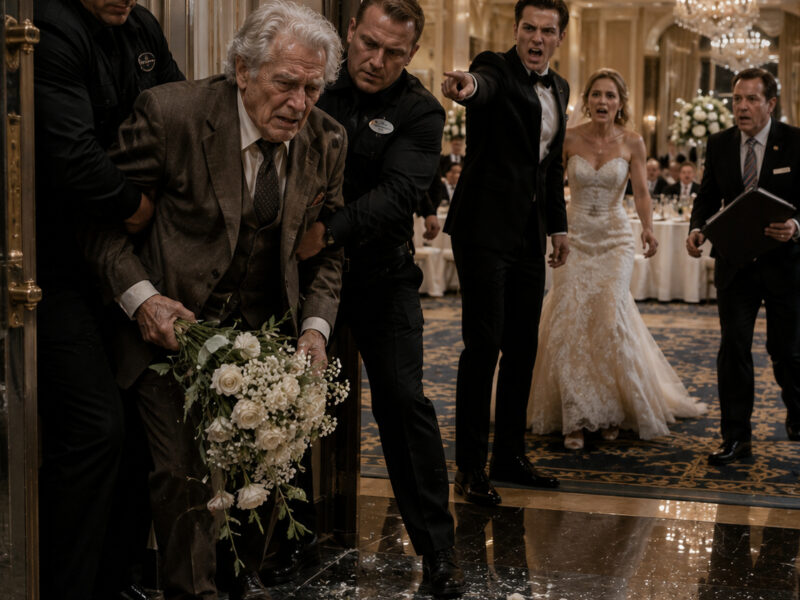
Two men in dark jackets approached my father with the quiet efficiency of people who had been trained to remove problems without raising their voices. One of them touched his elbow. The other spoke politely but firmly: the dress code was strict, the family had requested that only guests meeting a certain standard remain inside. My father tried to explain that he only wanted to sit in the back row, that he would not speak to anyone, that he simply wished to watch his daughter walk down the aisle. His voice was low and careful, the way it always became when he sensed he was already losing an argument before it began.
The groom coldly shook his head.
“He doesn’t belong here.”
The bouquet in my father’s hand—white roses and soft greenery I had chosen myself—slipped from his fingers and fell to the polished stone floor. A few petals scattered. The sound of the stems hitting the marble was small, almost delicate, yet it seemed to travel across the entire room. Guests turned. Conversations died mid-sentence. Someone near the champagne table whispered behind a gloved hand.
I started toward him, the heavy train of my dress catching on the edge of a chair. My mother-in-law’s fingers closed around my wrist like a soft but unyielding bracelet.
“Don’t,” she murmured, smiling for the benefit of anyone watching. “Not over a cheap suit. You’ll ruin the photographs. You’ll ruin the day.”
My father did not argue. He never had, not in public, not when pride might cost someone else comfort. He bent slowly, retrieved the bouquet, brushed a speck of dust from one of the roses with the side of his thumb, and walked out without looking back. The double doors closed behind him with a soft, final click.
For a moment the ballroom held its breath. Then the string quartet resumed playing, a little too brightly. The master of ceremonies cleared his throat and began the announcement that would bring the bride forward. I stood frozen in place, the weight of a hundred pairs of eyes pressing against my skin.
That was when the ballroom manager rushed in, face pale, a thick stack of papers clutched against his chest. He looked around wildly.
“Where is Mr. Thomas?”
No one answered at first. The groom, already irritated, gestured toward the doors.
“We asked him to leave. He was not appropriately dressed.”
The manager’s expression changed so completely that several guests stepped back. He opened the folder with shaking hands and held up the top page so that the chandelier light caught the printed name.
The entire room went silent again—deeper this time, the kind of silence that follows the sudden understanding that something irreversible has just occurred.
The person listed as the sole payer for the wedding—the venue, the flowers, the catering, the orchestra, the crystal glasses, the overnight rooms for out-of-town guests—was not the groom’s family. It was not me. It was my father.
He had sold the only house he owned six months earlier. He had requested absolute confidentiality from the hotel, asking them never to reveal the source of the funds because he did not want his future in-laws to feel embarrassed or indebted. An hour before the ceremony was scheduled to begin, he had signed the final payment slip in the manager’s office and then walked into the ballroom wearing the same suit he had worn to my high-school graduation.
The manager’s voice broke as he spoke the last sentence.
“He asked only that no one know. He said it was the last gift he could give his daughter.”
I could not move. The groom stared at the documents as if they were written in a language he had never learned. His mother pressed a hand to her throat. Somewhere near the back, a woman gasped.
A young hotel employee hurried in, slightly out of breath.
“He’s outside, sir. On the bench by the fountain. He’s still holding the flowers. He said he would wait until the ceremony was finished and then leave quietly so he wouldn’t disturb anyone.”
I looked down at the ivory satin of my shoes, then at the long train of the dress that had cost more than my father used to earn in three months. I slipped the shoes off. The marble was cold against my bare feet. Without a word to anyone, I gathered the skirt in both hands and ran.
I found him on the stone bench facing the hotel’s formal garden. The fountain behind him threw soft arcs of water into the air. Late-afternoon light filtered through the trees and rested on the shoulders of that old suit, turning the worn fabric almost silver. The bouquet lay across his knees. When he heard my footsteps he stood so quickly the flowers nearly fell again.
“Ellie—” His eyes widened with alarm. “What are you doing out here? The music started. You should be inside. I can wait somewhere else. I don’t want to cause any more trouble.”
I reached him before he could finish the sentence and wrapped my arms around him. The jacket smelled of the same detergent he had used for twenty years, of cedar from the closet, of the faint metallic scent of the bus he had taken that morning because he no longer owned a car. I pressed my face into the fabric and cried the way I had not cried since the night my mother died—openly, without any concern for who might see.
He held me the way he always had: steady, patient, as if he had all the time in the world and nothing more important to do than keep me from falling apart.
“You sold the house,” I said against his chest. The words came out broken. “The house where I grew up. The kitchen where Mom taught me to make her cinnamon rolls. The porch where you fixed my bicycle every summer. You sold it for this wedding.”
He rested his chin lightly on the top of my head. “It was only wood and paint, sweetheart. The important parts of that house left with you a long time ago. I wanted you to have the day you used to describe when you were little—the lights, the flowers, the soft music. I didn’t want anyone looking at you and thinking your father couldn’t provide.”
I pulled back enough to see his face. There were tears in his eyes, but he was still trying to smile, still trying to make the moment smaller than it was.
Behind us the ballroom doors remained open. A few guests had followed at a distance. The groom stood at the top of the steps, one hand on the railing, the other hanging uselessly at his side. His mother whispered something sharp into his ear. The manager hovered nearby, still holding the folder as if it might explode.
I took my father’s hand. Together we walked back toward the entrance. My bare feet left faint prints on the warm stone. The train of the dress dragged behind me, collecting small leaves and dust. When we crossed the threshold the conversations that had begun to restart died once more.
The groom stepped forward. His voice was careful now, almost gentle.
“Ellie, I didn’t know. I swear to you I had no idea. If I had known, I never would have— Please. We can still go through with it. We can fix this.”
I looked at the man I had planned to marry. For two years I had admired the way he carried himself, the way he spoke of the future, the way his family seemed so certain of their place in the world. Now I saw only the distance between the life he expected and the life my father had quietly built for me one sacrifice at a time.
I removed the engagement ring. The diamond caught the light one final time before I placed it in his open palm.
“A man who can look at the person who gave up everything so his daughter could have a beautiful day and decide that person is not good enough to sit in the same room,” I said, “will never understand what it means to build a family. I will not spend my life with someone who measures human worth by the quality of a suit.”
A few people near the front began to clap, then stopped when they realized no one else was joining. My former mother-in-law’s face had gone rigid. The groom stared at the ring as if it had become unfamiliar.
I turned to the room.
“There will be no ceremony today. Those of you who came because you care about me—thank you for being here. Those who came for other reasons—the bar remains open. My father has already paid for everything. Please enjoy it.”
Then I walked out with him, the heavy doors closing behind us for the second time that afternoon.
The hotel handled the cancellation with more kindness than I expected. Within days the full amount, minus a service fee the manager insisted on absorbing himself, was returned. It was not enough to buy back the old house. That had already been sold to a young couple who, according to the real-estate agent, had fallen in love with the backyard and the swing set my father had built when I was seven. But the returned money, carefully managed, was enough for something smaller and quieter.
Three months later we stood on the front porch of a white cottage at the edge of town. Two modest bedrooms. A kitchen with wide windows that filled with morning light. A small garden that needed work but already held the promise of roses. My father turned the key. The lock clicked open with a soft, ordinary sound that somehow felt like forgiveness.
We spent the following weeks painting walls the color of soft cream, hanging the few photographs we had managed to keep, planting the same variety of roses my mother had loved. On the day the last box was emptied, my father disappeared into the bedroom and returned wearing the suit.
The elbows were still shiny. The cuffs still showed the faint fraying of years. But he had polished the shoes until they reflected the afternoon light and pressed the trousers until the crease was perfect.
I laughed through sudden tears and stepped close to adjust his tie—the same navy one he had worn to every important moment of my childhood. My fingers smoothed the knot against his collar.
“Dad,” I said, “this was never a cheap suit. It was the most valuable thing anyone wore that day.”
He looked down at himself, then at me, and for the first time since the afternoon everything had fallen apart, real laughter reached his eyes.
“I suppose it’s earned its keep.”
That evening we ate on the back porch—simple food on paper plates, the sky turning the soft colors of late summer. No orchestra. No guest list. No one measuring the distance between what we owned and what we were supposed to own. Only the two of us and the quiet knowledge that love does not require marble floors or crystal glasses to be real.
In the months that followed, the story traveled the way small-town stories always do. Some people called me foolish. Others called me brave. A few of the original guests sent quiet notes. One elderly woman who had sat near the back wrote that she had never seen anything more beautiful than a daughter choosing her father. The groom attempted one final conversation—an awkward meeting in a café where he spoke of family pressure and the weight of appearances. I listened until he finished, then told him I hoped he learned something true, and that I wished him a life free of the need to rank people by the clothes they wore.
I never saw him again.
My father took a part-time position at the local library, shelving books and recommending stories to children who came in after school. In the evenings he worked in the garden until the roses began to climb the fence the way my mother’s once had. I found work at a small design studio where ideas mattered more than last names. At night we sat on the porch and talked about ordinary things: whether the porch needed a new coat of paint, what to plant when autumn arrived, how strange and good it felt to begin again without the constant weight of other people’s expectations.
Sometimes, when the house was quiet and the only sound was the soft creak of the old porch swing, I would think about the moment the manager walked into the ballroom with those papers. How close I had come to walking down an aisle toward a life built on surfaces. How the man who looked the least impressive in that glittering room had turned out to be the only one whose value could not be calculated in currency.
The suit still hangs in my father’s closet, cleaned and carefully preserved. On the rare evenings he wears it—library fundraisers, quiet dinners with new friends—people still glance at the fabric. But he stands a little taller each time, and I stand a little taller beside him.
Because some things look ordinary until you understand what they cost.
And some fathers wear their love so quietly that the world almost fails to notice—until the day the world is forced to see.
Years later, when I tell the story to the people who matter, I always begin the same way.
With those three words spoken in a ballroom that no longer feels like a place of celebration in my memory.
“Take him outside.”
And then I tell them what happened when the daughter refused to stay inside without him.
The cottage still stands. The roses still bloom every summer, climbing higher each year. On quiet evenings, when the light is soft and the air smells of earth and possibility, my father and I sit on the porch and remember that the most expensive gift anyone can give is not purchased with money at all.
It is given in secret. In sacrifice. In a suit that was never cheap.
It is given in the simple, stubborn decision to love someone enough to step out of the light so they can shine.
And sometimes, if you are very lucky, that someone turns around, takes off her shoes, gathers the heavy skirt of a dress she no longer needs, and runs after you into whatever comes next.
We have lived in the cottage for several years now. The garden has grown wild in the best way. The porch swing has been replaced once. The navy tie has been mended twice. But the suit remains exactly as it was on the day it walked out of a ballroom and into a different kind of forever.
Every so often, when the light is just right and the roses are in full bloom, my father will put it on for no reason at all. He will stand in front of the small mirror in the hallway, smooth the lapels, and smile at his reflection as if greeting an old friend who once helped him carry something heavier than anyone could see.
And I will stand behind him, rest my hands on his shoulders, and say the same words I said on the day we first unlocked the door of our new home.
“It was never a cheap suit, Dad.
It was the most valuable thing anyone wore that day.”
He always answers the same way, with the quiet certainty of a man who finally understands that some debts can never be repaid and do not need to be.
“I know, Ellie.
I know.”